Nvidia Is Getting Orders from China Again: Huang Calls OpenClaw the Next ChatGPT
Nvidia confirmed that it is receiving orders from China again and is actively ramping up H200 chip shipments, despite the export restrictions still in force. The same day, CEO Jensen Huang said OpenClaw will become "the next ChatGPT", and Chinese AI stocks soared immediately. In a parallel story, the prediction platform Kalshi faces criminal charges from the state of Arizona, and its CEO gave Bloomberg an exclusive interview.
AI-processed from Bloomberg Tech; edited by Hamidun News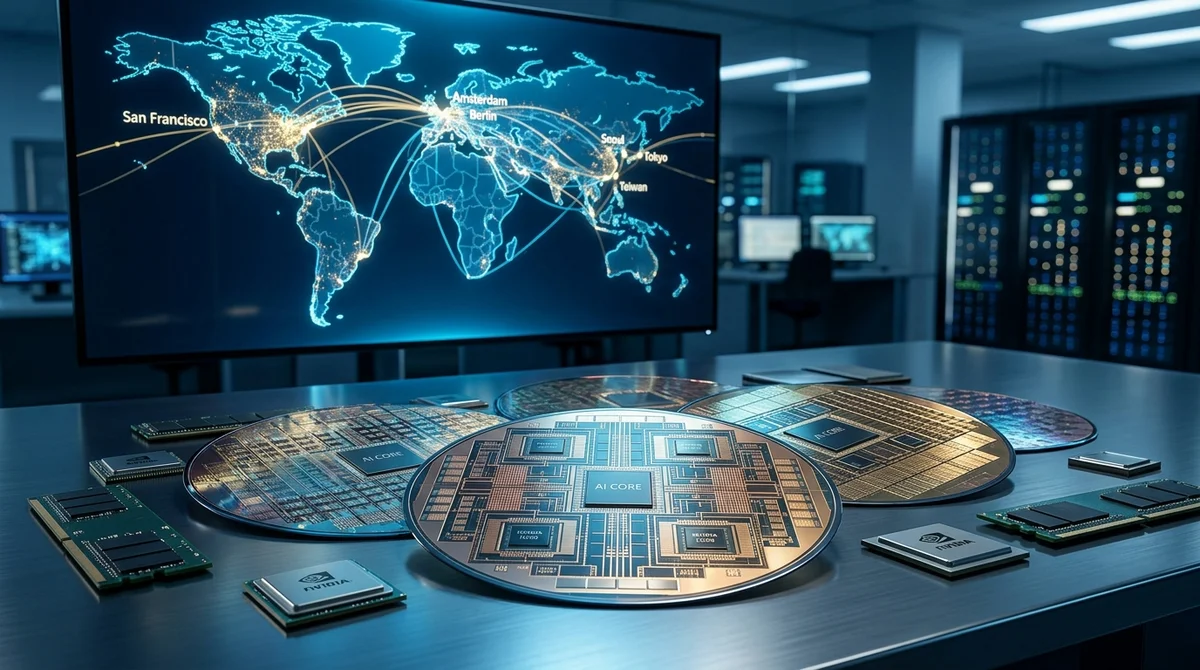
Nvidia announced that it is taking orders from China again and actively ramping up H200 chip shipments. The same day, CEO Jensen Huang called the Chinese AI product OpenClaw "the next ChatGPT", and Chinese AI stocks immediately moved higher.
China is buying Nvidia again
For two years, China has lived under US export restrictions on advanced semiconductors. First the Biden administration shut off H100 and A100 shipments. Then the bans widened, and it looked as though Nvidia was gradually losing one of its largest markets.
Reality turned out to be more complicated: the company adapted with a product maneuver. The H200 is not the top chip in Nvidia's lineup, but it is powerful enough for training and inference of large language models. Nvidia positions it as a product that does not fall under the strictest restrictions: "permitted" performance for the Chinese market. Chinese cloud providers and AI labs were quick to adjust.
- The H200 is formally not banned and is shipped legally
- The largest Chinese hyperscalers, Alibaba, Tencent and Baidu, are among the buyers again
- Nvidia is expanding local support and logistics for the Chinese market
- The H200 trails the B200 but covers most of the real workloads of AI labs
Nvidia confirmed that orders are coming in and H200 sales are growing steadily. It is the first clear sign that the company is rebuilding its presence in China, not by circumventing the bans but by adjusting its product lineup to the rules in force.
OpenClaw: Huang speaks, the market moves
Jensen Huang said OpenClaw is "the next ChatGPT". The market reacted instantly: shares of Chinese AI companies rose sharply. OpenClaw is a Chinese AI product gaining popularity in the region amid a wave of post-DeepSeek development.
"OpenClaw is the next ChatGPT." — Jensen Huang
When the CEO of the world's largest GPU maker publicly equates a Chinese product with ChatGPT, it is more than a compliment. It is an acknowledgment that Silicon Valley was not making even a year ago. DeepSeek showed in early 2025 that Chinese AI teams can build competitive products faster than Western labs can take it in. Huang is signaling that this cycle continues.
Huang's words should also be read through a business lens. Nvidia sells chips to everyone, OpenAI, Google, Anthropic and Chinese labs alike. If OpenClaw grows to ChatGPT scale, Nvidia will sell even more hardware to that ecosystem. The CEO's praise is both a market assessment and a strategic signal to investors.
Kalshi faces criminal charges in Arizona
The day's parallel story was Kalshi, a US prediction market platform. The state of Arizona filed criminal charges against the company, after which CEO Tarek Mansour gave Bloomberg an exclusive interview.
Kalshi works as an exchange for bets on real-world events: elections, IPOs, Federal Reserve decisions, sports matches. The platform holds a CFTC license and is considered a legal financial instrument at the federal level. Arizona sees it differently, and this is the first precedent of criminal prosecution of a prediction market at the state level.
When a state classifies exchange-traded derivatives as illegal bookmaking, a conflict arises: one regulator permitted it, another is prosecuting. For Polymarket, Manifold and other similar platforms, the outcome of the case will become a legal precedent.
What this means
Nvidia found a way into China through product flexibility, not by circumventing sanctions. Huang publicly acknowledged Chinese AI as an equal competitor, and the market reacted immediately. Kalshi is a reminder that even a licensed business can face a criminal case from an individual state. The AI industry is growing amid constant regulatory uncertainty and, by all appearances, is already used to it.
- Nov 1, 2026Local models lose to Opus and Codex: 0.21 on a MacBook versus 1.00 for Codex
- Nov 1, 2026Kimi scores 96.2% on a 1C database analytics test and emerges as a fallback if Claude access is blocked
- Nov 1, 2026OpenAI Rewrites GPT Behavior Rules: Five Values and a Chain of Command
- Nov 1, 2026Google admits AI Mode cuts search revenue, shares fall 15%
Key Questions Answered
What are the key details on China is buying Nvidia again?
For two years, China has lived under US export restrictions on advanced semiconductors. First the Biden administration shut off H100 and A100 shipments. Then the bans widened, and it looked as though Nvidia was gradually losing one of its largest markets. Reality turned out to be more complicated: the company adapted with a product maneuver. The H200 is not the top chip in Nvidia's lineup, but it is powerful enough for training and inference of large language models. Nvidia positions it as a product that does not fall under the strictest restrictions: "permitted" performanc
What are the key details on OpenClaw: Huang speaks, the market moves?
Jensen Huang said OpenClaw is "the next ChatGPT". The market reacted instantly: shares of Chinese AI companies rose sharply. OpenClaw is a Chinese AI product gaining popularity in the region amid a wave of post-DeepSeek development. "OpenClaw is the next ChatGPT." — Jensen Huang When the CEO of the world's largest GPU maker publicly equates a Chinese product with ChatGPT, it is more than a compliment. It is an acknowledgment that Silicon Valley was not making even a year ago. DeepSeek showed in early 2025 that Chinese AI teams can build competitive products faster than West
What are the key details on Kalshi faces criminal charges in Arizona?
The day's parallel story was Kalshi, a US prediction market platform. The state of Arizona filed criminal charges against the company, after which CEO Tarek Mansour gave Bloomberg an exclusive interview. Kalshi works as an exchange for bets on real-world events: elections, IPOs, Federal Reserve decisions, sports matches. The platform holds a CFTC license and is considered a legal financial instrument at the federal level. Arizona sees it differently, and this is the first precedent of criminal prosecution of a prediction market at the state level. When a state classifies ex
Build & Ship Production AI Agents Without Boilerplate Code
Start your free 72-hour trial at Hamidun Academy (academy.hamidun.com) — interactive lessons on Claude Code & Cursor, live Tech Radar, and production agent templates.
The AI world, distilled — once a week
Seven stories that actually mattered, hand-picked. No noise, no reposts, no press releases.
Done! Check your inbox for a confirmation.