Trump administration threatens to remove Anthropic from US government agencies after dispute over AI tools
The Trump administration is ready to fight Anthropic in court and wants its AI tools out of every US government agency. The cause is a dispute over exactly how the state may use the company's technology. The story matters beyond Anthropic. It shows that for AI vendors in the public sector, model quality is no longer the only thing that counts: rules on control, access and restrictions are now just as critical.
AI-processed from Bloomberg Tech; edited by Hamidun News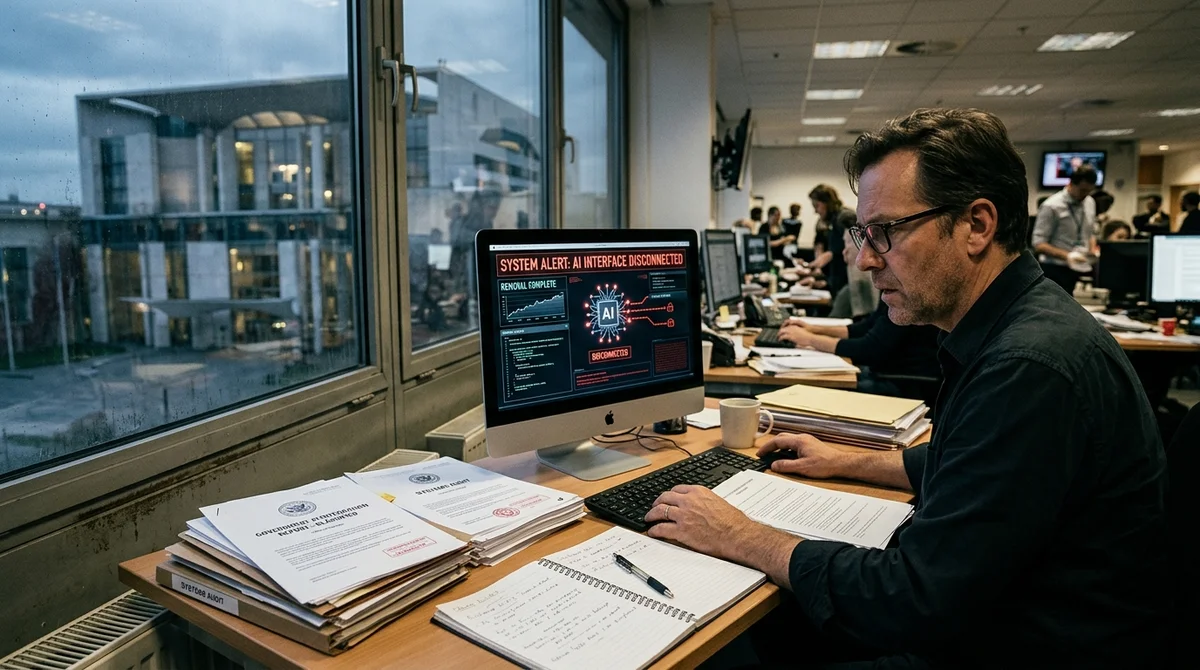
The administration of Donald Trump has decided to move its conflict with Anthropic from the negotiating table into the legal arena. US authorities want to ensure that the company's products are no longer used in any government agency.
What happened
On March 18, 2026, it became known that the Trump administration is ready for a court fight with Anthropic. The trigger was a dispute over exactly how US government bodies may use the company's artificial intelligence tools. The wording is harsh: this is not a pause in a single project but an attempt to remove Anthropic entirely from all American government agencies.
For the market, this looks like a sharp escalation. Conflicts between a government and a technology contractor usually revolve around price, deployment timelines or compliance questions. Here the dispute jumps straight to the question of whether a vendor has the right to remain inside the government perimeter at all. For the US AI market, this is no longer a technical nuance but a political and legal signal.
The core of the dispute
Only the basic cause of the conflict is publicly known: the sides disagree on how Anthropic's AI technology should be used. The detailed terms of the dispute have not been disclosed, but the nature of the wording matters. It shows the conflict is not just about model quality or product convenience, but about rules of use, restrictions and control over where and for what purpose the system may operate.
This is a sensitive topic for any generative AI provider. When the customer is a government, simply getting access to a strong model is not enough. The framework matters: which scenarios are permitted, who is responsible for risky cases, what restrictions are built into the product, and who makes the final decision if the customer and the vendor disagree. If they cannot reach agreement, a commercial dispute quickly becomes a legal one.
Anthropic matters here not only as a single company but as one of the prominent players in the AI market. A conflict of this scale will therefore inevitably be read more broadly: as a test of how independent model developers can remain when working with governments, and how hard governments are prepared to push in dictating the terms of AI use.
What it means for the market
If the administration carries this line through, the consequences may reach far beyond one company. The US public sector remains a powerful benchmark for the entire corporate market. A ban or forced displacement of one of the major AI vendors would send a signal to other customers too, from banks and universities to contractors in sensitive industries. Many will begin revisiting contract terms and model usage rights in advance.
These effects may emerge in the near term:
- review of existing pilots and procurement of AI tools in the public sector;
- tighter requirements on how a vendor restricts or permits use of a model;
- growing interest in alternative developers willing to sign up to stricter terms;
- faster emergence of separate versions of AI products for government;
- new court and regulatory precedents for the whole industry.
For Anthropic itself the risk is clear: even if the dispute concerns specific rules for using its technology, political escalation could hurt its access to large contracts and its position in negotiations with other government customers. For competitors it is a window of opportunity, but also a warning. What is sold to government is no longer just a model but managed infrastructure with very clear legal boundaries.
What it means
The Anthropic episode shows that the generative AI market is entering a new phase: strong models alone are no longer enough. In dealings with government, manageability, legal terms and control over usage scenarios become decisive. For AI companies, this is a direct signal: working with government bodies increasingly resembles not an ordinary software sale but a politically sensitive infrastructure deal.
- Nov 2, 2026LLM Agent Built a Gearbox in KOMPAS-3D, but Scored Only 50 out of 100 on the Specification
- Nov 2, 2026Agents ignored the prompt to read memory in 7 of 7 sessions: an analysis of 13 thousand logs
- Nov 2, 2026Karpathy Built HackerTube, a Catalog of 6,454 Videos, in Two Hours with Claude Code
- Nov 2, 2026We Audited 929 Automations at Alpina: What Corporate AI Training Should Look Like in 2026
Key Questions Answered
What happened?
On March 18, 2026, it became known that the Trump administration is ready for a court fight with Anthropic. The trigger was a dispute over exactly how US government bodies may use the company's artificial intelligence tools. The wording is harsh: this is not a pause in a single project but an attempt to remove Anthropic entirely from all American government agencies. For the market, this looks like a sharp escalation.
What are the key details on The core of the dispute?
Only the basic cause of the conflict is publicly known: the sides disagree on how Anthropic's AI technology should be used. The detailed terms of the dispute have not been disclosed, but the nature of the wording matters. It shows the conflict is not just about model quality or product convenience, but about rules of use, restrictions and control over where and for what purpose the system may operate. This is a sensitive topic for any generative AI provider.
What it means for the market?
If the administration carries this line through, the consequences may reach far beyond one company. The US public sector remains a powerful benchmark for the entire corporate market. A ban or forced displacement of one of the major AI vendors would send a signal to other customers too, from banks and universities to contractors in sensitive industries. Many will begin revisiting contract terms and model usage rights in advance.
Test Frontier LLMs & Autonomous Agents in One Workspace
Run Claude Opus 5.5, GPT-6, Gemini 3.1, and DeepSeek side-by-side in Nomad AI (nomadnet.ai) — unified model routing, deep research, and multimodal workflows under one subscription.
The AI world, distilled — once a week
Seven stories that actually mattered, hand-picked. No noise, no reposts, no press releases.
Done! Check your inbox for a confirmation.