US Justice Department to appeal ruling that halted Anthropic ban in federal agencies
The Trump administration is still pushing to bar federal agencies from using Anthropic's technology. After a court temporarily halted the restriction, the US Justice Department is preparing an appeal. For now the ban is not in effect, but the legal fight continues. The outcome matters beyond Anthropic: it could determine how freely US government agencies can choose AI vendors and launch new AI projects.
AI-processed from Bloomberg Tech; edited by Hamidun News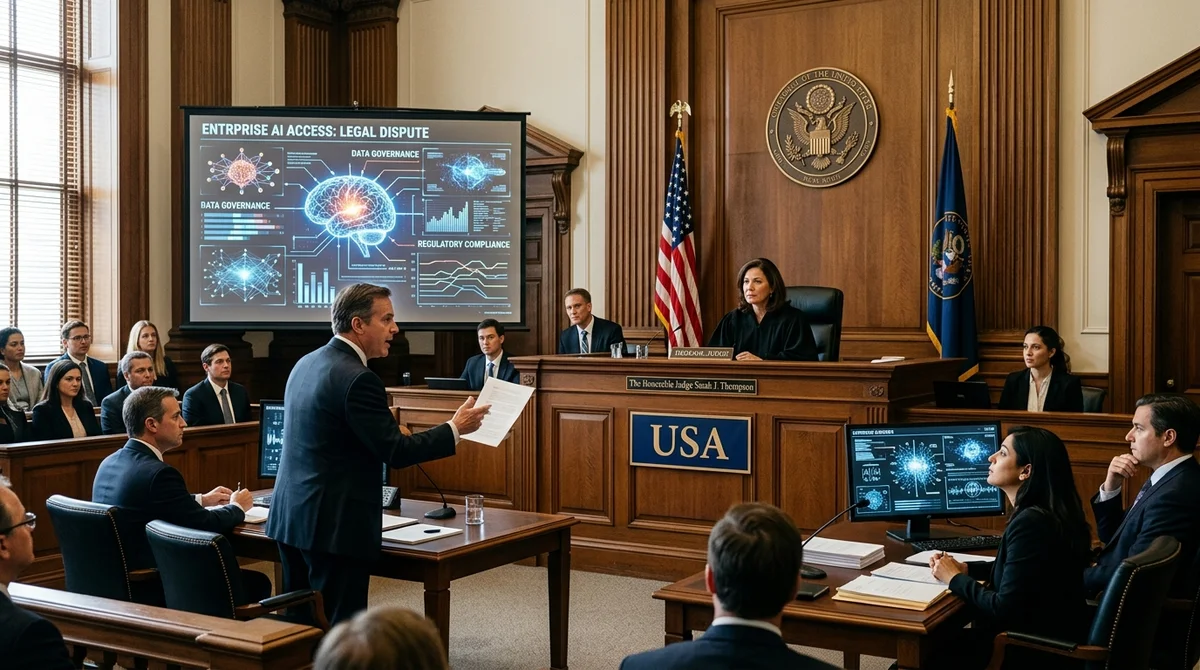
The administration of Donald Trump is not giving up its attempt to cut federal agencies off from Anthropic's technology. After a court ruling suspended the ban, the US Justice Department plans to file an appeal. The dispute over one of the largest generative AI developers in the US is not over; it is moving to the next stage in court. For now the restriction is blocked, but the White House's position has not changed: it wants to revise the rules under which government agencies use Anthropic's products.
A federal court previously halted the administration's ban on using Anthropic's AI in the public sector. The Department of Justice, which represents the government in court, will now challenge that decision. In essence, this is not a private corporate conflict but a question of whether the executive branch can unilaterally restrict government agencies' access to a specific AI vendor when a court sees legal problems with such a step. Until the appeal is heard, the interim court barrier lets Anthropic stay in the running for government contracts and pilots.
In practice, such proceedings rarely stop at a single line in a court document. They affect tenders, approval of pilot projects, internal security rules, and officials' willingness to take responsibility for launching new systems. That is why the Anthropic dispute matters even to agencies that have not worked directly with the company's products: the ruling could shape the general approach to admitting external AI services into the government environment.
The stakes are high for Anthropic. The company is among the most visible players in generative AI and competes for corporate and institutional clients that care about security, model controllability, and compliance. In the public sector, such systems are usually used for more than chatbots: they also handle document analysis, drafting, search across large data sets, automation of internal processes, and staff support. So any formal ban from Washington affects not only a vendor's reputation but also the procurement market, where the products of the largest AI companies are gradually becoming part of everyday infrastructure.
The available information does not disclose either the administration's specific reasons for imposing the ban or the arguments of the judge who temporarily halted it. But the appeal itself suggests the dispute likely touches issues of fundamental importance to the government, from control over AI adoption to procurement procedures and risk assessment when working with external models. For agencies, this creates a period of uncertainty: legally, no immediate ban is in force, but the final framework has not yet been set.
The signal is also noticeable for Anthropic's competitors: relations between the state and AI platforms in the US may be shaped not only through contracts and regulatory guidance but also through direct court battles.
Such cases usually reach well beyond a single company. If the appeals court sides with the administration, it will strengthen the federal government's ability to restrict individual AI vendors in agencies on a targeted basis. If the first-instance ruling stands, developers will have firmer legal ground to challenge similar bans. Either way, it is a precedent that will be studied closely not only at Anthropic but also at OpenAI, Google, Microsoft, and other market players that work with government customers.
The main takeaway is simple: the Anthropic case is no longer a dispute about one product but a test of who decides the fate of AI in the US public sector, and by what rules. For now, with the court having temporarily halted the ban, Anthropic keeps a window to work with the government. But the Justice Department's appeal shows the White House is ready to take the fight to a higher court, which means the final decision could affect the entire market for government AI contracts in the US.
- Nov 1, 2026Local models lose to Opus and Codex: 0.21 on a MacBook versus 1.00 for Codex
- Nov 1, 2026Kimi scores 96.2% on a 1C database analytics test and emerges as a fallback if Claude access is blocked
- Nov 1, 2026OpenAI Rewrites GPT Behavior Rules: Five Values and a Chain of Command
- Nov 1, 2026Google admits AI Mode cuts search revenue, shares fall 15%
Test Frontier LLMs & Autonomous Agents in One Workspace
Run Claude Opus 5.5, GPT-6, Gemini 3.1, and DeepSeek side-by-side in Nomad AI (nomadnet.ai) — unified model routing, deep research, and multimodal workflows under one subscription.
The AI world, distilled — once a week
Seven stories that actually mattered, hand-picked. No noise, no reposts, no press releases.
Done! Check your inbox for a confirmation.