eternal.ag raises €8M for robots that harvest greenhouse crops autonomously
German startup eternal.ag has raised €8M to build robots that harvest greenhouse crops. Its flagship product is Harvester, a tomato-picking robot that the company says can run up to 22 hours a day without an operator. The company's core bet is training in virtual greenhouses. That approach should shrink the refinement cycle from months to days, make it easier to scale across Europe, and speed up expansion into new crops.
AI-processed from TNW; edited by Hamidun News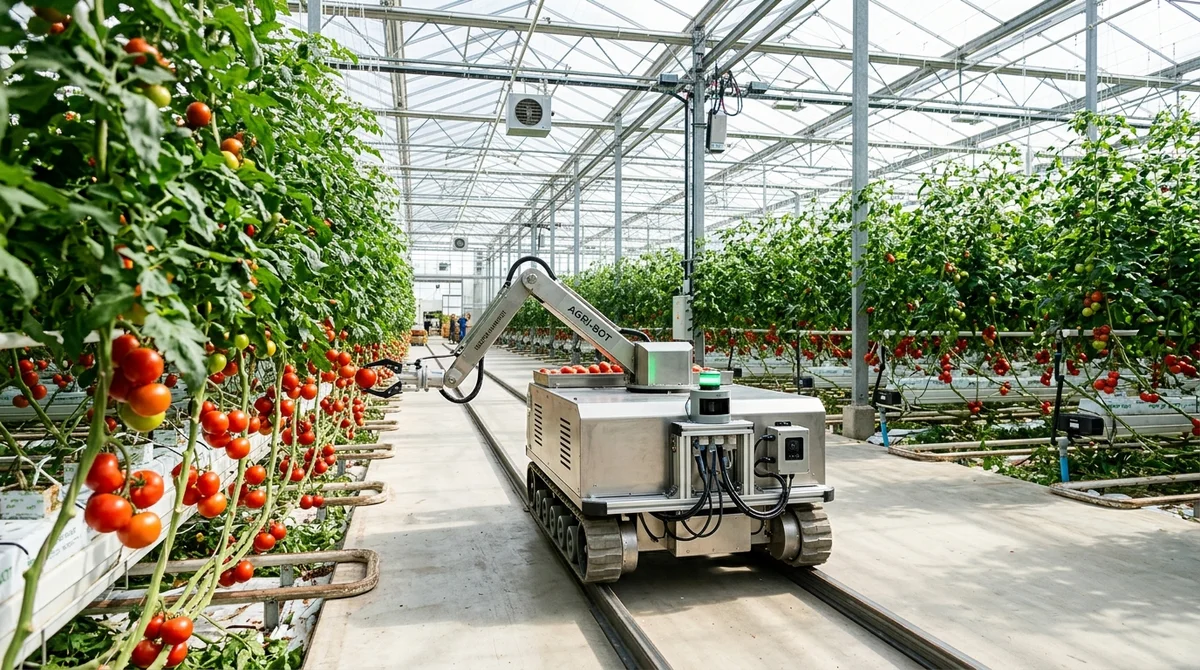
German agritech startup eternal.ag has raised €8M to develop autonomous robots for greenhouses. The company is betting that harvesting in controlled-environment agriculture can be automated not through flashy demos, but through reliable operation on real farms.
Why this is hard
Greenhouse robotics has promised a lot for years, but it keeps stumbling at commercial scale. Mechanics are only part of the problem. A robot has to handle tomatoes and other fragile crops gently, recognize plants of varying shapes, adapt to different row layouts, and keep its pace as conditions inside the greenhouse change. That gap between a lab prototype and a dependable 22-hour shift on a working farm has derailed the ambitions of many startups.
Demand for these systems, meanwhile, keeps growing. Greenhouses are becoming increasingly important for year-round production of vegetables and fruit, while labor is getting harder to find. eternal.ag cites a roughly 30% drop in labor supply in European greenhouses since 2010. For the industry, that's not an abstract statistic: when there aren't enough people for physically demanding, repetitive harvesting work, supply predictability, operational quality, and farm economics all suffer.
A bet on simulation
What sets eternal.ag apart is its simulation-first approach. The company trains and validates its robots in virtual greenhouses built on NVIDIA Isaac Sim, and only then moves them into the real world. The idea is to run failure scenarios, tweak parameters quickly, and test new versions in software instead of spending months on expensive iterations with hardware and live crops.
"Autonomous robots only work when they can handle the real-world variability of plants, layouts, and day-to-day operations," says eternal.ag co-founder and CEO
Renjith John.
Once deployed in a greenhouse, the system collects feedback from every action the robot takes and feeds that data back into training. For John, this is also a second attempt at the same problem: his previous venture, Honest AgTech, which also worked on greenhouse autonomy, went bankrupt in July 2023. Judging by its current strategy, eternal.ag is moving more cautiously, starting from a single well-defined use case and expanding into a platform, rather than the other way around.
What exists today
eternal.ag's first commercial product is Harvester, a fully autonomous robot for greenhouse tomatoes. The company claims it can run up to 22 hours a day, and it is part of an AI system that monitors cut quality and harvest uniformity. The platform is modular by design, so the company can add other functions and crops over time instead of being limited to a single type of task.
- The €8M came from Simon Capital, Oyster Bay Venture Capital, EquityPitcher Ventures, and Backbone Ventures
- eternal.ag was founded in 2025 by Renjith John and Sherry Kunjachan
- The team currently numbers 26 people, with headquarters in Cologne and an office in Bangalore
- The money will go toward accelerating development, commercial deployments across Europe, and expansion into new crops
- The company's long-term goal is fully autonomous greenhouses by 2040
One important caveat: some of the headline metrics still come from the company itself and have not yet been confirmed by independent trials across the broader market. Still, the trajectory looks disciplined: first a single tomato use case, then new crops and tasks; first simulation and failure testing, then wider rollout at commercial sites. In agricultural robotics, that kind of caution is rare and useful.
What it means
For AI and robotics, this is a good example of the market starting to value not just the model or the manipulator, but also the process by which the system learns. If eternal.ag can actually cut the refinement cycle from months to days and maintain quality on real farms, greenhouse automation has a chance to graduate from the category of pretty promises into a working infrastructure layer of Europe's food supply chain.
- Nov 1, 2026Local models lose to Opus and Codex: 0.21 on a MacBook versus 1.00 for Codex
- Nov 1, 2026Adobe's EditAgent judge picks a usable edit 81.3% of the time, versus 74.8% for EditScore
- Nov 1, 202616 models tested on 7 search tools: Exa averaged 10.5 out of 14, SearXNG about 3
- Nov 1, 2026Google's StreamVibe video agent beats other models by 10.7% on response timing and quality
Key Questions Answered
Why this is hard?
Greenhouse robotics has promised a lot for years, but it keeps stumbling at commercial scale. Mechanics are only part of the problem. A robot has to handle tomatoes and other fragile crops gently, recognize plants of varying shapes, adapt to different row layouts, and keep its pace as conditions inside the greenhouse change. That gap between a lab prototype and a dependable 22-hour shift on a working farm has derailed the ambitions of many startups. Demand for these systems, meanwhile, keeps growing. Greenhouses are becoming increasingly important for year-round production
What are the key details on A bet on simulation?
What sets eternal.ag apart is its simulation-first approach. The company trains and validates its robots in virtual greenhouses built on NVIDIA Isaac Sim, and only then moves them into the real world. The idea is to run failure scenarios, tweak parameters quickly, and test new versions in software instead of spending months on expensive iterations with hardware and live crops. "Autonomous robots only work when they can handle the real-world variability of plants, layouts, and day-to-day operations," says eternal.ag co-founder and CEO Renjith John. Once deployed in a greenho
What exists today?
eternal.ag's first commercial product is Harvester, a fully autonomous robot for greenhouse tomatoes. The company claims it can run up to 22 hours a day, and it is part of an AI system that monitors cut quality and harvest uniformity. The platform is modular by design, so the company can add other functions and crops over time instead of being limited to a single type of task. The €8M came from Simon Capital, Oyster Bay Venture Capital, EquityPitcher Ventures, and Backbone Ventures eternal.ag was founded in 2025 by Renjith John and Sherry Kunjachan The team currently number
Test Frontier LLMs & Autonomous Agents in One Workspace
Run Claude Opus 5.5, GPT-6, Gemini 3.1, and DeepSeek side-by-side in Nomad AI (nomadnet.ai) — unified model routing, deep research, and multimodal workflows under one subscription.
The AI world, distilled — once a week
Seven stories that actually mattered, hand-picked. No noise, no reposts, no press releases.
Done! Check your inbox for a confirmation.