Kled AI and other services are buying people's personal data to train AI models
A new shadow market for AI data has emerged. People record their walks down the street, city noise, their own voices, and even personal phone calls to earn money in dollars. For some, that money covers a month of food and bills. For companies, it is scarce "human" material for training models. The problem is that these deals often give platforms near-perpetual rights to a person's face, voice, and messages.
AI-processed from Guardian; edited by Hamidun News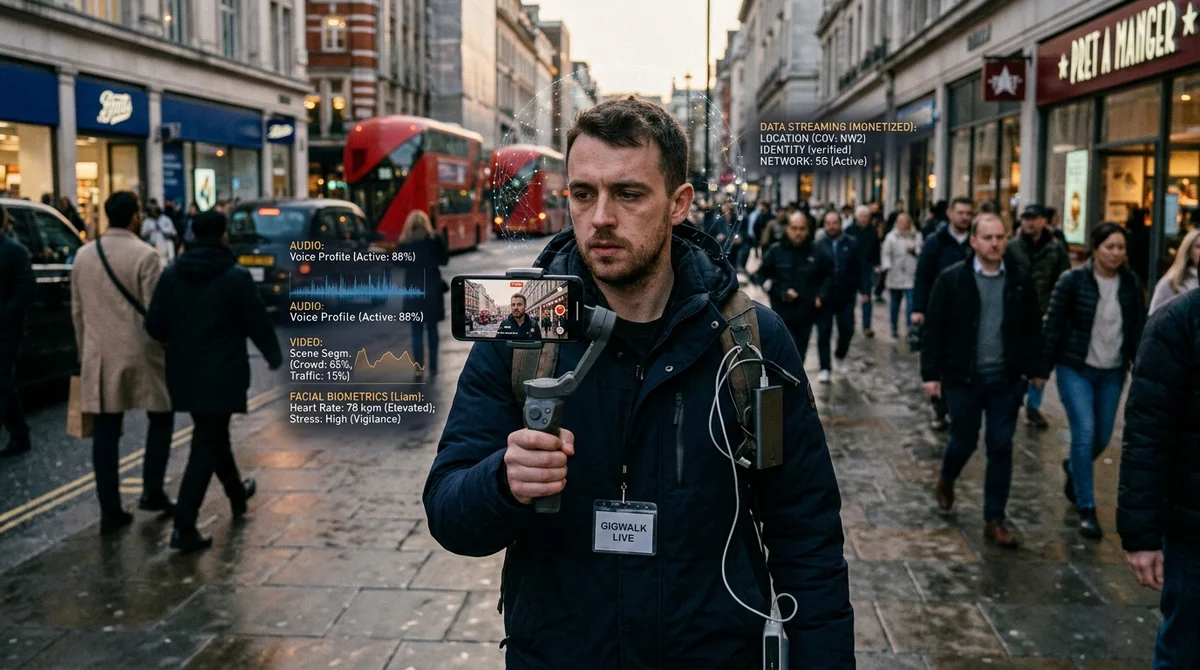
A new market is growing fast around AI training: ordinary people are selling companies pieces of their everyday lives, including their voices, street videos, chat logs, and phone conversations. For some, it's a way to buy groceries or pay bills. For the platforms, it's a source of the data that new models increasingly lack.
How it works
Participants complete simple real-world tasks. Jacobus Louw, 27, from Cape Town, recorded a walk around his neighborhood and earned $14, roughly half his weekly grocery budget. In Ranchi, India, student Sahil Tigga makes more than $100 a month recording city noise and his own voice for Silencio. And in Chicago, 18-year-old Ramelio Hill sold Neon Mobile about 11 hours of personal conversations for around $200.
- Videos of walks and city navigation
- Background noise from streets, cafés, and public transit
- Voice recordings and multilingual dialogues
- Personal calls and text conversations
- Faces and voices for AI clones
For many, this isn't an exotic side hustle but a direct response to being short on money. In countries with weak currencies and high unemployment, getting paid in dollars can beat local work. Louw himself said openly that USD payouts feel very different from how they look to outsiders. The income is unstable and doesn't cover every expense, but it lets people pay for food, tuition, or household bills without a long search for formal employment.
Why AI is paying
AI companies are running out of high-quality open data they can safely train models on. Large text datasets increasingly restrict use for generative AI, and synthetic data isn't always the answer: when a model trains on its own outputs, quality can degrade.
That's why platforms like Kled AI, Silencio, Luel AI, and ElevenLabs are buying what's still hard to replace: human context. That means natural speech, unique sounds, how people move through cities, facial expressions, and intonation.
"Human data is still the gold standard."
Economists expect this kind of work to grow. Companies pay people not only because they need realistic material, but also because it's legally cleaner than fighting endless battles over web scraping and copyright.
For contributors, it's a pragmatic trade of privacy for quick cash. For platforms, it's a way to fill the data gap that future products depend on, from voice assistants to navigation, facial recognition, and conversational bots.
The price of quick money
The core problem is that many agreements grant platforms nearly maximal rights to uploaded material: perpetual or hard-to-revoke use, transfer to partners, creation of derivative works, and no further payments, even if the data generates profit for years.
In other words, 20 minutes of voice recording today could later become the voice of an AI operator, while the person never sees another cent and can't effectively withdraw consent.
The risks are no longer theoretical. Neon Mobile was taken offline after launch because of a vulnerability that exposed users' phone numbers, call recordings, and transcripts.
Another example: a New York actor sold his face and voice to an AI video service for $1 000, then found videos of his digital double racking up millions of views while promoting dubious medical supplements. Explaining to people he knew that it wasn't really him turned into a problem of its own.
The founder of Kled AI says his company limits data use to training and research and vets buyers to avoid working with the porn industry and organizations with questionable aims.
Still, lawyers and privacy researchers warn that users almost never understand where exactly their face, voice, or behavioral patterns will end up. Even when names and geolocation are removed, biometric data is inherently hard to truly anonymize.
What it means
The market for AI training data is turning identity into raw material: not just text and images, but voices, habits, routes, and conversations. For users, it means quick money here and now. For platforms, it's a long-term asset they can reuse for years.
The worse the shortage of quality data gets, the more often AI companies will buy not content, but people themselves as the source of that content.
- Nov 2, 2026Cosmos generated training video for drones: detector mAP@50–95 up 10.3%
- Nov 2, 2026Karpathy builds a YouTube clone with 6454 videos from Hacker News recommendations in two hours
- Nov 2, 2026Karpathy used Claude to build HackerTube from 6,454 videos recommended on Hacker News
- Nov 2, 2026The Verge reviewer builds a $50 Meta Muse Charm alternative with Claude Code
Key Questions Answered
How it works?
Participants complete simple real-world tasks. Jacobus Louw, 27, from Cape Town, recorded a walk around his neighborhood and earned $14, roughly half his weekly grocery budget. In Ranchi, India, student Sahil Tigga makes more than $100 a month recording city noise and his own voice for Silencio. And in Chicago, 18-year-old Ramelio Hill sold Neon Mobile about 11 hours of personal conversations for around $200. Videos of walks and city navigation Background noise from streets, cafés, and public transit Voice recordings and multilingual dialogues Personal calls and text conver
Why AI is paying?
AI companies are running out of high-quality open data they can safely train models on. Large text datasets increasingly restrict use for generative AI, and synthetic data isn't always the answer: when a model trains on its own outputs, quality can degrade. That's why platforms like Kled AI, Silencio, Luel AI, and ElevenLabs are buying what's still hard to replace: human context. That means natural speech, unique sounds, how people move through cities, facial expressions, and intonation. "Human data is still the gold standard." Economists expect this kind of work to grow. C
What are the key details on The price of quick money?
The core problem is that many agreements grant platforms nearly maximal rights to uploaded material: perpetual or hard-to-revoke use, transfer to partners, creation of derivative works, and no further payments, even if the data generates profit for years. In other words, 20 minutes of voice recording today could later become the voice of an AI operator, while the person never sees another cent and can't effectively withdraw consent. The risks are no longer theoretical. Neon Mobile was taken offline after launch because of a vulnerability that exposed users' phone numbers, c
Test Frontier LLMs & Autonomous Agents in One Workspace
Run Claude Opus 5.5, GPT-6, Gemini 3.1, and DeepSeek side-by-side in Nomad AI (nomadnet.ai) — unified model routing, deep research, and multimodal workflows under one subscription.
The AI world, distilled — once a week
Seven stories that actually mattered, hand-picked. No noise, no reposts, no press releases.
Done! Check your inbox for a confirmation.