Stable Diffusion XL at home: a guide for anyone who thought it was too complicated
Most users never try running Stable Diffusion XL locally. Graphics cards, the command line and unfamiliar jargon put them off. Publisher BHV has released a practical guide that takes readers from zero to confident use: installation, choosing an interface, tuning generation parameters, and LoRA adapters. The result is full control over the process, with no monthly subscriptions and no prompts handed over to third-party services.
AI-processed from Habr AI; edited by Hamidun News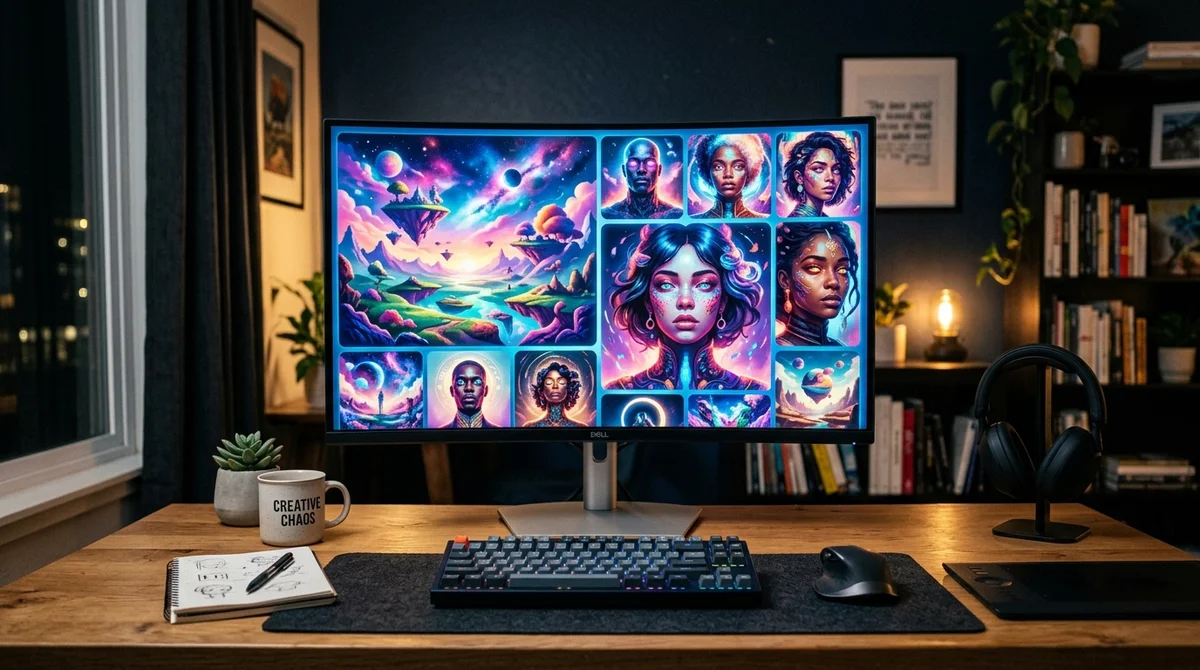
Most people who want to generate images with AI pick one of two paths: nominally free services such as ChatGPT, or a paid Midjourney subscription. Both mean depending on someone else's infrastructure, someone else's rules and content restrictions. The third path, running Stable Diffusion XL directly on your own computer, remains terra incognita for most, even though the barrier to entry has dropped significantly over the past two years.
Why SDXL seems out of reach
Local neural networks have earned a rather unwelcoming reputation. "You need a powerful graphics card," "you have to know the command line," "hundreds of gigabytes of disk space": newcomers meet comments like these in the very first search results. Some of these fears are justified; others are heavily exaggerated and describe 2022, not today. Besides, free cloud services are not all that free: they limit the number of generations, store your prompts and often use them to further train their own models. Open local models are a different story.
The real barriers a new user faces:
- Unfamiliar terminology: model weights, LoRA, ControlNet, VAE, CFG Scale
- A graphics card with 6+ GB of VRAM is desirable, but it can also run on a CPU, just more slowly
- Choosing an interface (Automatic1111, ComfyUI or InvokeAI) is not obvious without experience
- No structured Russian-language guide that starts from zero
What running locally gives you
Unlike cloud services, a local model does not send your prompts to a third-party server. By default, Midjourney publishes all generated images to a shared Discord gallery. That is handy for community inspiration but unacceptable for commercial or confidential work. SDXL runs completely offline, and no data goes anywhere.
The economics are simple, too. A Midjourney subscription starts at $10 a month, and requests through cloud APIs gradually add up on the bill. A one-time SDXL setup on your own hardware is free. The model generates images at 1024×1024 resolution out of the box and supports fine-grained style tuning via LoRA adapters, with no limit on the number of generations.
"Running
Stable Diffusion on your own machine is like having your own studio instead of renting a coworking desk by the hour."
What the BHV book covers
Publisher BHV has released a practical guide to Stable Diffusion XL aimed at users without a technical background. The book goes from a clean installation to advanced techniques: choosing an interface, tuning generation parameters, and working with additional models and extensions.
The main audience is not developers but designers, marketers, illustrators and curious users who want a powerful tool without diving into the math of diffusion processes. Every step comes with example results, so readers understand exactly what they are changing and what effect it has.
The lack of a structured Russian-language guide, practical and free of filler, was one of the main barriers to switching to local models. The book holds the reader's hand from "what is SDXL" to confident work with the model in any of the popular interfaces.
What this means
AI image-generation tools are gradually shifting from the cloud to personal computers. Local models offer privacy, independence from subscriptions and no censorship by a third-party service. As the open-model ecosystem grows and interfaces become easier to use, the gap between "hard" and "not hard" is narrowing.
An accessible practical guide removes a barrier for the next wave of users who are tired of paying for someone else's infrastructure.
- Oct 29, 2026Modal Passes $1B ARR and Hits a $16B Valuation on Demand for Sandboxes
- Oct 26, 2026Getty Images Says It Will File for Bankruptcy to Go Private; Shares Fall 68%
- Oct 26, 2026Getty Images files for bankruptcy to restructure as shares crash 68%
- Oct 26, 2026Getty Images prepares to file for bankruptcy: shares plunge 68% as owners put in $533 million
Key Questions Answered
Why SDXL seems out of reach?
Local neural networks have earned a rather unwelcoming reputation. "You need a powerful graphics card," "you have to know the command line," "hundreds of gigabytes of disk space": newcomers meet comments like these in the very first search results. Some of these fears are justified; others are heavily exaggerated and describe 2022, not today. Besides, free cloud services are not all that free: they limit the number of generations, store your prompts and often use them to further train their own models. Open local models are a different story. The real barriers a new user fa
What running locally gives you?
Unlike cloud services, a local model does not send your prompts to a third-party server. By default, Midjourney publishes all generated images to a shared Discord gallery. That is handy for community inspiration but unacceptable for commercial or confidential work. SDXL runs completely offline, and no data goes anywhere. The economics are simple, too. A Midjourney subscription starts at $10 a month, and requests through cloud APIs gradually add up on the bill. A one-time SDXL setup on your own hardware is free. The model generates images at 1024×1024 resolution out of the b
What the BHV book covers?
Publisher BHV has released a practical guide to Stable Diffusion XL aimed at users without a technical background. The book goes from a clean installation to advanced techniques: choosing an interface, tuning generation parameters, and working with additional models and extensions. The main audience is not developers but designers, marketers, illustrators and curious users who want a powerful tool without diving into the math of diffusion processes. Every step comes with example results, so readers understand exactly what they are changing and what effect it has. The lack o
Test Frontier LLMs & Autonomous Agents in One Workspace
Run Claude Opus 5.5, GPT-6, Gemini 3.1, and DeepSeek side-by-side in Nomad AI (nomadnet.ai) — unified model routing, deep research, and multimodal workflows under one subscription.
The AI world, distilled — once a week
Seven stories that actually mattered, hand-picked. No noise, no reposts, no press releases.
Done! Check your inbox for a confirmation.