US House Committee Moves to Tighten Controls on Nvidia AI Chip Leakage to China
A bill that would tighten control over AI chip shipments to China is moving forward in the US. After the case involving a co-founder of Super Micro, lawmakers want manufacturers such as Nvidia to track intermediaries, end buyers and shipping routes more actively. If the initiative becomes law, export compliance will get noticeably stricter across the entire supply chain, from chipmakers to server assemblers.
AI-processed from Bloomberg Tech; edited by Hamidun News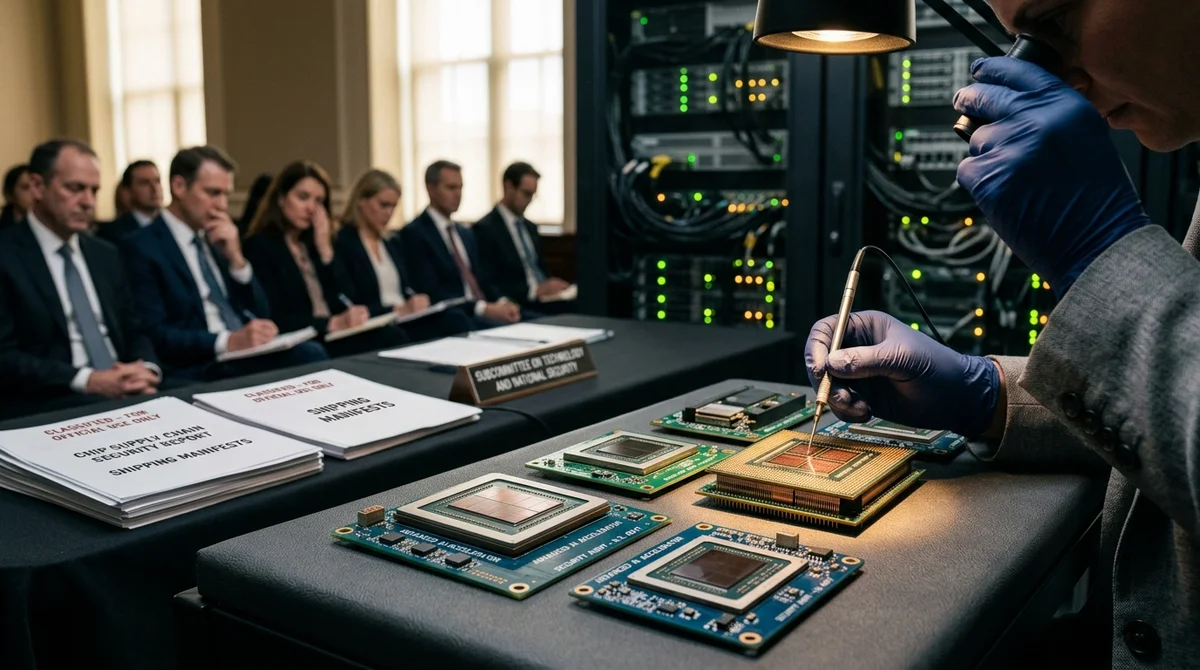
A US House committee has backed a bill intended to make chip manufacturers shut down gray-market channels that route AI processors to China. The trigger was the March case involving a co-founder of Super Micro, who is accused of redirecting Nvidia processors to Chinese buyers.
Why the issue gained speed
This is not yet a law passed, but the next significant step: the relevant House panel has moved the initiative forward procedurally. The bill would require the US Department of Commerce to demand more action from chipmakers to prevent smuggling and circumvention of export restrictions. In other words, the government does not want merely to catch violations after the fact, but to shift part of the responsibility in advance onto those who make key AI components and control the first links of the supply chain.
That makes the news important not only for politics but also for the accelerator market. US authorities have long restricted China's access to advanced computing systems, but the Super Micro story showed that formal bans are not enough if the chain still includes intermediaries, assemblers and buyers willing to bypass the rules. After the March indictment, pressure shifted from individual violators to the whole distribution system, where chip makers have the most data and influence.
A new logic of control
If the bill advances, manufacturers and their partners will probably be expected to do more than file a single formal certificate. They would need a set of ongoing checks across the entire sales and supply chain. The regulator wants to see not only the fact of export, but also who acts as an intermediary, where a shipment goes after the first international delivery, how its ownership changes, and whether the paperwork diverges from the actual route of the equipment.
The minimum set of expectations looks like this:
- stricter vetting of distributors and intermediaries
- confirmation of the end buyer and the shipment's destination
- monitoring of suspicious routes through third countries
- prompt alerts to authorities about schemes to circumvent restrictions
The exact wording may still change, but the direction is clear. Washington wants compliance to stop being a box-ticking exercise on export documents and become a continuous monitoring process. For companies, that means more internal analytics, more legal risk in case of errors, and extra costs for vetting deals, especially for large servers and systems with several AI accelerators inside.
Who is affected first
Pressure will first increase on the ecosystem around Nvidia, because its processors feature in the case that became the political trigger for the bill. In practice, though, the circle is wider: server assemblers, distributors, integrators and any company through which advanced chips physically pass on the way to the end customer will come under extra scrutiny. The longer and more opaque the chain, the likelier regulators are to see it as a weak point.
For the market, this will almost certainly mean higher compliance costs and slower deals in sensitive regions. Manufacturers will have to vet partners more deeply, and buyers will have to prove in more detail that a purchase and the equipment's end use are legitimate. For China, this is a bad signal: even if demand for advanced AI chips persists, getting them through indirect channels will be harder. For the US, it is an attempt to close an operational, not merely declarative, hole in export controls.
What this means
The US is taking the next step from general export restrictions toward individual accountability throughout the AI hardware supply chain. If the initiative advances, manufacturers such as Nvidia will have to prove not only what they sell, but also where each critical accelerator ends up.
- Nov 1, 2026Local models lose to Opus and Codex: 0.21 on a MacBook versus 1.00 for Codex
- Nov 1, 2026Habr author fine-tunes YOLOv8l on dental X-rays and pushes mAP50 to 0.642
- Nov 1, 2026Voice bots built on LLMs turn to Jev, a fast classifier, for decisions in 200–500 ms
- Nov 1, 2026MoneyGate safety layer blocked all 42 fraudulent requests to local AI models
Key Questions Answered
Why the issue gained speed?
This is not yet a law passed, but the next significant step: the relevant House panel has moved the initiative forward procedurally. The bill would require the US Department of Commerce to demand more action from chipmakers to prevent smuggling and circumvention of export restrictions. In other words, the government does not want merely to catch violations after the fact, but to shift part of the responsibility in advance onto those who make key AI components and control the first links of the supply chain. That makes the news important not only for politics but also for th
What are the key details on A new logic of control?
If the bill advances, manufacturers and their partners will probably be expected to do more than file a single formal certificate. They would need a set of ongoing checks across the entire sales and supply chain. The regulator wants to see not only the fact of export, but also who acts as an intermediary, where a shipment goes after the first international delivery, how its ownership changes, and whether the paperwork diverges from the actual route of the equipment. The minimum set of expectations looks like this: stricter vetting of distributors and intermediaries confirma
Who is affected first?
Pressure will first increase on the ecosystem around Nvidia, because its processors feature in the case that became the political trigger for the bill. In practice, though, the circle is wider: server assemblers, distributors, integrators and any company through which advanced chips physically pass on the way to the end customer will come under extra scrutiny. The longer and more opaque the chain, the likelier regulators are to see it as a weak point. For the market, this will almost certainly mean higher compliance costs and slower deals in sensitive regions. Manufacturers
Test Frontier LLMs & Autonomous Agents in One Workspace
Run Claude Opus 5.5, GPT-6, Gemini 3.1, and DeepSeek side-by-side in Nomad AI (nomadnet.ai) — unified model routing, deep research, and multimodal workflows under one subscription.
The AI world, distilled — once a week
Seven stories that actually mattered, hand-picked. No noise, no reposts, no press releases.
Done! Check your inbox for a confirmation.