China Warns Washington's Export Bills Could Disrupt Chip Supplies
China has responded to new export restrictions for the semiconductor industry moving through the US House of Representatives. Beijing argues that such measures, if adopted, would hit the global chip supply chain and deepen trade fragmentation. The package of bills covers supplies of key equipment, strengthens controls and tightens oversight around the China track.
AI-processed from Bloomberg Tech; edited by Hamidun News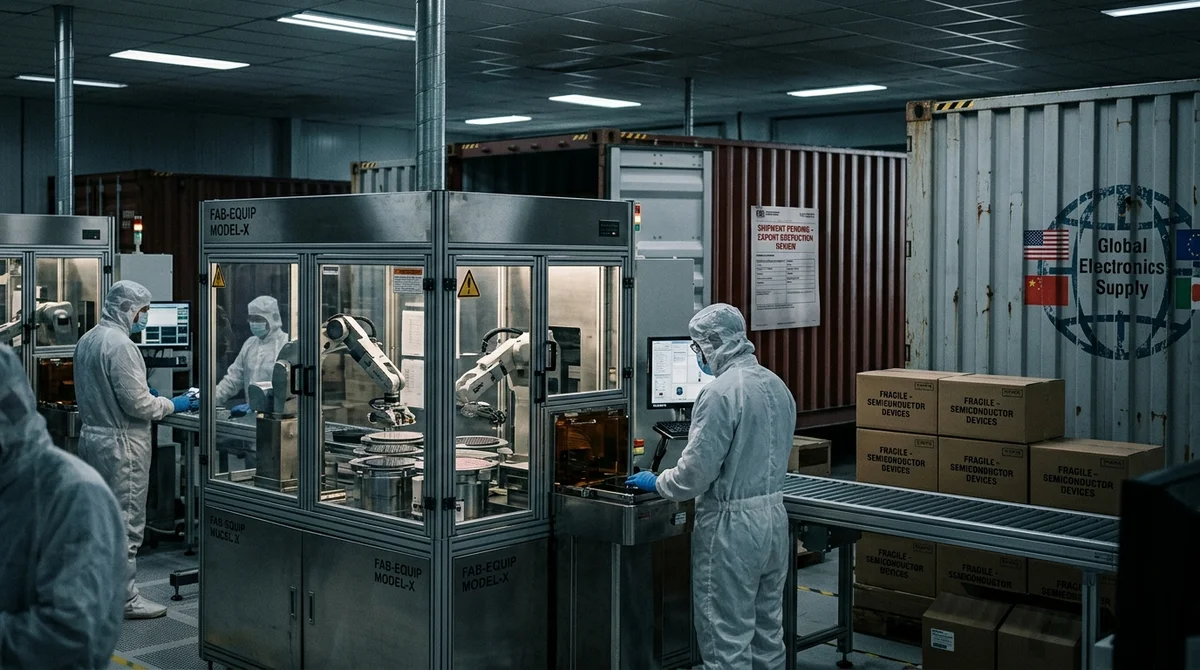
China has warned that new US export bills could hurt not only Chinese companies but the entire global semiconductor supply chain. After the US House Foreign Affairs Committee advanced a package of measures targeting the chip industry on April 22, Beijing said it is closely following the legislative process and assessing the possible consequences for its interests.
The response was triggered by a package of American export control initiatives, including the MATCH Act. In broad terms, it aims to further restrict supplies of critical chip-manufacturing equipment to countries Washington sees as a strategic risk, primarily China. The committee also advanced other measures in parallel: they strengthen controls against circumvention of restrictions, toughen the regime for investigating violations and expand pressure tools around sensitive technologies. For the US, this is part of a broader effort to contain China's technological growth in segments considered important for defense, AI and industrial policy.
China's Ministry of Commerce on April 25 called this logic an abuse of the national security argument. The ministry said that if the bills are ultimately adopted, they would seriously undermine the international economic and trade order and significantly hit the stability of the global semiconductor production and logistics chain. Beijing also made clear it does not intend to leave the matter unanswered: Chinese authorities promised to closely monitor the bills' progress, assess the damage to national interests and, if necessary, take measures to protect the legitimate rights of Chinese companies.
The reason for such a sharp reaction is clear: the semiconductor market has long operated as a deeply interconnected cross-border system. Chip design, software tools, manufacturing equipment, materials, fabs, packaging and final assembly are rarely concentrated in one country. Even targeted export bans can set off a long chain of consequences, from delivery delays and pricier contracts to reconfigured production lines and revised investment plans. The chipmaking equipment segment is especially sensitive, with critical expertise split among American, European and Japanese suppliers. As restrictions grow broader and tougher, companies on both sides of the Pacific face not only direct bans but also rising legal uncertainty.
An important nuance is that the semiconductor conflict long ago outgrew a bilateral dispute. Earlier US restrictions have already forced international partners to adjust licenses, service contracts and product lineups for the Chinese market. As a result, some players are losing revenue, some are moving assembly elsewhere, and some are accelerating localization. So even the discussion of new rules affects decisions now: companies build in schedule buffers, revisit purchasing and treat long-term commitments more cautiously. For the industry, it is another sign that the technological decoupling of the US and China continues, even though the specific wording of the bills may still change in later stages.
In recent years, export controls have become one of the main instruments of pressure in the global competition for chips and computing capacity. Each new tightening hits the familiar market model in which equipment makers, contract fabs, chip designers and corporate customers could rely on relatively predictable rules. Businesses now have to plan not only for demand and capacity but also for political risk: where equipment can be bought, which shipments will require licenses, and which contracts could be halted by new rules.
In the short term, this is not about an immediate cutoff of supplies but about another raising of the stakes. Still, the very fact that such bills are advancing increases pressure on suppliers, speeds the search for alternative channels and pushes China toward an even more aggressive push for technological self-sufficiency. For the global market, this means more fragmentation, less predictability and costlier logistics in an industry without which neither electronics, nor the auto industry, nor AI infrastructure works today.
- Oct 31, 2026Author puts his script before an AI jury: the verdict cost 850 thousand tokens
- Oct 29, 2026OvisOCR3: an 0.8B-parameter model that reads documents better than specialized systems
- Oct 29, 2026Tencent releases Youtu-Parsing-Omni: one model parses documents, audio and video
- Oct 28, 2026Liquid AI releases LFM2.5-24B-A2B: an agent model with 2B active parameters
Test Frontier LLMs & Autonomous Agents in One Workspace
Run Claude Opus 5.5, GPT-6, Gemini 3.1, and DeepSeek side-by-side in Nomad AI (nomadnet.ai) — unified model routing, deep research, and multimodal workflows under one subscription.
The AI world, distilled — once a week
Seven stories that actually mattered, hand-picked. No noise, no reposts, no press releases.
Done! Check your inbox for a confirmation.