US House Weighs Sanctions on Chinese Firms for Copying AI Models
Congress is stepping up pressure on China over artificial intelligence. House Republicans propose sanctions against Chinese entities that, in their view, improperly harvest outputs from leading American AI models and use them to train their own systems. The initiative shows how the race for AI leadership is moving further out of the boardroom and into geopolitics.
AI-processed from Bloomberg Tech; edited by Hamidun News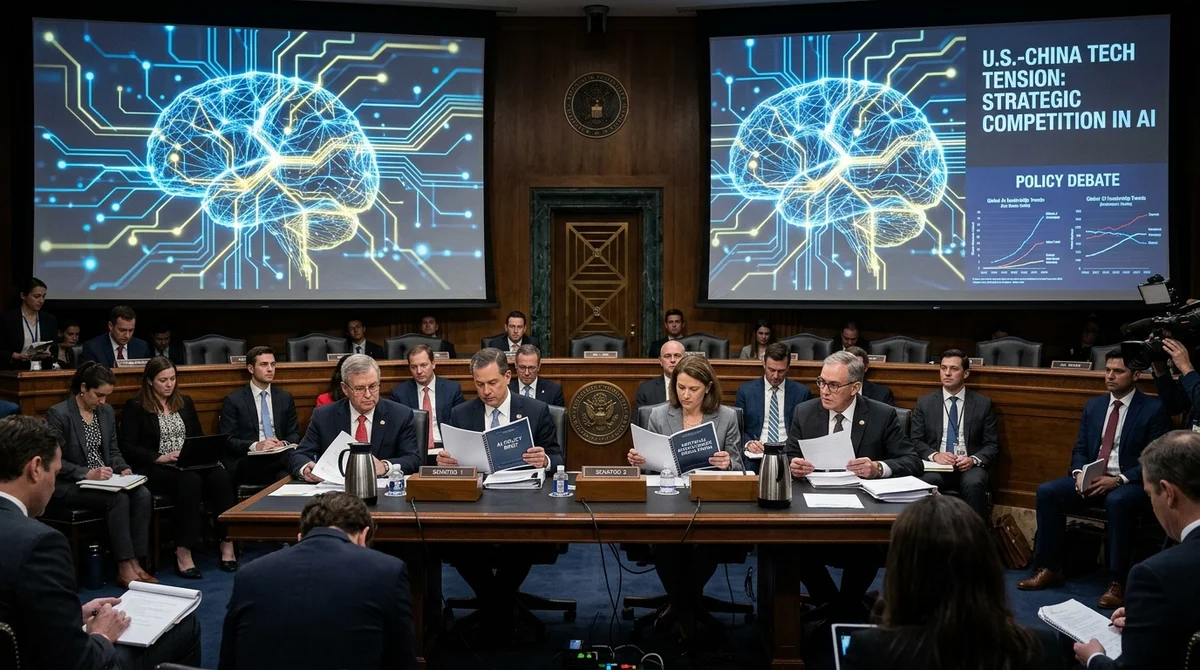
The US House of Representatives is ready to discuss new measures against Chinese companies and organizations that, in the view of American lawmakers, copy the capabilities of leading US AI systems by harvesting their responses at scale and then using that data to build their own competing models. For Washington this is no longer only a question of protecting intellectual property. It is part of a broader technology strategy: whoever controls the most advanced models gains an edge in the economy, defense and digital infrastructure.
The initiative comes from House Republicans. They propose considering sanctions against Chinese entities if it is established that they improperly extract outputs from American artificial intelligence models and turn them into the basis for their own products. The logic of the complaint matters here: this is not simply competition between developers, but an attempt to draw a line between ordinary use of services and systematic copying, in which an outside player pulls a large number of responses from someone else's model, analyzes the patterns and shortcuts its way to building an equivalent.
The topic is painful for the industry because training large AI models requires enormous computing resources, access to scarce chips, strong research teams and multibillion-dollar investment. If a company can avoid part of those costs by using the outputs of an existing American system as training material, it gets a serious boost. In practical terms, lawmakers are describing a scheme in which someone else's model becomes a hidden teacher: it is fed thousands or millions of queries, the responses are collected, and a cheaper or more specialized version is then trained on that data.
The political dispute is now forming around exactly these practices. It is especially sensitive for American developers, because a model's value is increasingly determined not only by its architecture but by the quality of accumulated responses, tuning and user scenarios.
The discussion of sanctions fits into Congress's broader course of containing China in the global race for AI leadership. In recent years Washington has already imposed export restrictions on advanced semiconductors and chipmaking equipment, tightened control over transfers of sensitive technology and tried to limit Chinese players' access to critical components of the AI stack. Now the focus is shifting to protecting the models themselves as a strategic asset.
Proving improper extraction of outputs will be harder than documenting a shipment of a specific chip: it requires patterns of mass queries, signs of automated collection and grounds to believe the data was used to train new systems. The dispute quickly moves beyond politics and runs into the question of technical observability.
The signal from Congress matters to American tech companies for several reasons. First, the government shows it is ready to treat unauthorized extraction of model outputs not as a gray area but as a problem of national competitiveness. Second, it may push developers toward tougher technical safeguards: rate limits, monitoring of suspicious activity, watermarks, additional customer verification and legal restrictions in API contracts. Third, the market gets a new reference point: the fight over model quality is increasingly intertwined with questions of data provenance, access control and international politics. It also raises the importance of audit logs, compliance and mechanisms that can prove who interacted with a model, how and to what extent.
If the initiative advances, the dispute over copying AI models will stop being an internal conflict between companies and will finally become a subject of foreign-policy pressure. That means the AI market is entering a phase in which speed of research and scale of investment are no longer the only things that matter; so is the ability of states to protect their technological advantages. For China, this means the risk of new restrictions. For the US, it is an attempt to lock in the rules of the game at a moment when technological leadership can still be converted into political leadership.
- Oct 31, 2026Author puts his script before an AI jury: the verdict cost 850 thousand tokens
- Oct 29, 2026OvisOCR3: an 0.8B-parameter model that reads documents better than specialized systems
- Oct 29, 2026Tencent releases Youtu-Parsing-Omni: one model parses documents, audio and video
- Oct 28, 2026Liquid AI releases LFM2.5-24B-A2B: an agent model with 2B active parameters
Ship AI Faster with Founders, Engineers & Weekly Architecture Reviews
Inside Vibe Club (hamidun.com/club) — weekly live masterminds with Zhemal Khamidun, Tech Radar, full LMS access, and 370+ production Claude Code skills.
The AI world, distilled — once a week
Seven stories that actually mattered, hand-picked. No noise, no reposts, no press releases.
Done! Check your inbox for a confirmation.