Starcloud raises $170M at a $1.1B valuation for orbital data centers
Starcloud raised $170M in a Series A round at a $1.1B valuation. The company wants to turn experiments with computing in orbit into a full-fledged business: it already has an Nvidia H100 GPU operating in space, and it is now designing a Starship-class vehicle for an orbital data center that is supposed to compete on price with ground-based facilities. The round was led by Benchmark.
AI-processed from TNW; edited by Hamidun News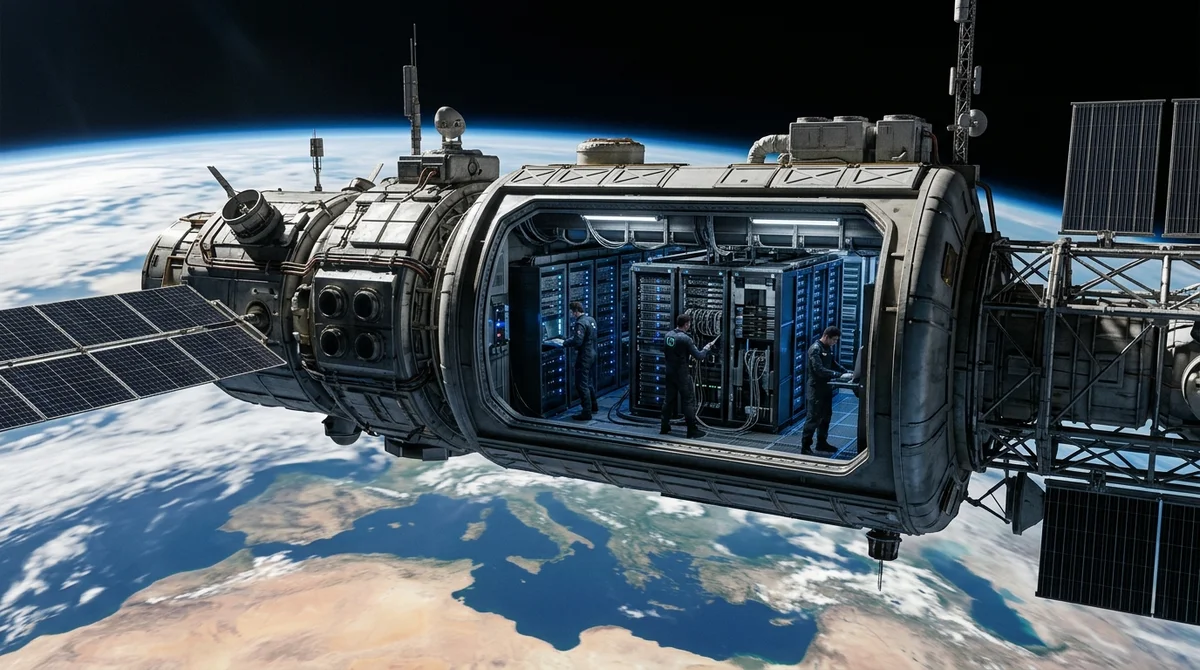
Starcloud raised $170M in a Series A round at a $1.1B valuation to speed up development of orbital data centers. The startup, based in Redmond, Washington, is trying to turn space computing from a flashy experiment into an infrastructure business with clear economics.
Starcloud's orbital bet
The company's main goal now is to build a Starship-class spacecraft that will serve as the basis for the first orbital data center able to compete on cost with ground-based facilities. It is a significant shift in positioning: this is no longer about a one-off technology demonstration, but an attempt to build a new category of computing infrastructure. Amid the AI boom and a shortage of capacity on Earth, Starcloud is betting that orbit may eventually become not an exotic option but one more place to host compute-hungry workloads.
The round itself also shows how high expectations run for the project. For a relatively young company, a $1.1B valuation at the Series A stage signals that investors are buying not current revenue but the scale of the idea. Benchmark led the round. The full list of other participants is not disclosed in the available excerpt, but even this is enough to see a trend: the market is ready to fund not only models and chips but also alternative physical infrastructure for AI.
What already works
Starcloud came to this round with more than renderings. The company already has an Nvidia H100 GPU running in orbit, and that makes the story noticeably more serious than a typical space pitch. The startup also claims it trained the first AI model in space. Even if this is not yet mass operation but an early working demonstration, the company has crossed a threshold beyond which you can discuss engineering execution rather than an idea.
This matters for the market for several reasons:
- the project already relies on a compute module operating in space;
- the team has not only a concept but also experience running an AI workload off Earth;
- the focus has shifted from experiment to a vehicle of the next scale;
- the company talks not merely about flight but about cost parity with ground-based data centers.
The last point is the most ambitious. Launching hardware into space is hard, but proving the economics is harder. If Starcloud can get close to the stated level, the conversation about orbital computing will quickly move out of futuristic news and into questions of payback, reliability, and competition for enterprise AI workloads. For now this is a promise, not a confirmed result, but the company now has the capital to test it in hardware rather than on slides.
Where the money will go
Starcloud needs the new capital for more than continuing research. The next stage requires far more expensive and complex engineering: scaling the platform, designing a large-class vehicle, and preparing the shift from isolated demonstrations to a system that can be compared with terrestrial infrastructure on price and useful compute output.
Viewed as a market signal, the deal illustrates a new direction for the AI industry. Money is flowing not only into foundation models, applications, and clouds, but into a deeper layer of the stack, where the physical limit of computing is set. The higher the demand for training and inference, the harder investors look for unconventional ways to add capacity. Starcloud is trying to claim this niche before others and establish itself as an infrastructure player, not just a space startup with a polished presentation.
What this means
The Starcloud deal shows that the race for AI capacity is moving beyond terrestrial data centers. If the company confirms the stated economics of orbital computing, the market will get not another space PR case but a new class of infrastructure for heavy AI workloads.
- Nov 1, 2026Local models lose to Opus and Codex: 0.21 on a MacBook versus 1.00 for Codex
- Nov 1, 2026Habr author fine-tunes YOLOv8l on dental X-rays and pushes mAP50 to 0.642
- Nov 1, 2026Voice bots built on LLMs turn to Jev, a fast classifier, for decisions in 200–500 ms
- Nov 1, 2026MoneyGate safety layer blocked all 42 fraudulent requests to local AI models
Key Questions Answered
What are the key details on Starcloud's orbital bet?
The company's main goal now is to build a Starship-class spacecraft that will serve as the basis for the first orbital data center able to compete on cost with ground-based facilities. It is a significant shift in positioning: this is no longer about a one-off technology demonstration, but an attempt to build a new category of computing infrastructure. Amid the AI boom and a shortage of capacity on Earth, Starcloud is betting that orbit may eventually become not an exotic option but one more place to host compute-hungry workloads. The round itself also shows how high expect
What already works?
Starcloud came to this round with more than renderings. The company already has an Nvidia H100 GPU running in orbit, and that makes the story noticeably more serious than a typical space pitch. The startup also claims it trained the first AI model in space. Even if this is not yet mass operation but an early working demonstration, the company has crossed a threshold beyond which you can discuss engineering execution rather than an idea. This matters for the market for several reasons: the project already relies on a compute module operating in space; the team has not only a
Where the money will go?
Starcloud needs the new capital for more than continuing research. The next stage requires far more expensive and complex engineering: scaling the platform, designing a large-class vehicle, and preparing the shift from isolated demonstrations to a system that can be compared with terrestrial infrastructure on price and useful compute output. Viewed as a market signal, the deal illustrates a new direction for the AI industry. Money is flowing not only into foundation models, applications, and clouds, but into a deeper layer of the stack, where the physical limit of computing
Test Frontier LLMs & Autonomous Agents in One Workspace
Run Claude Opus 5.5, GPT-6, Gemini 3.1, and DeepSeek side-by-side in Nomad AI (nomadnet.ai) — unified model routing, deep research, and multimodal workflows under one subscription.
The AI world, distilled — once a week
Seven stories that actually mattered, hand-picked. No noise, no reposts, no press releases.
Done! Check your inbox for a confirmation.