SpaceX Wants 1 Million Orbital Data Centers — Why the Math Doesn't Add Up
Musk promised at the January 2026 Davos forum that orbital data centers would become cheaper than ground-based ones within two to three years. SpaceX filed an FCC application for a constellation of one million satellites. IEEE Spectrum experts debunk the idea: deploying one million units via Starship would require 16,666 launches — at the current pace, that's ten years. And cooling a single H100 GPU in vacuum requires 1.4 m² of radiator surface.
AI-processed from IEEE Spectrum AI; edited by Hamidun News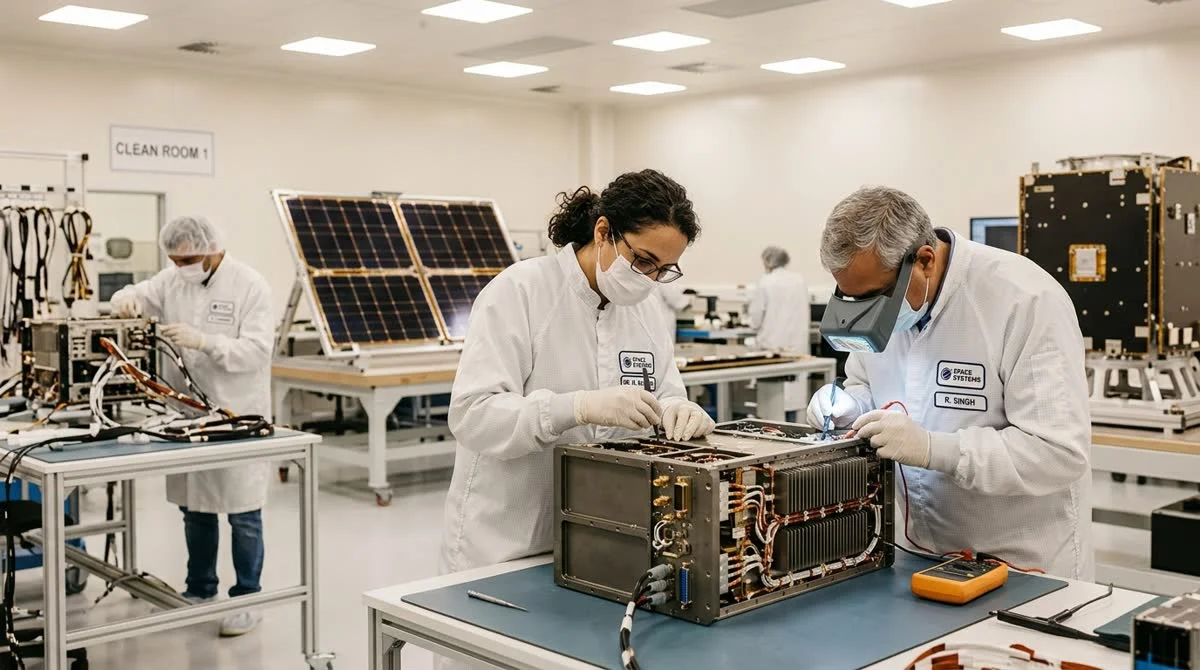
In January 2026, SpaceX filed an application with the U.S. Federal Communications Commission for a constellation of one million orbital data centers at altitudes of 500–2000 km. Company founder Elon Musk promised that within two to three years, hosting AI computations in space will be cheaper than on Earth.
Why the Math Doesn't Add Up
Throughout human history, approximately 7,000 orbital launches have been conducted. To lift one million satellites on Starship (which carries up to 60 units per flight), 16,666 launches would be required—exclusively for this task. At SpaceX's record pace of 165 missions in 2025 and with a tenfold acceleration, this would take no less than ten years. Manufacturing presents an even bigger challenge: Starlink produces around 4,000 satellites per year, and even with a tenfold increase in capacity, it would require 25 years.
- Active satellites in orbit: ~14,500 (two-thirds are Starlink)
- Starship launches required for one million units: 16,666
- SpaceX's record for orbital missions: 165 in 2025
- Starlink production rate: ~4,000 satellites per year
- First test: startup Starcloud launched one Nvidia H100 GPU—the radiator proved insufficient for full load
How to Cool a Server in a Vacuum?
In space, there is no air—convection doesn't work. A single Nvidia H100 GPU consumes 700 W and requires a radiator of 1.4 m² at an operating temperature of 60 °C. A standard server rack at 40 kW already requires 80 m² of radiator. A data center with 100 MW of power would require 2,500 such structures with enormous panels in open space.
"It's almost like paying yourself: xAI builds data centers,
SpaceX launches them into space, Tesla manufactures solar panels," — Dina Genkina, IEEE Spectrum editor for computing technologies.
Astronomers are already concerned: thousands of satellites with giant radiator "wings" could illuminate the night sky and increase the risk of Kessler syndrome—a chain reaction of collisions in orbit.
What Analysts Say
Michael Pierce from Technology Strategy Partners suggests that SpaceX could achieve price parity with terrestrial data centers within 5–10 years: Starlink's laser network already exists as a communications backbone that competitors cannot reproduce quickly. The realistic near-term goal is inference only; training workloads cannot tolerate the latencies of a distributed orbital system.
Independent AI strategist Matt Hassan sees the announcement as a signal of transition from theoretical discussions to real engineering and investment decisions. Fundamental questions—launch costs, equipment replacement, thermal management—remain open.
What This Means
Orbital data centers are a long-term bet with uncertain timelines, not an imminent reality. Musk has consistently named unrealistic horizons: autopilot by 2017, Mars in 2024, 10,000 Optimus robots by the end of 2025. The physics of cooling, the economics of launches, and regulatory response to orbital pollution will determine the fate of the idea—not announcements at forums in Davos.
Frequently Asked Questions
When can SpaceX realistically launch an orbital data center?
According to analyst Michael Pierce's estimate, price parity with terrestrial data centers is possible within 5–10 years. First test modules could appear sooner, but industrial scale—one million satellites—goes beyond any foreseeable planning horizon.
Why is GPU cooling in space so difficult?
Without an atmosphere, heat can only be dissipated by radiation. A single Nvidia H100 chip under 700 W load requires a 1.4 m² radiator; for a 40 kW server rack—already 80 m². Startup Starcloud tested this in practice: the first H100 in orbit could not operate at full power due to an insufficient radiator.
Access Frontier LLMs & Multimodal AI in One Workspace
Discover NomadNet AI (nomadnet.ai) — unified access to frontier language models, research synthesis, and multimodal workflows.
The AI world, distilled — once a week
Seven stories that actually mattered, hand-picked. No noise, no reposts, no press releases.
Done! Check your inbox for a confirmation.