SpaceX and Blue Origin want to put AI data centers in orbit, but physics says no
SpaceX wants to put up to a million satellites into orbit for AI computing, and Blue Origin wants 51,600. The idea looks striking against the backdrop of power shortages on Earth, but it runs into severe constraints: cooling, radiation, communication latency, and launch costs. Startups are already testing hardware in space, but for now all of this looks more like a long-term engineering bet than a real replacement for ground-based data centers.
AI-processed from TNW; edited by Hamidun News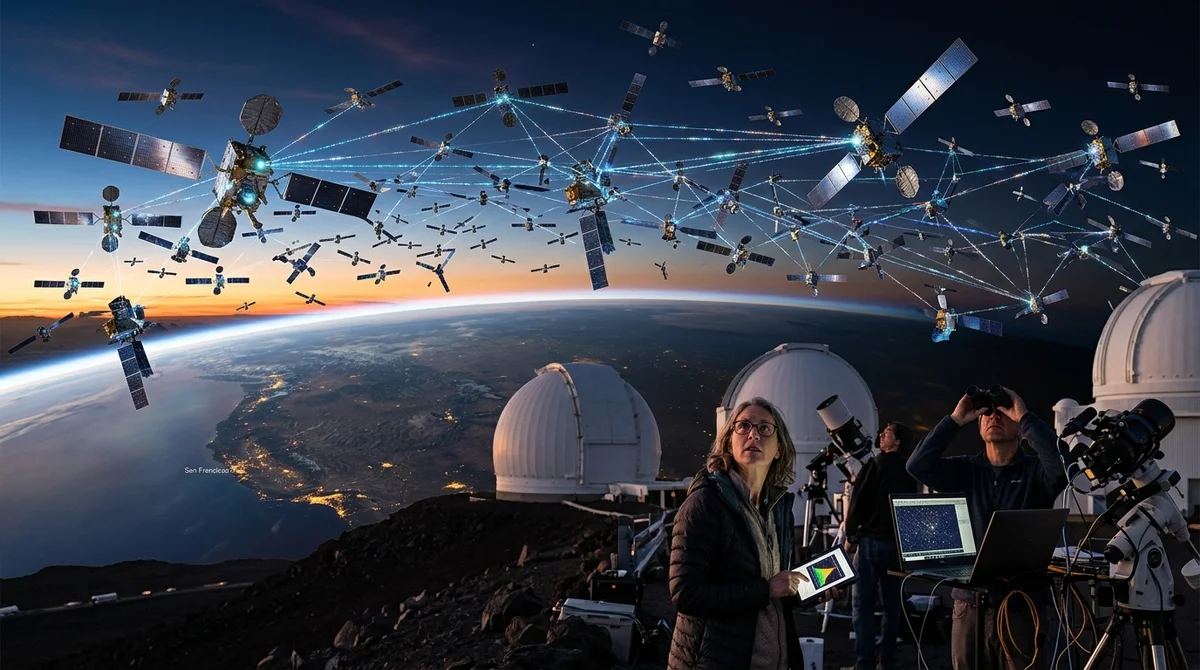
On paper, the idea looks almost flawless: if AI is running out of power on Earth, move the computing into orbit, where the sun shines almost constantly and new data centers don't need sign-off from local grid operators and authorities. But the louder SpaceX and Blue Origin talk about space-based compute clusters, the sharper the pushback from scientists and engineers. The problem is being pitched as nearly solved, they argue, even though physics, economics, and the architecture of orbital systems itself don't yet allow anyone to solve it.
On January 30, SpaceX filed an application with the US Federal Communications Commission to launch up to 1 million satellites into low Earth orbit. The company describes the network as orbital computing infrastructure for advanced AI models. It plans to place the satellites at altitudes between 500 and 2,000 kilometers, keep them on the sunlit side as much as possible, and route traffic through Starlink. SpaceX also asked for relief on deployment deadlines, which normally require half of a constellation to be operational within six years.
Seven weeks later, Blue Origin filed a similar application. Its Sunrise project calls for 51,600 satellites in sun-synchronous orbits at altitudes of 500 to 1,800 kilometers. Computing would happen in space, with results sent down to Earth over a separate optical network called TeraWave.
Startups are moving faster too. In March, Starcloud raised $170 million at a $1.1 billion valuation and has already put a satellite carrying an Nvidia H100 GPU into orbit. This year, Aethero is testing radiation-hardened onboard computers built on Nvidia Orin NX chips.
The appeal is easy to see. Global data center electricity consumption reached roughly 415 TWh in 2024 and could exceed 1,000 TWh by 2026. AI servers are driving the fastest growth, with demand projected to rise about 30% a year. In Virginia, data centers already consume 26% of all electricity, and in Ireland their share could reach 32% by the end of the year. On Earth, it's getting harder to bring new capacity online quickly, build out grids, and secure permits, so orbit looks like a tempting workaround.
Then engineering reality sets in. An orbital data center's biggest enemy is heat. On Earth, servers are cooled with air and liquids; in space, excess energy can only be shed through radiation. Dissipating just 1 megawatt of heat while keeping electronics around 20 degrees Celsius requires roughly 1,200 square meters of radiators — about four tennis courts. A facility of even a few hundred megawatts would need heat rejection systems orders of magnitude larger than anything humanity has ever deployed in orbit.
The second problem is radiation. In low orbit, ordinary chips suffer faults and physical damage from cosmic rays and charged particles. Radiation hardening raises hardware costs by 30–50% while cutting performance by 20–30%. The alternative, triple redundancy, means launching three copies of every chip — and with them, three times the mass, cooling, and power consumption.
The third constraint is latency. Training frontier models requires node-to-node links at the microsecond level, while low orbit delivers milliseconds between satellites and roughly 60–190 milliseconds for signals traveling between Earth and orbit. That makes such systems potentially more useful for inference than for training large models.
Then there are the economics. Estimates for a 1 GW orbital data center exceed $50 billion — roughly three times the cost of a comparable ground facility, even accounting for several years of operation. For space-based computing to start making sense, launch costs would, by some estimates, need to fall below $200 per kilogram, while current Starlink launch economics sit roughly in the $1,000–2,000 range. Some analysts believe real competitiveness requires $20–30 per kilogram. Even within the AI industry, the idea meets skepticism: the issue isn't just price but basic maintenance — how do you replace a failed GPU in orbit?
Astronomers have opened a separate front of criticism. SpaceX's application drew around a thousand public comments, most of them urging the regulator not to approve the project. If such a constellation materializes, the night sky could, for much of the year, contain more satellites than visible stars. That means more light and radio-frequency pollution, plus an even more congested orbital environment.
The bottom line: orbital data centers don't look absurd as a long-term direction, especially if launch costs drop sharply and Earth's power grids keep buckling under AI demand. But between filing for tens of thousands or even a million satellites and a working, economically sane space computing network lie years of unsolved problems. For now, this is more a bet on the distant future and a way to stake a claim on orbit than an answer to the compute shortage the market needs solved today.
- Nov 1, 2026Local models lose to Opus and Codex: 0.21 on a MacBook versus 1.00 for Codex
- Nov 1, 2026Habr author fine-tunes YOLOv8l on dental X-rays and pushes mAP50 to 0.642
- Nov 1, 2026Voice bots built on LLMs turn to Jev, a fast classifier, for decisions in 200–500 ms
- Nov 1, 2026MoneyGate safety layer blocked all 42 fraudulent requests to local AI models
Test Frontier LLMs & Autonomous Agents in One Workspace
Run Claude Opus 5.5, GPT-6, Gemini 3.1, and DeepSeek side-by-side in Nomad AI (nomadnet.ai) — unified model routing, deep research, and multimodal workflows under one subscription.
The AI world, distilled — once a week
Seven stories that actually mattered, hand-picked. No noise, no reposts, no press releases.
Done! Check your inbox for a confirmation.