Cowboy Space raises $275M for data centers in space
Demand for AI compute is outpacing the supply of rockets. Cowboy Space has raised $275M to launch data centers into space. There's a catch: there aren't enough rockets, launches are expensive, and orbital data centers are a very new idea.
AI-processed from TechCrunch; edited by Hamidun News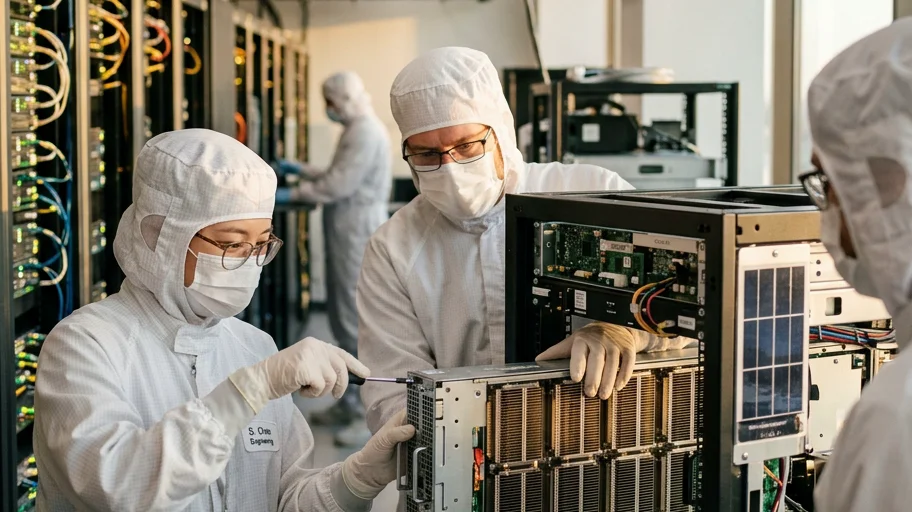
Demand for compute to train large language models is growing exponentially. Data centers around the world are running at capacity, and new ground facilities are slow and expensive to build and need huge amounts of electricity. Companies are competing for available sites, power, and cooling. Some entrepreneurs have reached a radical conclusion: it's time to launch data centers into space.
Cowboy Space heads to orbit
Cowboy Space, a startup focused on commercial space launches, has just closed a $275M Series B round. The company plans to use the money to design, build, and launch specialized data center satellites.
The idea sounds like science fiction, but it has a logic to it. Space is a cold vacuum, which is ideal for cooling servers. Solar panels can generate power without interference from the weather. Location stops being a critical factor: data travels at the speed of light no matter how many kilometers separate the server from the end user.
Projects like this once looked like pure fantasy. But when demand for AI compute took off and land for data centers started running out, investors reconsidered. In 2024-2025, serious money began flowing into the field.
The main obstacle: not enough rockets
Cowboy Space faces an interesting paradox: sending data centers to space requires rockets. But rockets are in short supply. Every commercial operator (SpaceX, Blue Origin, Rocket Lab, and others) is running at full capacity.
Every launch costs a fortune. Putting a data center into orbit isn't like launching a small satellite for a few million dollars; it means lifting an object that weighs tens of tons. A single launch can cost $100-300M, depending on the rocket's payload capacity and its current price.
That means the return on investment depends on steady, long-term demand for orbital compute. Customers need guarantees that their data will be processed reliably and on time. And orbital infrastructure is entirely new territory.
The technology isn't simple either
Cooling servers in space requires fundamentally new approaches. On Earth, data centers use liquid cooling and huge electrically powered fans. That approach doesn't work in a vacuum.
Hardware reliability has to be close to absolute. On the ground, if a server breaks, a technician comes out and replaces it. In orbit, that won't happen. Either the hardware runs flawlessly for 10 years or so, or a $100M investment is lost.
Every kilogram has a price: launching a cubic meter of material into space costs tens of thousands of dollars. So engineers have to cut the data center's weight and size as much as possible without sacrificing performance.
- Extreme reliability requirements — no room for repairs in orbit
- Revolutionary cooling systems for a vacuum
- Maximum reduction of structural weight
- Solar panels as the only power source
- Very high risks and an immature ecosystem
What this means
If Cowboy Space and other startups in the field manage to clear the technical and financial hurdles, this really could change the architecture of cloud computing. But over the next 5-10 years, orbital data centers will remain a niche solution — a complement to ground facilities, not a replacement.
The real AI compute shortage will be solved primarily on Earth: by building new data centers, optimizing power, and developing more efficient processor architectures. Space is for the future.
Key Questions Answered
What are the key details on Cowboy Space heads to orbit?
Cowboy Space, a startup focused on commercial space launches, has just closed a $275M Series B round. The company plans to use the money to design, build, and launch specialized data center satellites. The idea sounds like science fiction, but it has a logic to it. Space is a cold vacuum, which is ideal for cooling servers. Solar panels can generate power without interference from the weather. Location stops being a critical factor: data travels at the speed of light no matter how many kilometers separate the server from the end user. Projects like this once looked like pur
What are the key details on The main obstacle: not enough rockets?
Cowboy Space faces an interesting paradox: sending data centers to space requires rockets. But rockets are in short supply. Every commercial operator (SpaceX, Blue Origin, Rocket Lab, and others) is running at full capacity. Every launch costs a fortune. Putting a data center into orbit isn't like launching a small satellite for a few million dollars; it means lifting an object that weighs tens of tons. A single launch can cost $100-300M, depending on the rocket's payload capacity and its current price. That means the return on investment depends on steady, long-term demand
What are the key details on The technology isn't simple either?
Cooling servers in space requires fundamentally new approaches. On Earth, data centers use liquid cooling and huge electrically powered fans. That approach doesn't work in a vacuum. Hardware reliability has to be close to absolute. On the ground, if a server breaks, a technician comes out and replaces it. In orbit, that won't happen. Either the hardware runs flawlessly for 10 years or so, or a $100M investment is lost. Every kilogram has a price: launching a cubic meter of material into space costs tens of thousands of dollars. So engineers have to cut the data center's wei
Test Frontier LLMs & Autonomous Agents in One Workspace
Run Claude Opus 5.5, GPT-6, Gemini 3.1, and DeepSeek side-by-side in Nomad AI (nomadnet.ai) — unified model routing, deep research, and multimodal workflows under one subscription.
The AI world, distilled — once a week
Seven stories that actually mattered, hand-picked. No noise, no reposts, no press releases.
Done! Check your inbox for a confirmation.