Kepler Communications opens the largest orbital cluster of 40 Nvidia Orin chips
Kepler Communications has opened access to the largest orbital computing cluster: 40 Nvidia Orin chips on 10 satellites linked by a laser network. New customer Sophia Space will upload its software to the spacecraft and try to deploy it across six chips at once. If the test succeeds, the space computing market will move beyond the concept stage into operational services.
AI-processed from TechCrunch; edited by Hamidun News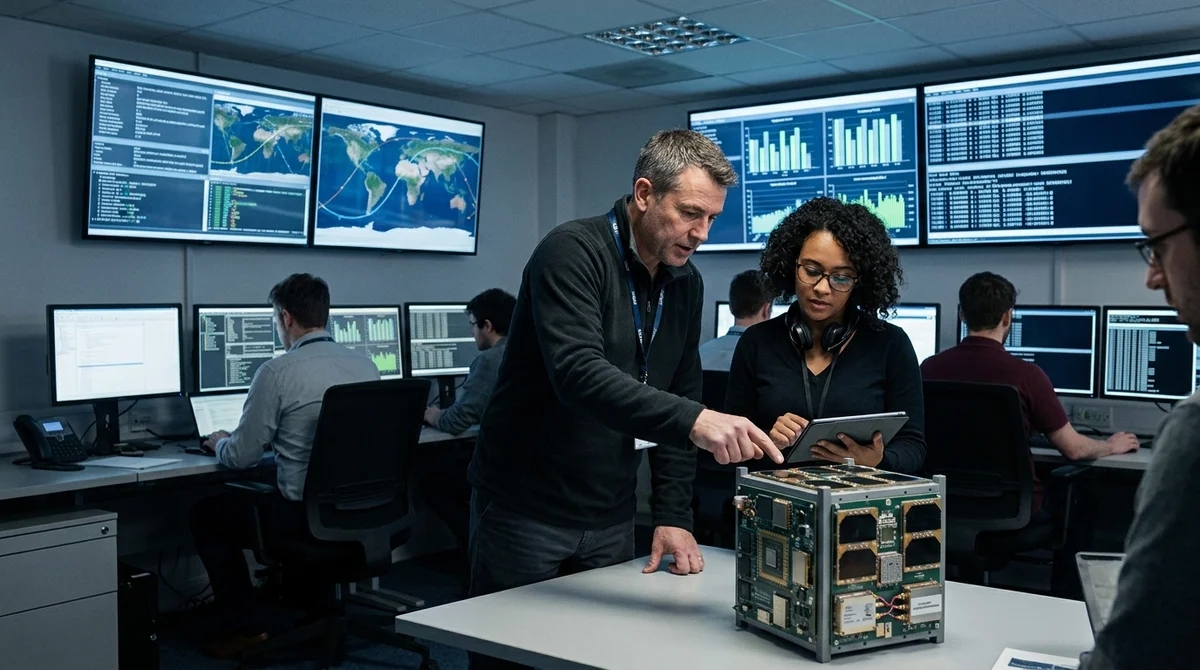
Kepler Communications brought to market the largest orbital computing cluster to date and has already begun selling access to it. The first notable case became a deal with Sophia Space: the startup will test its space computer software on Kepler satellites.
What Kepler Launched
The Kepler cluster is approximately 40 Nvidia Orin chips aboard 10 active satellites, connected by laser communication channels. The company deployed this system to orbit in January and by April already had 18 customers. This is not yet a full-fledged orbital data center, but rather a more narrow and practical infrastructure: transmit data between spacecraft, run computations near the data source, and accelerate information processing without constantly sending the entire data stream to Earth.
Kepler emphasizes that they are building not an orbital data center in the traditional terrestrial sense, but a network layer for applications in space and near space atmosphere. The company wants to serve not only its own spacecraft but also third-party satellites, and in the future—drones and aircraft that need fast communication and data processing without a long route through ground infrastructure. In other words, the value here lies in the continuous availability of computing on orbit, not in the peak power of a single spacecraft.
Test for Sophia Space
For Sophia Space, partnership with Kepler is an opportunity to test a key element of its future platform before launching its own satellite, scheduled for late 2027. The startup is developing space computers with passive cooling. The idea is to overcome one of the main problems of orbital computing: powerful processors generate significant heat, and active cooling systems make the spacecraft heavier, more expensive, and more complex to launch.
For such a project, testing in a real orbital environment is more important than laboratory tests. According to the plan, Sophia will upload its own operating system to a Kepler satellite and attempt to deploy and configure it on six chips across two spacecraft simultaneously. On terrestrial servers, such a task looks basic, but in the orbital environment this will be the first experiment of its kind.
If everything works, the company will eliminate an important technological risk before its first launch and gain practical confirmation that its architecture is suitable not for demonstrations but for real operation.
"We need distributed accelerators for inference, not one
super-powerful chip for training."
Where the Demand Will Be
The most understandable scenario for orbital computing is not training large models in space, but processing data right where it appears. This is especially important for satellite sensors, where response speed and communication channel bandwidth are limited. If part of the tasks are performed in orbit, already processed results can be transmitted to Earth, rather than raw data streams. This reduces latency and saves expensive transmission bandwidth.
- Pre-processing of imagery and telemetry onboard
- Working with heavier sensors like synthetic aperture radars
- Network and computing services for third-party satellites
- Laser data transmission between space, aircraft, and drones
- Fast event recognition and filtering for government and defense systems
Kepler has already demonstrated laser communication between a satellite and an air platform in a demonstration for the U.S. government. This explains well why the market is forming right now: large orbital data centers, which SpaceX, Blue Origin, and several well-funded startups talk about, still look like a 2030s story. But distributed computing for specific tasks can be sold today—especially when customers care more about continuous availability and useful results than maximum peak power.
What This Means
The space computing market is shifting from grand promises to the first practical infrastructure. Kepler and Sophia Space are betting not on giant orbital farms, but on a practical computing layer next to satellite data—and if such tests become regular, space-tech will gain a new working segment long before full-fledged orbital data centers. For the AI market, this is also a new class of infrastructure tailored for inference at the edge of the network.
Want to stop reading about AI and start using it?
AI News is a curated feed of AI/tech news. Hamidun Academy teaches you to use AI systematically in your work.
The AI world, distilled — once a week
Seven stories that actually mattered, hand-picked. No noise, no reposts, no press releases.
Done! Check your inbox for a confirmation.