Lansoft names the AI technologies that will reach production in 2026
Lansoft examined which AI technologies will survive 2026 in production rather than in slide decks. The most mature stack is optimized transformers such as FlashAttention and Performer. Neuromorphic chips are useful in sensors and IoT, BCI in medicine, while the authors advise leaving quantum ML to researchers for at least another decade. The main criterion is simple: only what already delivers gains in cost, speed and reliability counts.
AI-processed from Habr AI; edited by Hamidun News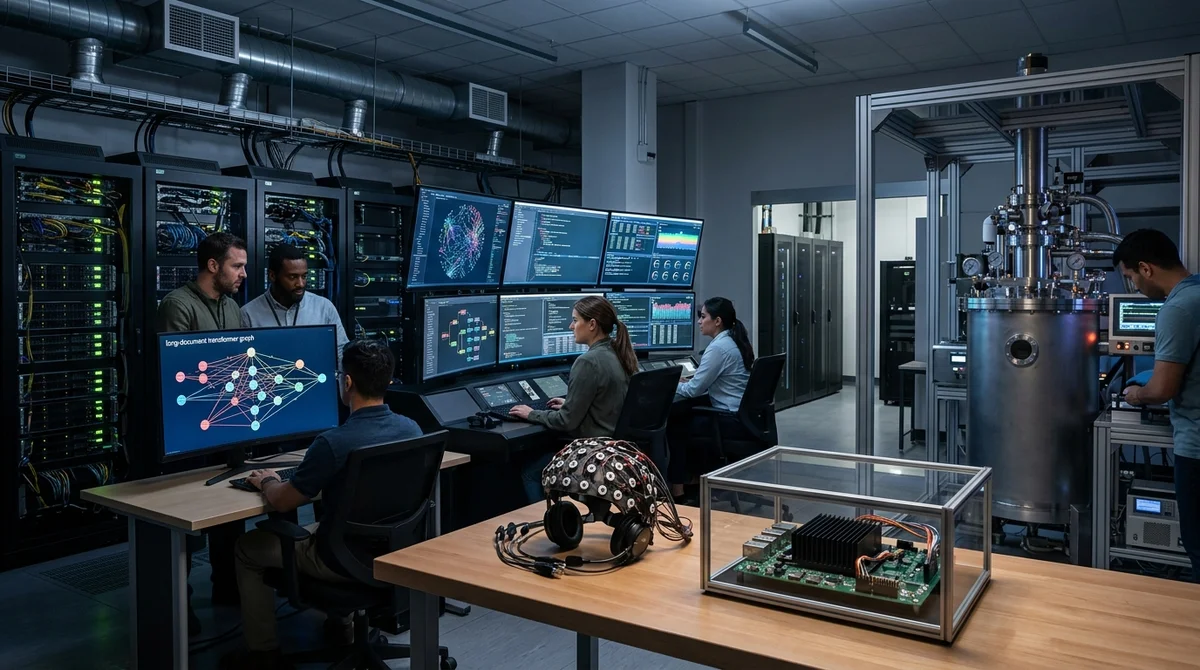
Lansoft's article examines which AI directions are genuinely ready for deployment in 2026, and which still run into hardware, power consumption and physical limits. The main conclusion is simple: the market will go not to the loudest ideas, but to those that already deliver predictable gains in speed, cost and reliability.
What already works
The most mature part of the set is not a new magical architecture but optimizations of classic transformers. The authors remind readers that the central problem of large models on long documents has not gone away: self-attention still grows quadratically, so GPU memory runs out very quickly, and the cost of training and inference climbs sharply. That is why, in real production, promises of revolution lose to engineering methods that squeeze more out of an already well-understood stack.
- FlashAttention speeds up training and inference without losing accuracy, provided modern GPUs are available.
- Performer is useful where context length is critical and a small margin of error is acceptable.
- Linformer saves memory, but suits mainly classification rather than generation.
- Hybrid schemes look like the most practical scenario: short queries go to regular models, long ones to cheaper approximations.
In the author's assessment, optimized transformers will become the foundation for most AI systems in the coming years. No sharp paradigm shift is expected here; rather, speedups will be built deeper into frameworks, and teams will combine FlashAttention, quantization and linear attention variants for a specific task. This does not eliminate the models' appetite for resources, but it makes them noticeably more practical for documents, analytics and enterprise scenarios.
Niche use cases
The article describes neuromorphic chips as a narrowly specialized but real tool. Their strength is energy efficiency: spiking networks use minimal energy where data arrives as a stream of signals from sensors, cameras or microphones. For IoT, wearables and simple robotics this sounds very attractive. But the ecosystem is still raw, training such models is slow, and porting large language models to this architecture remains more of a scientific experiment than a roadmap for business.
BCI follows similar logic. Brain-computer interfaces already deliver value, but not where they are usually advertised. Their real area of use is medical rehabilitation, neuroprosthetics and help for patients who cannot speak or move. For the mass consumer market the constraints are too severe: low bitrate, noisy signal, complex calibration and quality that depends on the individual user. So today BCI is not a replacement for the keyboard or everyday "mind reading", but a medical and research tool.
Where it is still too early
Quantum ML gets the harshest verdict in the text. The author explicitly separates theory from practice: yes, quantum computers promise speedups on certain classes of problems, but current systems are too noisy, unstable and limited in qubit count to become a useful platform for machine learning. Even the strong players in the market still demonstrate progress in lab conditions, not production scenarios comparable to classical CPUs and GPUs.
The practical takeaway is down-to-earth. Quantum computing can already be useful in chemistry, materials science and some optimization problems, but not in LLM training, tabular ML or computer vision. If a company is building an AI product today, it is too early to bet on a quantum stack. At best, this is an area for R&D monitoring on a horizon beyond 2030, when stable logical qubits, proper error correction and more convenient software appear.
What this means
Looking at the AI market without hype, the picture is pragmatic. In production over the next few years, improved transformers will survive above all; neuromorphic solutions and medical BCI will settle into niches; and quantum ML will remain a topic for researchers. For business this is a good guide: invest where the gain can be calculated right now, not where only the slide decks look good.
- Nov 1, 2026Local models lose to Opus and Codex: 0.21 on a MacBook versus 1.00 for Codex
- Nov 1, 2026MoneyGate safety layer blocked all 42 fraudulent requests to local AI models
- Nov 1, 2026ThinkJev Makes AI Think Only About Hard Questions: 28% Fewer Tokens
- Oct 31, 2026Open-source LLM gateway KTMS 1.0 plugs your own GPUs into the cloud and survives outages
Key Questions Answered
What already works?
The most mature part of the set is not a new magical architecture but optimizations of classic transformers. The authors remind readers that the central problem of large models on long documents has not gone away: self-attention still grows quadratically, so GPU memory runs out very quickly, and the cost of training and inference climbs sharply. That is why, in real production, promises of revolution lose to engineering methods that squeeze more out of an already well-understood stack. FlashAttention speeds up training and inference without losing accuracy, provided modern
What are the key details on Niche use cases?
The article describes neuromorphic chips as a narrowly specialized but real tool. Their strength is energy efficiency: spiking networks use minimal energy where data arrives as a stream of signals from sensors, cameras or microphones. For IoT, wearables and simple robotics this sounds very attractive. But the ecosystem is still raw, training such models is slow, and porting large language models to this architecture remains more of a scientific experiment than a roadmap for business. BCI follows similar logic. Brain-computer interfaces already deliver value, but not where t
Where it is still too early?
Quantum ML gets the harshest verdict in the text. The author explicitly separates theory from practice: yes, quantum computers promise speedups on certain classes of problems, but current systems are too noisy, unstable and limited in qubit count to become a useful platform for machine learning. Even the strong players in the market still demonstrate progress in lab conditions, not production scenarios comparable to classical CPUs and GPUs. The practical takeaway is down-to-earth. Quantum computing can already be useful in chemistry, materials science and some optimization
Test Frontier LLMs & Autonomous Agents in One Workspace
Run Claude Opus 5.5, GPT-6, Gemini 3.1, and DeepSeek side-by-side in Nomad AI (nomadnet.ai) — unified model routing, deep research, and multimodal workflows under one subscription.
The AI world, distilled — once a week
Seven stories that actually mattered, hand-picked. No noise, no reposts, no press releases.
Done! Check your inbox for a confirmation.