Factory AI doubles its iteration speed with LangChain's LangSmith
Factory AI, a startup building AI agents that write code, used LangSmith to automate its feedback loop. The team set up tracing for every request, automated prompt evaluations and fast isolation of regressions. The result: iteration speed doubled. The "change the prompt → check → decide" cycle is now half as long.
AI-processed from LangChain Blog; edited by Hamidun News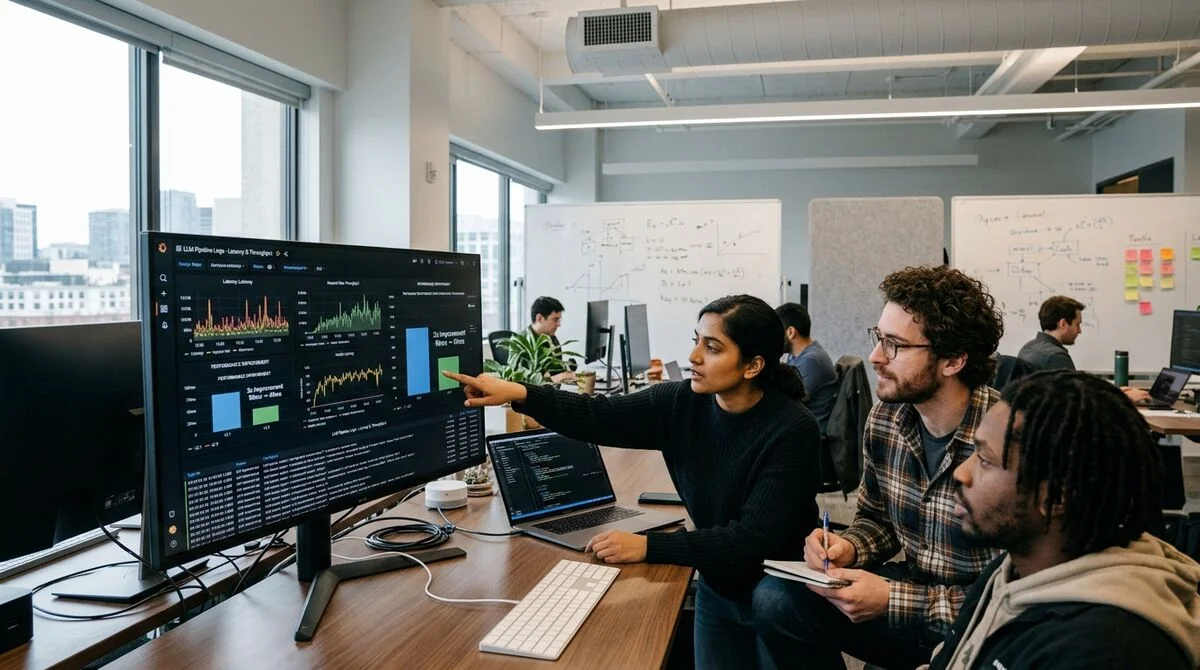
Factory AI, a company that develops AI agents to automate code writing, has doubled its iteration speed after integrating LangSmith. LangChain's tool for tracing and evaluating LLM pipelines let the team automate its feedback loop.
Why debugging is hard without observability
When an AI product reaches production, teams often lose visibility into what is happening. It is unclear why an agent gave a wrong answer, at which step the pipeline broke, and whether a prompt change improved or worsened the system's behavior. Factory AI ran into this classic bottleneck: debugging took hours, a specific bug could not always be reproduced, and manual log analysis slowed down all product work.
LangSmith is LangChain's platform for tracing, evaluating and monitoring LLM applications. It records every step of the pipeline: the incoming prompt, model calls, intermediate results, the final answer and latency. Debugging becomes deterministic: the team sees an exact snapshot of each request and can reproduce any case straight from production.
How the team closed the feedback loop
The key change was automating the feedback loop. Previously, getting from "a user complained" to "we found the cause" took too long, especially when a problem reproduced inconsistently. After integrating LangSmith, the Factory AI team built a structured process:
- every request to the agent is traced and available for detailed inspection in real time
- automated evaluations (evals) run on fresh production data without manual triggering
- prompt versions are compared through the built-in experiment framework
- post-deployment regressions are isolated in minutes, not hours
- real problem cases are automatically added to a test dataset for future checks
The structured approach replaced manual analysis: every change is now tested against real traffic, and the team no longer waits for complaints to pile up to learn that something went wrong.
The result: 2x iteration speed
According to Factory AI, iteration speed doubled. The "change the prompt → evaluate on real data → decide" cycle is half as long. What used to take a full working day now fits into a few hours.
For product teams this matters a great deal: the shorter the cycle, the more hypotheses they can test per sprint, the faster agent quality improves, and the less engineering time goes to detective work instead of building new capabilities.
"We can't improve what we can't measure."
This principle from classical engineering is finally being applied systematically to LLM products.
What this means
The Factory AI case reflects a broader trend: AI companies are starting to treat LLM pipelines as real production systems, with observability, alerts, prompt versioning and a strict CI/CD evaluation process. Without tools like LangSmith, iteration on AI products turns into guesswork, and teams spend their time hunting for problems instead of solving them.
For teams still running LLM pipelines without monitoring, this result is a concrete argument: investing in observability pays off through measurably faster development and fewer "dark" problems in production.
- Nov 1, 2026Google's StreamVibe video agent beats other models by 10.7% on response timing and quality
- Nov 1, 2026New test catches hidden AI agent collusion by measuring how a partner reacts to a paraphrase
- Nov 1, 2026Illinois compiled 12 151 open problems and tested whether AI can solve them
- Oct 31, 2026AI engineer writes a single reward function for agent teams: win rate climbs from 51% to 90%
Key Questions Answered
Why debugging is hard without observability?
When an AI product reaches production, teams often lose visibility into what is happening. It is unclear why an agent gave a wrong answer, at which step the pipeline broke, and whether a prompt change improved or worsened the system's behavior. Factory AI ran into this classic bottleneck: debugging took hours, a specific bug could not always be reproduced, and manual log analysis slowed down all product work. LangSmith is LangChain's platform for tracing, evaluating and monitoring LLM applications. It records every step of the pipeline: the incoming prompt, model calls, int
How the team closed the feedback loop?
The key change was automating the feedback loop. Previously, getting from "a user complained" to "we found the cause" took too long, especially when a problem reproduced inconsistently. After integrating LangSmith, the Factory AI team built a structured process: every request to the agent is traced and available for detailed inspection in real time automated evaluations (evals) run on fresh production data without manual triggering prompt versions are compared through the built-in experiment framework post-deployment regressions are isolated in minutes, not hours real probl
What are the key details on The result: 2x iteration speed?
According to Factory AI, iteration speed doubled. The "change the prompt → evaluate on real data → decide" cycle is half as long. What used to take a full working day now fits into a few hours. For product teams this matters a great deal: the shorter the cycle, the more hypotheses they can test per sprint, the faster agent quality improves, and the less engineering time goes to detective work instead of building new capabilities. "We can't improve what we can't measure." This principle from classical engineering is finally being applied systematically to LLM products.
Test Frontier LLMs & Autonomous Agents in One Workspace
Run Claude Opus 5.5, GPT-6, Gemini 3.1, and DeepSeek side-by-side in Nomad AI (nomadnet.ai) — unified model routing, deep research, and multimodal workflows under one subscription.
The AI world, distilled — once a week
Seven stories that actually mattered, hand-picked. No noise, no reposts, no press releases.
Done! Check your inbox for a confirmation.