Solaria raises €300M to power AI data centers with solar and batteries
Solaria has raised nearly €300M and wants to turn its solar assets into infrastructure for AI data centers. The company offers sites with grid connections already secured, long-term PPAs and battery storage, which Europe is badly short of right now. The offering was 6.7 times oversubscribed. That suggests investors are buying more than solar generation: they are buying access to scarce power capacity.
AI-processed from TNW; edited by Hamidun News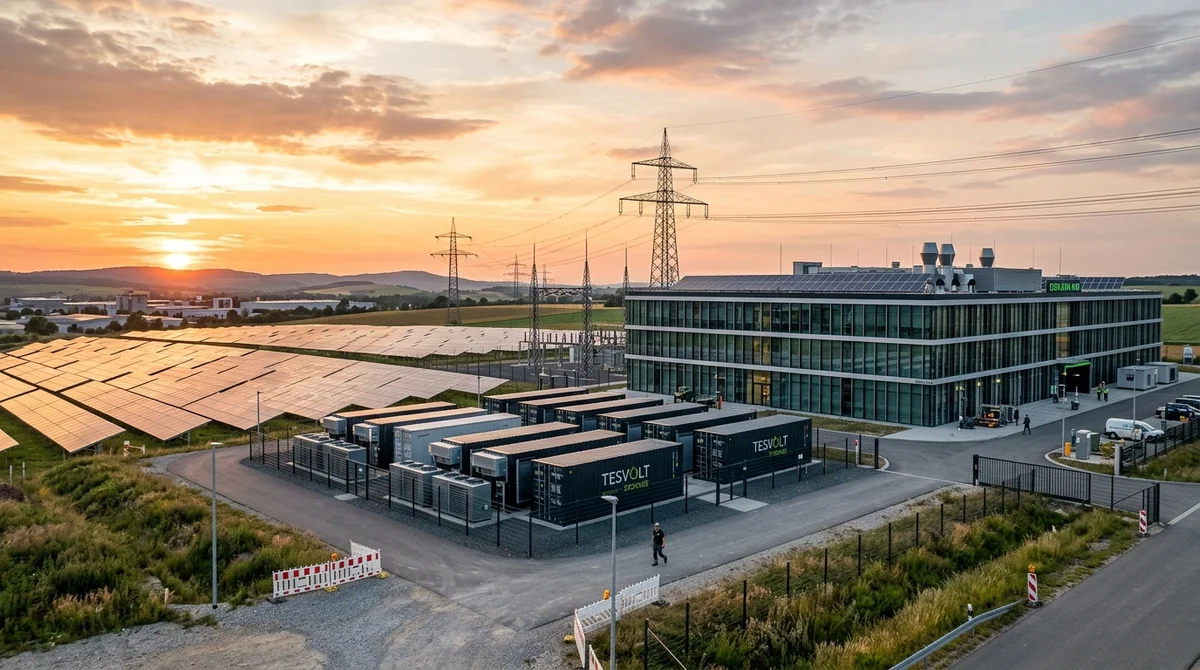
Spain's Solaria has raised €299.88M to develop data center sites with solar generation and battery storage next to the facilities themselves. Amid the AI boom, the company is betting on Europe's scarcest resource: not the panels themselves, but already confirmed access to the power grid.
Why the market bought in
European data centers face several constraints at once: grids cannot keep up with growing load, approvals for new connections move slowly, and grid connection queues in the UK, Ireland and Germany stretch for years. For operators, this means that even with land, capital and customers in hand, launching a new site can be delayed by three to five years. Solaria is trying to bypass this bottleneck by offering infrastructure where part of the energy problem has already been solved in advance.
The company completed a private placement of almost €300M at €24 per share, issuing up to 10% of its capital. The key signal is not only the amount but the demand: the placement was 6.7 times oversubscribed across the entire price range. That is especially telling given the pressure on Spanish solar companies, where electricity prices have dropped because of strong hydropower output and new capacity. In other words, investors are betting not on the ordinary business of selling solar power, but on Solaria's pivot toward AI infrastructure.
How the scheme works
Solaria's model is called Powered Land. Essentially, the company offers hyperscalers and colocation operators sites next to existing or under-construction solar generation, where the grid connection is already secured, the electrical infrastructure is partly built, and long-term green power supply contracts can be signed right away. For the data center market this is a rare combination: not just a plot to build on, but a ready-made energy shell, which is usually the hardest thing to obtain quickly.
Solaria already has a set of assets that supports this model:
- more than 70 solar plants in Spain, Italy, Portugal and Germany
- about 1000 km of its own power grid infrastructure
- 97 substations
- confirmed grid capacity accumulated over more than 20 years
The last item is what makes the company's offer hard to copy: panels can be built relatively fast, but retracing the path to approved connections and substations cannot be done quickly.
What is already in the portfolio
As of November 2025, Solaria had assembled a portfolio of 3.4 GW of secured data center capacity across five countries. The largest volumes are in Italy at 1.4 GW and Germany at 1.2 GW, followed by the UK and Spain. Two major deals with Merlin Properties have already been signed, totaling 438 MW of data center capacity, 871 MW of solar PPAs with a 40-year term and a ten-year contract for 600 MWh of battery storage. Another deal of roughly 500 MW is currently in late-stage discussions.
The second investment track is to fix the main flaw of solar generation for data centers: it cannot be used as the sole power source without storage. Solaria plans to invest €770M in hybridizing its parks, adding wind and BESS. The goal for the end of 2028 is 500 MW of wind capacity and 4 GWh of storage on the Iberian Peninsula. Across Europe, the company already has a 5.1 GW storage portfolio, of which 1.9 GW have confirmed grid connection permits. A separate JV with Stoneshield Capital and Gravyx is developing another 14 GWh of storage projects.
What this means
The market is starting to value power for AI as a standalone infrastructure layer rather than an auxiliary service. If Solaria's model works, the winners will include not only solar asset owners but also data center operators, who increasingly need not just access to electricity but fast access to capacity that is already allocated, contractable and partly backed up.
- Feb 5, 2026AI's Appetite: Tata Power Prepares a Gigawatt for Data Centers
- Oct 13, 2026AI and Climate: Data Centers Use 415 TWh a Year, While the Benefits Remain Mostly Forecasts
- Jul 18, 2026Honda starts building data center batteries at plant meant for canceled EVs
- May 17, 2026SoftBank to Make Batteries for AI Data Centers at Former Sharp Plant
Key Questions Answered
Why the market bought in?
European data centers face several constraints at once: grids cannot keep up with growing load, approvals for new connections move slowly, and grid connection queues in the UK, Ireland and Germany stretch for years. For operators, this means that even with land, capital and customers in hand, launching a new site can be delayed by three to five years. Solaria is trying to bypass this bottleneck by offering infrastructure where part of the energy problem has already been solved in advance.
How the scheme works?
Solaria's model is called Powered Land. Essentially, the company offers hyperscalers and colocation operators sites next to existing or under-construction solar generation, where the grid connection is already secured, the electrical infrastructure is partly built, and long-term green power supply contracts can be signed right away. For the data center market this is a rare combination: not just a plot to build on, but a ready-made energy shell, which is usually the hardest thing to obtain quickly.
What is already in the portfolio?
As of November 2025, Solaria had assembled a portfolio of 3.4 GW of secured data center capacity across five countries. The largest volumes are in Italy at 1.4 GW and Germany at 1.2 GW, followed by the UK and Spain. Two major deals with Merlin Properties have already been signed, totaling 438 MW of data center capacity, 871 MW of solar PPAs with a 40-year term and a ten-year contract for 600 MWh of battery storage. Another deal of roughly 500 MW is currently in late-stage discussions.
Test Frontier LLMs & Autonomous Agents in One Workspace
Run Claude Opus 5.5, GPT-6, Gemini 3.1, and DeepSeek side-by-side in Nomad AI (nomadnet.ai) — unified model routing, deep research, and multimodal workflows under one subscription.
The AI world, distilled — once a week
Seven stories that actually mattered, hand-picked. No noise, no reposts, no press releases.
Done! Check your inbox for a confirmation.