AI's Appetite: Tata Power Prepares a Gigawatt for Data Centers
Everyone is talking about the GPU shortage, but an electricity shortage is looming on the horizon. Tata Power CEO Praveer Sinha told Bloomberg he expects an additional 1 GW of demand from AI infrastructure alone. For scale, that is enough to power about 750,000 households. India is becoming a new data center hub, and the load on its grids is growing exponentially. The next battle among tech giants may be fought not over silicon, but over access to a stable power outlet and server cooling.
AI-processed from Bloomberg Tech; edited by Hamidun News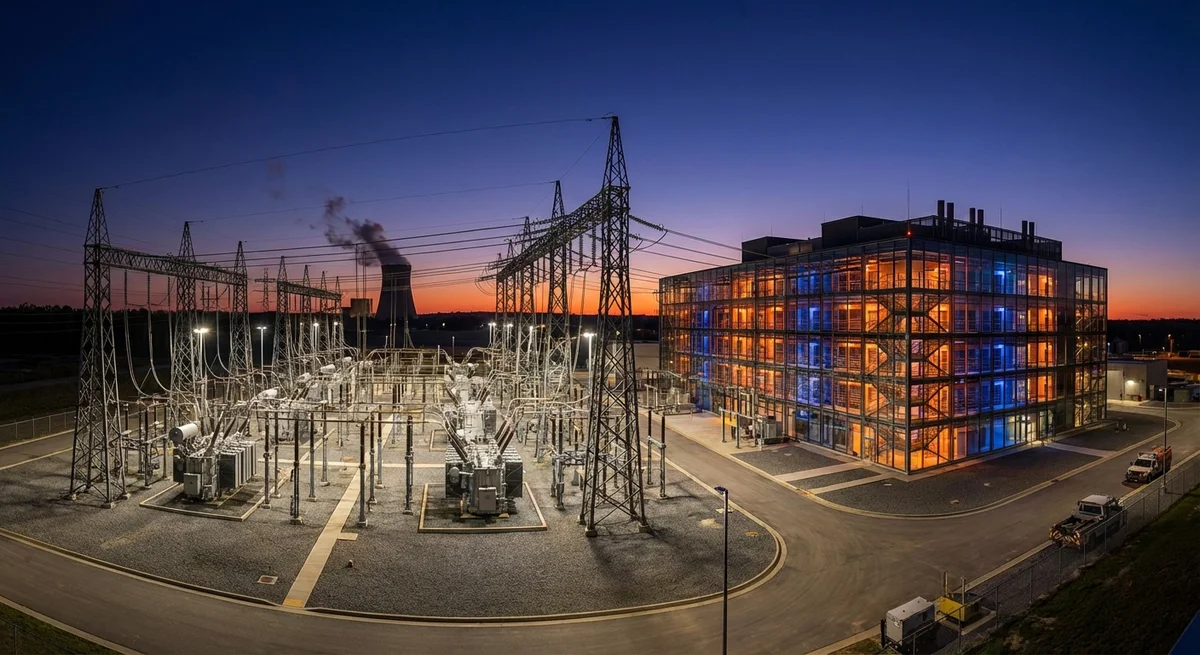
We are used to thinking of artificial intelligence as something ethereal: lines of code, cloud computing, neurons in a virtual space. But you can't cheat physics. Behind every "smart" ChatGPT answer stands a very real turbine burning fuel, or a hydroelectric dam. While investors watch NVIDIA's stock price, power engineers look at consumption charts with dread. The industry is hitting a new ceiling, and it is not the number of transistors on a chip but a plain shortage of electricity.
The situation is becoming critical, and the confirmation comes from India. Praveer Sinha, CEO of Tata Power, one of the region's largest energy companies, named a figure that forces a rethink of infrastructure development plans. The company is preparing to supply 1 gigawatt (GW) of capacity exclusively for artificial intelligence. For context: 1 GW is roughly what the DeLorean needs to travel to the future in the film "Back to the Future" (well, almost: it was 1.21 GW), or enough energy to supply electricity to an average European city of a million people.
Why does this matter right now? Because we are witnessing a paradigm shift. Data centers used to be built for data storage and classic computing. AI workloads are different. Training models and, even more importantly, inference (the process of generating answers) demand colossal amounts of energy. NVIDIA H100 processors run as hot as stoves, requiring not only power but also powerful cooling. Tata Power sees this trend from the inside: India is turning into a global backend for IT giants, and if the bottleneck used to be the internet link, it is now the transformer substation.
Sinha's statement in his Bloomberg interview is not just local news. It is a signal to the whole market. Energy infrastructure is inert. You cannot build a new power plant as fast as Zuckerberg buys 350,000 graphics cards. The gap between the speed of AI adoption and the capacity of power grids will only widen. We already see Microsoft and Amazon investing in nuclear power and small modular reactors, trying to give their server farms autonomous power.
Interestingly, this gigawatt-scale request from Tata Power also puts the environmental agenda in question. Big Tech spent years telling us about its carbon neutrality. But when leadership in the AI race is on the scales, "green" promises may take a back seat. Providing 1 GW of stable 24/7 load from sun and wind alone is practically impossible without giant energy storage systems, which do not yet exist at industrial scale.
Bottom line: Energy is becoming the new bottleneck of the AI revolution. Where startups once needed money for cloud services, they will soon have to compete for physical access to electricity. Is the world ready to burn more coal for a smarter chatbot?
*Meta is designated an extremist organization and banned in Russia.
- Nov 2, 2026Meta's Muse assistant keeps dossiers on loved ones and gets root on Ubuntu by default
- Nov 1, 2026Local models lose to Opus and Codex: 0.21 on a MacBook versus 1.00 for Codex
- Nov 1, 2026Kimi scores 96.2% on a 1C database analytics test and emerges as a fallback if Claude access is blocked
- Nov 1, 2026OpenAI Rewrites GPT Behavior Rules: Five Values and a Chain of Command
Test Frontier LLMs & Autonomous Agents in One Workspace
Run Claude Opus 5.5, GPT-6, Gemini 3.1, and DeepSeek side-by-side in Nomad AI (nomadnet.ai) — unified model routing, deep research, and multimodal workflows under one subscription.
The AI world, distilled — once a week
Seven stories that actually mattered, hand-picked. No noise, no reposts, no press releases.
Done! Check your inbox for a confirmation.