Investors pour billions into AI humanoid robots, but their value remains unproven
AI humanoid robots are moving fast from demos into the mainstream. Billions have already gone into the sector, and expectations for automation keep rising. But the central question is still open: can these machines stop merely impressing on stage and deliver steady value in real conditions today, in warehouses, factories, services, logistics and other work settings?
AI-processed from Bloomberg Tech; edited by Hamidun News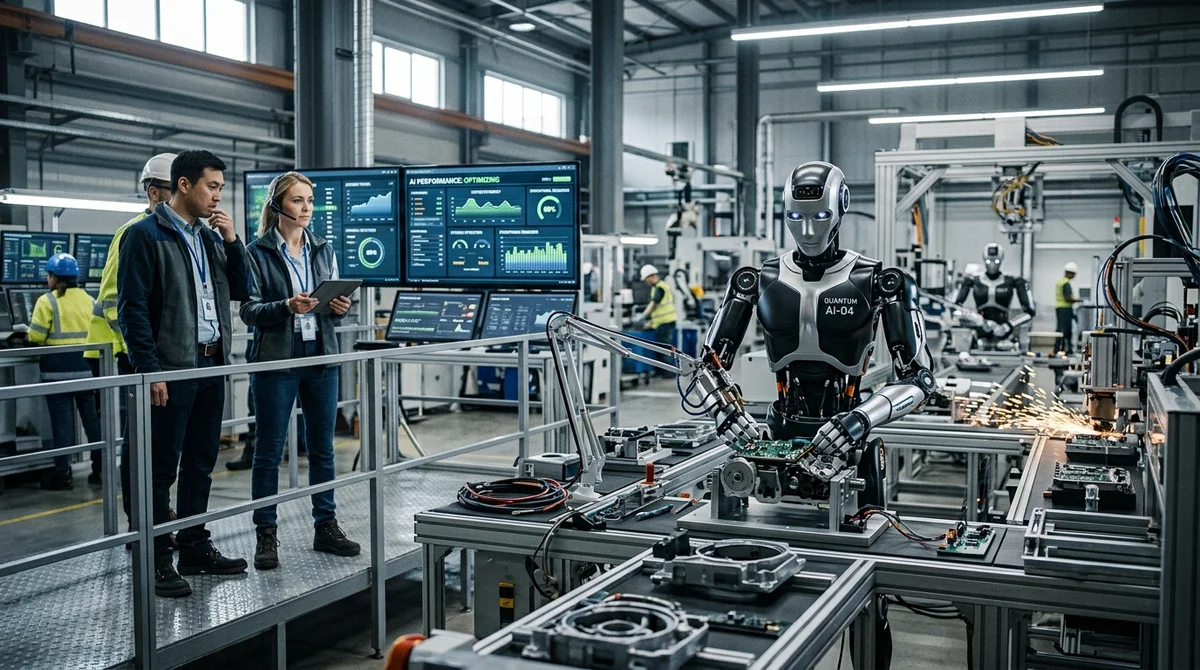
AI humanoid robots are moving quickly from lab demos into a category the mass market is now watching. Billions of dollars are flowing into the industry, but the main question has not changed: can these machines work reliably in a real environment, rather than just look impressive in presentations?
Why the market sped up
Interest in humanoid robots has jumped where two trends meet. On one side, generative AI has become better at understanding speech, instructions and visual surroundings. On the other, the robots themselves have become noticeably more agile, more stable and cheaper to build than they were a few years ago.
As a result, the idea of a "universal worker body" looks convincing again: in theory, one machine can perform different tasks without rebuilding infrastructure around a specialized manipulator or conveyor. That is why the market has begun shifting from the research phase to the commercial one.
Investors are betting on a scenario in which the humanoid form gives an edge wherever everything is already designed for people: aisles, stairs, shelves, carts, tools and workstations. For companies, this sounds like a promise of gentler automation: instead of rebuilding a site around the robot, send the robot into an environment built for humans. On paper this looks powerful and explains why the sector attracts ever more capital.
Where the main risk lies
The problem is that mainstream appeal and proven effectiveness are not the same thing. A demo in which a robot walks gracefully, lifts a box or answers a voice command does not prove it can handle an eight-hour shift. The real world quickly breaks polished videos: items are not where they should be, lighting changes, people walk nearby, tasks arrive mixed together, and the cost of a mistake is far higher than in a test area. This is where hype collides with operational reality.
- It needs to run reliably without frequent restarts and manual intervention
- Safety, predictability and clear behavior around people matter
- The economics must work at large-scale deployment, not only in a pilot
- Businesses need a measurable result: speed, quality, relief from staff shortages
Deployment cost is a separate question. Even if a robot can handle a basic set of operations, a business must account for maintenance, energy, software updates, remote monitoring and risk insurance. If the total cost of ownership is comparable to human labor or conventional automation, the solution makes no sense.
That is why investors care not only about technological progress, but also about how quickly it turns into sustainable unit economics in the near term, and over what horizon it pays back.
What companies need to prove
The next stage for developers is not another viral video but boring yet decisive operational statistics. The market needs data on how many hours a robot works without failures, how quickly it learns new operations, how much maintenance costs, and where exactly it already beats a human or classic automation. Without this, the billions in investment will be seen as a bet on future potential, not on a current product.
For corporate customers, this is not enough: they need a clear ROI, not a technological promise. If manufacturers manage to show value in specific verticals, such as logistics, manufacturing, warehouse zones or service processes with repetitive actions, attitudes toward the segment will change quickly. The conversation will then shift from "why is this needed at all" to "how fast can we deploy it."
But if pilots stay expensive, fragile and dependent on constant engineer support, the market can easily cool its expectations. In this race, the winner will not be the most spectacular robot but the one that becomes a predictable working tool.
What this means
The market for AI humanoid robots is entering a maturity test. The money and the interest have arrived, but now the sector has to prove one simple thing: these machines must not amaze the public, but reliably handle real business tasks better or cheaper than existing alternatives.
- Nov 1, 2026Pika Labs releases open video model H3 Flex: 6 steps instead of 50
- Nov 1, 2026Google's StreamVibe video agent beats other models by 10.7% on response timing and quality
- Oct 31, 2026AI cartoon series: a 24-second episode built ten ways, the best cost 162 credits
- Oct 31, 2026Anthropic: Fold Subagents Back Into a Single Loop — One Customer's Tasks Ran Twice as Fast
Key Questions Answered
Why the market sped up?
Interest in humanoid robots has jumped where two trends meet. On one side, generative AI has become better at understanding speech, instructions and visual surroundings. On the other, the robots themselves have become noticeably more agile, more stable and cheaper to build than they were a few years ago. As a result, the idea of a "universal worker body" looks convincing again: in theory, one machine can perform different tasks without rebuilding infrastructure around a specialized manipulator or conveyor. That is why the market has begun shifting from the research phase to
Where the main risk lies?
The problem is that mainstream appeal and proven effectiveness are not the same thing. A demo in which a robot walks gracefully, lifts a box or answers a voice command does not prove it can handle an eight-hour shift. The real world quickly breaks polished videos: items are not where they should be, lighting changes, people walk nearby, tasks arrive mixed together, and the cost of a mistake is far higher than in a test area. This is where hype collides with operational reality. It needs to run reliably without frequent restarts and manual intervention Safety, predictability
What companies need to prove?
The next stage for developers is not another viral video but boring yet decisive operational statistics. The market needs data on how many hours a robot works without failures, how quickly it learns new operations, how much maintenance costs, and where exactly it already beats a human or classic automation. Without this, the billions in investment will be seen as a bet on future potential, not on a current product. For corporate customers, this is not enough: they need a clear ROI, not a technological promise. If manufacturers manage to show value in specific verticals, suc
Test Frontier LLMs & Autonomous Agents in One Workspace
Run Claude Opus 5.5, GPT-6, Gemini 3.1, and DeepSeek side-by-side in Nomad AI (nomadnet.ai) — unified model routing, deep research, and multimodal workflows under one subscription.
The AI world, distilled — once a week
Seven stories that actually mattered, hand-picked. No noise, no reposts, no press releases.
Done! Check your inbox for a confirmation.