RLWRLD and Nvidia Build a Universal Standard for Measuring Humanoid Robot Dexterity
South Korean startup RLWRLD and Nvidia have teamed up to build DexBench, the first universal benchmark to measure how precisely robots manipulate physical objects. Founder and CEO Jeongi Ryu said the goal is to develop next-generation industry standards for humanoid robotics. DexBench is meant to do for robots what ImageNet did for computer vision.
AI-processed from Bloomberg Tech; edited by Hamidun News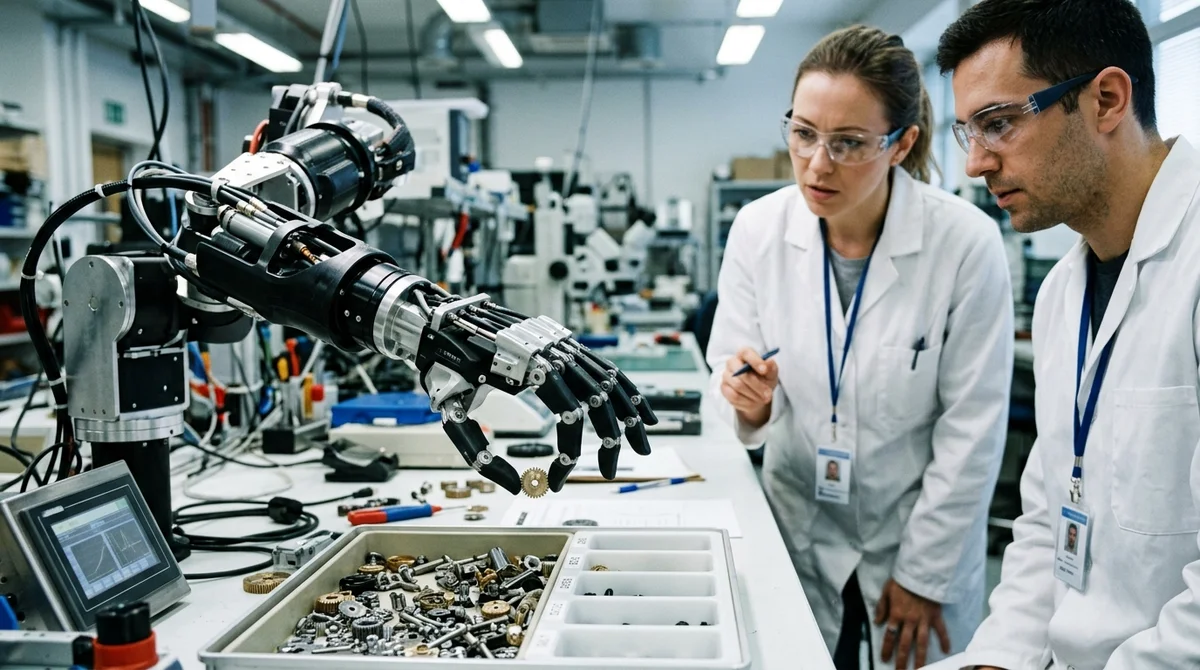
South Korean startup RLWRLD has partnered with Nvidia to develop DexBench, the first universal benchmark for measuring how precisely robots control their hands during physical tasks.
The problem DexBench aims to solve
The humanoid robot market is growing fast, but without shared standards. Every manufacturer tests its manipulators differently: some measure grasp speed, others positioning accuracy, others the force applied or resilience to failures. Comparing results across companies is practically impossible.
This is a problem not only for researchers but, above all, for industrial buyers. A factory or warehouse choosing a humanoid robot cannot objectively judge whose system will handle a specific task better.
The solution is a single reference test that every player in the market takes under the same rules. DexBench is being developed as exactly that kind of standard. Its test scenarios will include grasping varied objects, fine assembly, moving fragile items and reacting situationally to unexpected obstacles, all of which are in demand in manufacturing and logistics.
The roles of RLWRLD and Nvidia
RLWRLD is a South Korean startup founded by Jeongi Ryu. He positions the company not as the maker of yet another robot but as a developer of an infrastructure layer for the whole industry: standards, benchmarks and evaluation methodology, without which the industry cannot develop properly.
Nvidia joined the partnership as a technology anchor with enormous influence over the robotics hardware stack. The company is already building an ecosystem through its Isaac platform, a toolset for simulation, reinforcement learning and deployment of robotics models. DexBench fits neatly into this strategy: Nvidia wants industry evaluation standards to take shape on its foundation.
The partnership's specific goals:
- Develop unified metrics for the dexterity and precision of a robot's hand movements
- Create standardized test scenarios for industrial and warehouse use
- Open the benchmark to a wide range of manufacturers
- Integrate DexBench into Nvidia's Isaac training infrastructure
- Establish the results as a next-generation industry standard
A race without rules
The humanoid robot market is booming: Figure AI, Apptronik, Agility Robotics, Boston Dynamics and dozens of Asian startups are racing to release new models. Investors have put billions of dollars into the sector, and large manufacturers are starting their first pilots.
"We intend to develop next-generation standards for humanoid robotics," said
Jeongi Ryu, founder and CEO of RLWRLD
But right now, while standards have not yet taken hold, the key players have a chance to set the rules of the game for years. If DexBench becomes the de facto standard with Nvidia's backing, manufacturers will have to adopt it, and buyers will finally get an objective frame of reference for comparison. The market could consolidate around measurable results rather than marketing claims.
The ImageNet analogy is telling: when that computer vision benchmark appeared in 2010, it accelerated the field's progress by a full decade. DexBench's creators expect a similar effect for physical AI.
What this means
For the industry, DexBench is an attempt to do for robotics what ImageNet did for computer vision: provide a common reference point and launch competition on measurable results. If the RLWRLD and Nvidia initiative takes hold, standards for humanoid robots could emerge much faster than expected, and that would reshuffle the balance of power in the market.
- Nov 1, 2026Local models lose to Opus and Codex: 0.21 on a MacBook versus 1.00 for Codex
- Nov 1, 2026Habr author fine-tunes YOLOv8l on dental X-rays and pushes mAP50 to 0.642
- Nov 1, 2026Voice bots built on LLMs turn to Jev, a fast classifier, for decisions in 200–500 ms
- Nov 1, 2026MoneyGate safety layer blocked all 42 fraudulent requests to local AI models
Key Questions Answered
What are the key details on The problem DexBench aims to solve?
The humanoid robot market is growing fast, but without shared standards. Every manufacturer tests its manipulators differently: some measure grasp speed, others positioning accuracy, others the force applied or resilience to failures. Comparing results across companies is practically impossible. This is a problem not only for researchers but, above all, for industrial buyers. A factory or warehouse choosing a humanoid robot cannot objectively judge whose system will handle a specific task better. The solution is a single reference test that every player in the market takes
What are the key details on The roles of RLWRLD and Nvidia?
RLWRLD is a South Korean startup founded by Jeongi Ryu. He positions the company not as the maker of yet another robot but as a developer of an infrastructure layer for the whole industry: standards, benchmarks and evaluation methodology, without which the industry cannot develop properly. Nvidia joined the partnership as a technology anchor with enormous influence over the robotics hardware stack. The company is already building an ecosystem through its Isaac platform, a toolset for simulation, reinforcement learning and deployment of robotics models. DexBench fits neatly
What are the key details on A race without rules?
The humanoid robot market is booming: Figure AI, Apptronik, Agility Robotics, Boston Dynamics and dozens of Asian startups are racing to release new models. Investors have put billions of dollars into the sector, and large manufacturers are starting their first pilots. "We intend to develop next-generation standards for humanoid robotics," said Jeongi Ryu, founder and CEO of RLWRLD But right now, while standards have not yet taken hold, the key players have a chance to set the rules of the game for years. If DexBench becomes the de facto standard with Nvidia's backing, manu
Test Frontier LLMs & Autonomous Agents in One Workspace
Run Claude Opus 5.5, GPT-6, Gemini 3.1, and DeepSeek side-by-side in Nomad AI (nomadnet.ai) — unified model routing, deep research, and multimodal workflows under one subscription.
The AI world, distilled — once a week
Seven stories that actually mattered, hand-picked. No noise, no reposts, no press releases.
Done! Check your inbox for a confirmation.