Micro1 Collects Home Videos Worldwide to Train Humanoid Robots
Training humanoid robots has unexpectedly become a new segment of the gig economy. Micro1 and other companies pay people in Nigeria, India, and other countries for first-person videos of cleaning, cooking, and ironing. These videos help robots learn to manipulate objects, but simultaneously raise questions about privacy, data quality, and who controls such training pipelines.
AI-processed from MIT Technology Review; edited by Hamidun News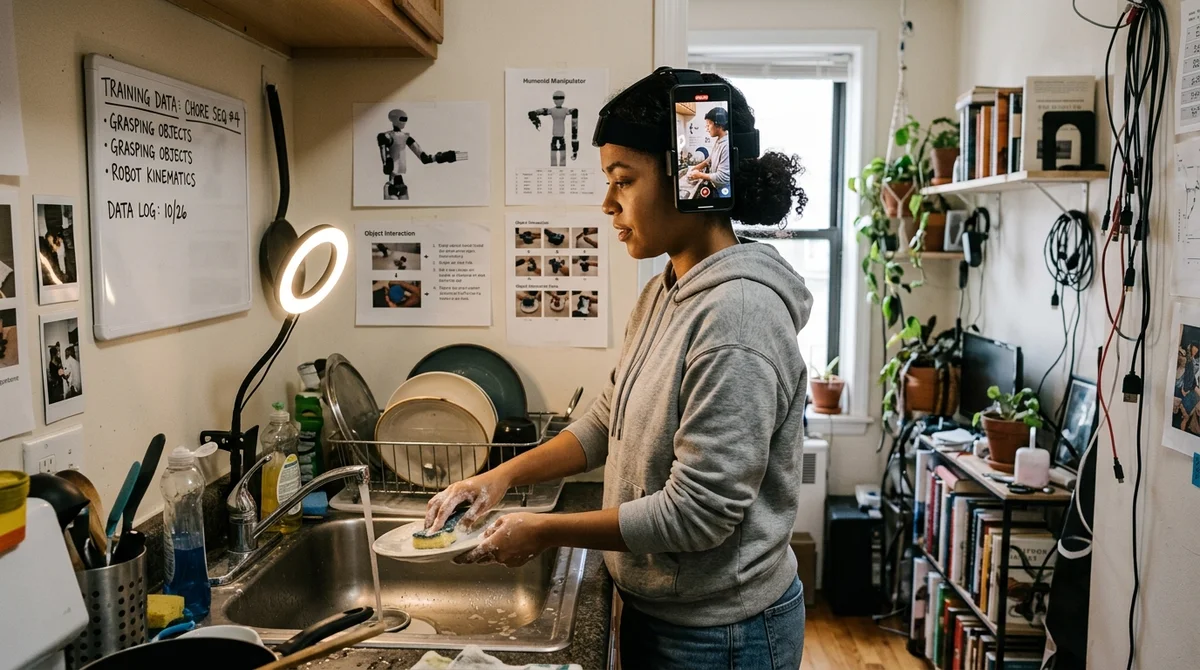
Training humanoid robots has hit obstacles not only in mechanics and chips, but in the shortage of real data about how humans move and handle objects at home. That's why a new market is rapidly growing around the industry: thousands of gig workers are recording ironing, cleaning, and cooking at home, and then these videos become training data for robots.
How the market works
One of these workers is Zeus, a medical student from Nigeria. After his hospital shift, he turns on a ring light, attaches his iPhone to his forehead, and records everyday actions from a first-person perspective. Micro1, a company from Palo Alto, collects such videos from contractors in more than 50 countries, including India, Nigeria, and Argentina, then sells them to robotics companies. Candidates are first screened by an AI assistant, and the videos themselves go through automatic and manual verification before labeling.
- folding clothes and ironing
- washing dishes and cleaning the kitchen
- cooking and working with utensils
- moving objects around the room
- simple navigation in tight home spaces
On the surface, this looks like very simple side work: you need to move naturally, keep your hands in frame, and repeat familiar household actions. But it's precisely in such videos that models learn to understand object grasping, changes in body position, and basic scenarios for interacting with things. For some workers, this is decent income: Zeus gets paid around $15 an hour. At the same time, the work quickly becomes monotonous, and in a small apartment it's hard to come up with enough new scenes and variations.
Why robots need this
The latest boom in robotics has largely grown out of the success of large language models. The industry logic is simple: if chatbots learned from huge volumes of text, then humanoid robots can also be trained on large volumes of movement data. The problem is that the physical world is far more complex than the internet. Simulations work reasonably well for walking or demonstration tricks, but they poorly capture the force of pressure, friction, imprecise movements, and the chaos of a real kitchen, bedroom, or warehouse.
According to Micro1 CEO Ali Ansari, robotics companies are already spending more than $100 million a year buying real data. In 2025, investors poured over $6 billion into humanoid robots, and it's not just Micro1 hunting for such data: similar programs are being developed by Scale AI and Encord, DoorDash pays couriers to film household tasks, and in China workers are being taught movements through VR headsets and exoskeletons in special centers. Even at this scale, the market is still only building data collection infrastructure.
"This will take longer than many think."
This assessment, which robotics experts in the material also share, well describes the current state of the market and industry expectations. Even tens and hundreds of thousands of hours of video don't yet look like sufficient volume for truly universal robots. The industry still has to figure out which data is actually useful, how many variations are needed for reliable training, and whether such a collection can be gathered without sharp cost increases and quality drops.
Where risks begin
The most obvious problem is privacy. Companies ask not to show faces, names, phone numbers, and other obvious identifiers. But even without them, the videos still capture the interior of an apartment, personal belongings, habits, children, neighbors, and daily routines. For workers with families, the task is especially awkward: you need to constantly watch to make sure a child or neighbor doesn't appear in the frame. As a result, "robot data" turns out to be a very detailed record of someone else's everyday life.
There's a second problem too—quality and transparency of the entire chain. Interviewed workers understand they're helping train robots, but often don't know how the recordings will be stored, who they'll be passed to, and whether they can later get them deleted. Roboticists, meanwhile, warn that household habits aren't always safe and aren't always suitable as a model for a machine. If a robot absorbs unsuccessful patterns from home videos, the errors will appear in actual work, and controlling this with a stream of videos from thousands of people is very difficult.
What this means
The boom in humanoid robots today is sustained not only by new models and hardware, but by a hidden market of manual labor that supplies the industry with data about everyday life. If companies want to bring home and industrial robots to mass adoption, they'll have to solve not only the training problem, but also questions of consent, privacy, and data quality. Otherwise, the "last mile" of automation will turn out to be much longer than presentations promise.
Want to stop reading about AI and start using it?
AI News is a curated feed of AI/tech news. Hamidun Academy teaches you to use AI systematically in your work.
The AI world, distilled — once a week
Seven stories that actually mattered, hand-picked. No noise, no reposts, no press releases.
Done! Check your inbox for a confirmation.