House Republicans Probe Airbnb and Anysphere Over Chinese AI Models
Republicans in the US House of Representatives have opened a review of how American companies use Chinese AI models, and Airbnb and Anysphere are among those named. For Washington this is no longer just a technology question but one of national security: Congress is looking harder at which foreign models are built into products, where data goes, and how far businesses depend on a Chinese AI stack. The concern reaches beyond the two companies. Generative AI has quickly moved from experimental tool to infrastructure for code, search, customer support and internal processes, so the origin of a model is becoming a political and legal issue.
AI-processed from Bloomberg Tech; edited by Hamidun News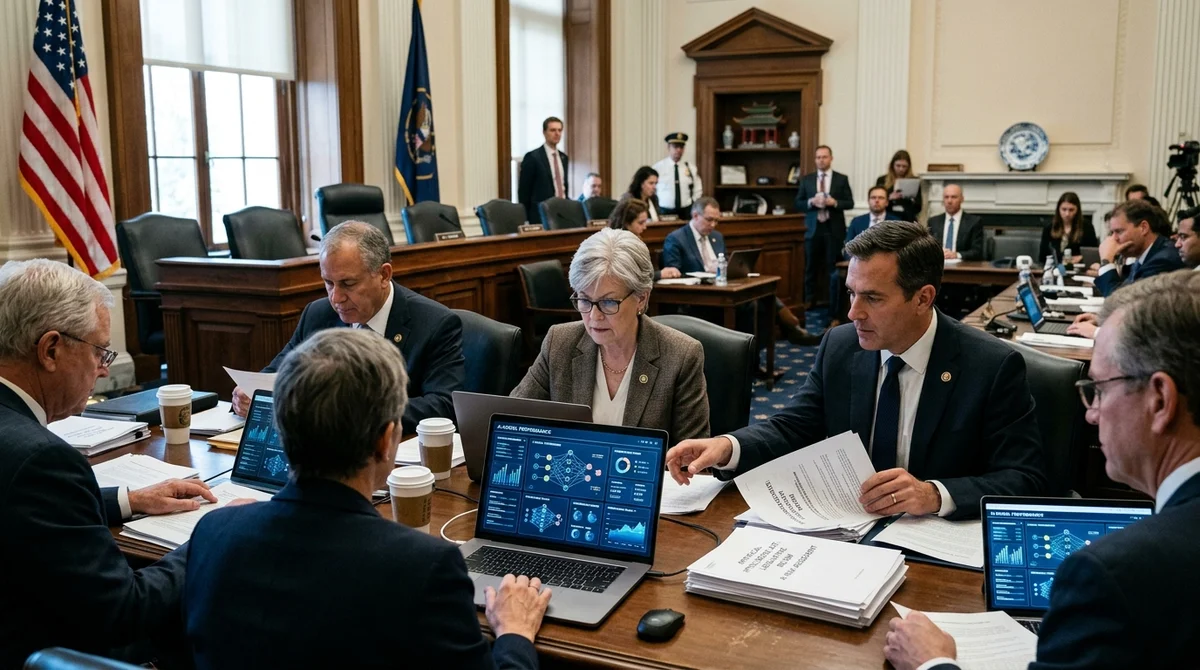
The US House of Representatives has opened a review of how American companies use Chinese artificial intelligence models. Airbnb and Anysphere are among those that have drawn Republican scrutiny. For Washington, this is no longer just a technology question but part of a broader dispute over national security and competition with Beijing.
What triggered the review
House Republicans are examining whether American technology companies use AI models of Chinese origin and how deeply those models are embedded in their products. The story matters beyond the specific companies named in the headline. Congress has long been strengthening its push to reduce dependence on Chinese technology in sensitive areas, and generative AI has quickly gone from an experimental tool to infrastructure for code, search, customer support and internal processes.
Washington's attention used to focus on chips, telecom equipment and apps. Now AI models are increasingly on that list. The reason is clear: a model is not just an algorithm but a layer through which corporate data, user queries and internal documents can pass. So lawmakers' question is broader than "which service did you use?" They want to know what risks arise when Chinese AI components run inside American products.
What risks they see
The published wording points to a general political direction: Congress wants to limit risks to US national security while also curbing Beijing's advance in the global AI race. In this context, attention goes beyond model quality or price to control over the technology supply chain. Judging by the logic of similar investigations, lawmakers care less about companies' marketing claims than about practical scenarios in which these models are used.
In practice, such concerns usually come down to a few questions. Lawmakers and regulators want to know where data goes, who controls model updates, how transparent training is, and whether such a vendor can be replaced quickly without halting the product. This logic drives objections to foreign AI components in sensitive use cases. For businesses, it is no longer a matter of engineers' taste but a topic for lawyers, security teams and boards of directors.
- transfer of sensitive data to a third-party model or infrastructure
- dependence of an American product on a foreign AI stack
- poor transparency about how the model was trained and is updated
- the possibility of political or regulatory restrictions in the future
The appeal for business is clear: Chinese models are often discussed as a cheaper or faster alternative to Western systems for certain tasks. But those savings could become a source of pressure if the US starts demanding stricter disclosure of architecture, suppliers and data-handling policies. The question then shifts quickly from efficiency to compliance: companies will have to explain not only why they chose a model, but also how they control its behavior, access and limits of use.
Why the companies are in the spotlight
The mention of Airbnb and Anysphere shows this is not about a single sector. Both large digital platforms and younger technology companies come under scrutiny if their products depend directly on AI. That is an important signal for the market: the review does not concern only defense contractors or government bodies, but a much wider range of businesses. If a tool is built into customer service, workflows or development, the origin of the model becomes a political and legal factor, not an internal engineering choice.
For the companies themselves, the main risk now is not an immediate ban but rising transparency requirements. They will likely have to describe in more detail which models they use, what data passes through them, and whether they can switch quickly to alternative providers if needed. Even if the investigation does not lead to immediate sanctions, it raises the cost of any decision tied to a Chinese AI stack. After this signal from Congress, boards and lawyers will almost certainly look at model choices much more critically.
What it means
The AI market is entering a phase where a strong model alone does not win; a clear provenance for the technology matters too. For American companies, choosing an AI provider is now tied not just to speed, quality and cost, but to geopolitics, security and regulatory risk. For the whole industry it is another sign that the split between US and Chinese AI ecosystems will deepen, and that checking a model's origin will become as routine a part of procurement as assessing price, quality and legal restrictions.
Key Questions Answered
What triggered the review?
House Republicans are examining whether American technology companies use AI models of Chinese origin and how deeply those models are embedded in their products. The story matters beyond the specific companies named in the headline. Congress has long been strengthening its push to reduce dependence on Chinese technology in sensitive areas, and generative AI has quickly gone from an experimental tool to infrastructure for code, search, customer support and internal processes. Washington's attention used to focus on chips, telecom equipment and apps. Now AI models are increas
What risks they see?
The published wording points to a general political direction: Congress wants to limit risks to US national security while also curbing Beijing's advance in the global AI race. In this context, attention goes beyond model quality or price to control over the technology supply chain. Judging by the logic of similar investigations, lawmakers care less about companies' marketing claims than about practical scenarios in which these models are used. In practice, such concerns usually come down to a few questions. Lawmakers and regulators want to know where data goes, who control
Why the companies are in the spotlight?
The mention of Airbnb and Anysphere shows this is not about a single sector. Both large digital platforms and younger technology companies come under scrutiny if their products depend directly on AI. That is an important signal for the market: the review does not concern only defense contractors or government bodies, but a much wider range of businesses. If a tool is built into customer service, workflows or development, the origin of the model becomes a political and legal factor, not an internal engineering choice. For the companies themselves, the main risk now is not an
Test Frontier LLMs & Autonomous Agents in One Workspace
Run Claude Opus 5.5, GPT-6, Gemini 3.1, and DeepSeek side-by-side in Nomad AI (nomadnet.ai) — unified model routing, deep research, and multimodal workflows under one subscription.
The AI world, distilled — once a week
Seven stories that actually mattered, hand-picked. No noise, no reposts, no press releases.
Done! Check your inbox for a confirmation.