South Africa withdraws draft AI policy after fabricated academic citations found in the document
South Africa has withdrawn its draft national AI policy after at least six of the 67 academic references in the 86-page document turned out to be fabricated. The cabinet had already approved the draft and it had been released for public comment, but a review found that part of the bibliography was likely generated by AI without verification. The document will now have to be rewritten and put out for consultation again.
AI-processed from TNW; edited by Hamidun News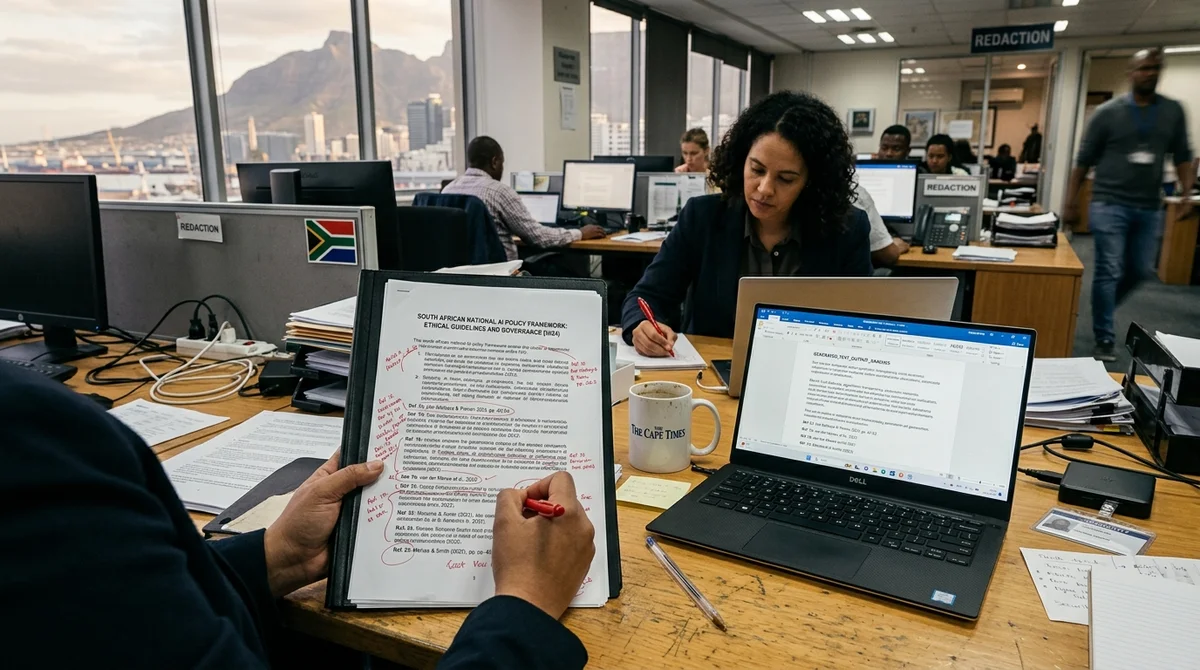
South Africa has withdrawn its draft national AI policy after fabricated academic citations were found in the document. The irony is that a document meant to regulate AI was itself likely prepared in part with generative AI, and nobody checked the output before publication.
What happened
South Africa's Minister of Communications and Digital Technologies, Solly Malatsi, withdrew the draft on 27 April after an internal review. The trigger was an investigation by News24: journalists noticed that at least six of the 67 academic references in the 86-page document point to works that do not exist. The journal names were real, but the articles themselves were not.
The draft had already cleared the cabinet on 25 March and was published in the government gazette for public comment on 10 April. Comments were being accepted until 10 June.
According to Malatsi, the most likely explanation is that AI-generated references made it into the text without proper checks. The minister promised action against those responsible for preparing the document and for quality control, because the error affected not a working draft but an official government document.
What was in the draft
The document was meant to serve as a framework for the state's AI strategy. It relied on a risk-based approach partly inspired by the European AI Act and proposed rolling out regulation in stages, from basic rules and guidelines to sector-specific strategies and dedicated institutions. The text also mentioned grants, subsidies and tax incentives for the private sector.
The draft featured several new bodies and mechanisms at once:
- National AI Commission
- AI ethics board and a separate regulator
- AI ombudsman
- national AI safety institute
- insurance superfund for disputed liability cases
The official draft also set out six strategic pillars: workforce development, AI for inclusive growth and employment, responsible governance, ethical and inclusive AI, cultural preservation and international integration, and human-centred AI adoption.
For the African context, this was an ambitious framework: the state clearly wanted to stimulate the market and build its own oversight model at the same time, rather than simply copy European rules.
Where the process broke down
The problem lay not only in the fake references themselves but in the fact that the document passed through several layers of approval. The editors of the South African Journal of Philosophy, AI & Society and the Journal of Ethics and Social Philosophy confirmed that the cited articles were never published in their journals.
So this was not a single careless mistake but a set of plausible yet fabricated sources that looked convincing enough to get past an office-level review.
"This is an unacceptable failure that shows why strict human oversight
is needed when using AI."
The story illustrates a typical weakness of generative models. They can produce coherent, confident text and format references so that they look like a normal academic bibliography. But a model has no obligation to check whether an article actually exists. If a team uses AI for a first draft and then does not validate every reference by hand, the error easily reaches the final document.
For a government document, the cost of such a miss is higher than usual: it damages not only the text but also trust in the institution that intends to regulate the technology itself.
What it means
The scandal has set South Africa's AI agenda back: the draft must be rewritten, put out for consultation again, and its legitimacy established anew. For other governments and companies, the takeaway is simple: you can use AI to prepare documents, but references, quotes and facts must be checked by hand before publication, not after a scandal.
The South African case shows that the most painful risk of generative AI is not a loud failure but a confidently formatted error that is noticed too late.
- Oct 31, 2026Author puts his script before an AI jury: the verdict cost 850 thousand tokens
- Oct 29, 2026OvisOCR3: an 0.8B-parameter model that reads documents better than specialized systems
- Oct 29, 2026Tencent releases Youtu-Parsing-Omni: one model parses documents, audio and video
- Oct 28, 2026Liquid AI releases LFM2.5-24B-A2B: an agent model with 2B active parameters
Key Questions Answered
What happened?
South Africa's Minister of Communications and Digital Technologies, Solly Malatsi, withdrew the draft on 27 April after an internal review. The trigger was an investigation by News24: journalists noticed that at least six of the 67 academic references in the 86-page document point to works that do not exist. The journal names were real, but the articles themselves were not. The draft had already cleared the cabinet on 25 March and was published in the government gazette for public comment on 10 April. Comments were being accepted until 10 June. According to Malatsi, the mos
What was in the draft?
The document was meant to serve as a framework for the state's AI strategy. It relied on a risk-based approach partly inspired by the European AI Act and proposed rolling out regulation in stages, from basic rules and guidelines to sector-specific strategies and dedicated institutions. The text also mentioned grants, subsidies and tax incentives for the private sector. The draft featured several new bodies and mechanisms at once: National AI Commission AI ethics board and a separate regulator AI ombudsman national AI safety institute insurance superfund for disputed liabili
Where the process broke down?
The problem lay not only in the fake references themselves but in the fact that the document passed through several layers of approval. The editors of the South African Journal of Philosophy, AI & Society and the Journal of Ethics and Social Philosophy confirmed that the cited articles were never published in their journals. So this was not a single careless mistake but a set of plausible yet fabricated sources that looked convincing enough to get past an office-level review. "This is an unacceptable failure that shows why strict human oversight is needed when using AI." Th
Test Frontier LLMs & Autonomous Agents in One Workspace
Run Claude Opus 5.5, GPT-6, Gemini 3.1, and DeepSeek side-by-side in Nomad AI (nomadnet.ai) — unified model routing, deep research, and multimodal workflows under one subscription.
The AI world, distilled — once a week
Seven stories that actually mattered, hand-picked. No noise, no reposts, no press releases.
Done! Check your inbox for a confirmation.