Two Democratic Alliance Ministers in South Africa Caught Up in Scandal Over AI Errors
Two Democratic Alliance (DA) ministers in South Africa are at the center of a scandal over AI hallucinations in official documents. Solly Malatsi withdrew a draft national AI policy containing fictitious references, and Leon Schreiber suspended two officials after a similar case in an immigration document. The party now demands that mandatory, formal review of materials be introduced urgently across all departments.
AI-processed from Bloomberg Tech; edited by Hamidun News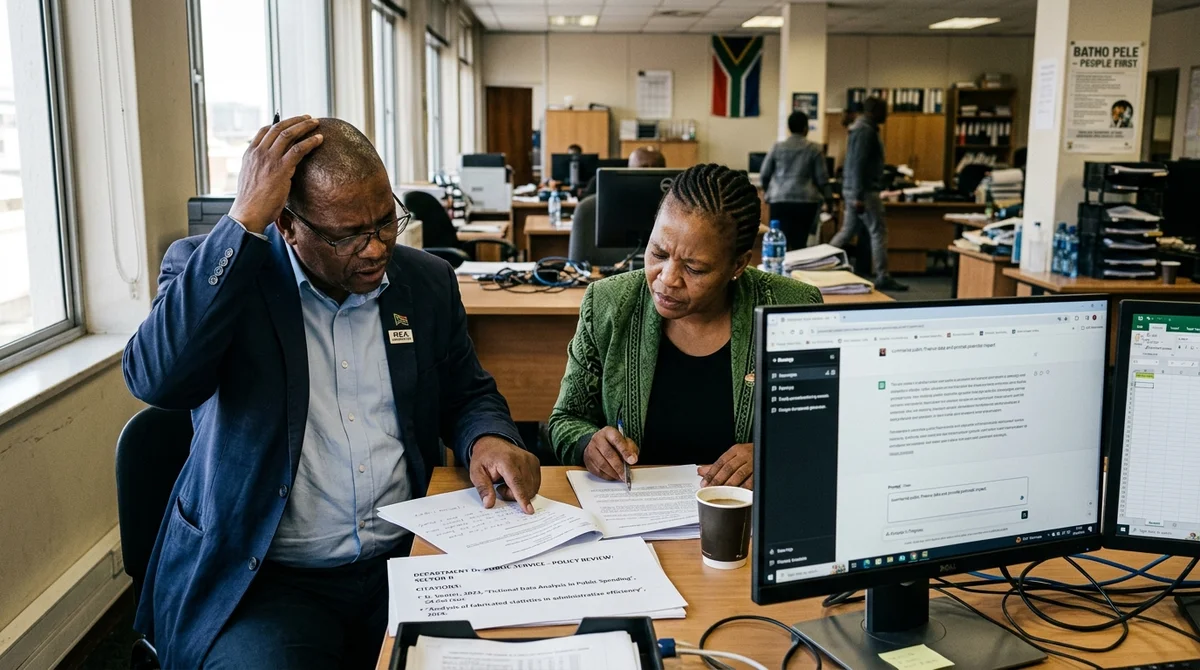
South Africa's government has received a rare and painful example of how AI hallucinations turn from an abstract risk into a political scandal. In a single week, unreliable references in official documents put two Democratic Alliance ministers under pressure.
Two failures in a row
The story is especially awkward for the Democratic Alliance. The party has been part of the ruling coalition since 2024 as its second-largest force, and it consistently pushes the idea of technological modernization of the state. Against that backdrop, the string of errors looks less like an isolated slip by officials and more like a blow to the party's own political thesis: if you promise to make the civil service faster and smarter with new tools, you must be the first to show you can control their quality.
On 30 April, Home Affairs Minister Leon Schreiber suspended two senior officials after references resembling AI hallucinations were found in a cabinet-approved immigration policy document. On 26 April, Minister of Communications and Digital Technologies Solly Malatsi was forced to fully withdraw the draft national AI policy that had been put out for public comment. The irony is that the problems turned up in the very document meant to set the rules for responsible use of artificial intelligence.
How the errors were found
The scandal over the draft AI policy began after journalists and experts checked the reference list at the end of the document. The 86-page draft, published on 10 April 2026 after cabinet approval on 25 March, contained 67 references. At least some of them turned out to be fictitious: the journals either had not published the cited articles, or the titles themselves looked model-generated. The ministry ultimately acknowledged that AI-generated citations had most likely made it into the text without proper manual verification, and the document lost credibility before consultations had even ended.
The document itself was ambitious: it proposed creating several new bodies to regulate AI, including a national commission, an ethics board, a safety institute and a special insurance fund to cover damage from such systems. So the scandal hit not only the form but also the substance: discussion of the regulatory architecture almost immediately faded into the background, because no trust in the original text remained.
"This should not have happened.
We will learn this lesson with humility," Malatsi said.
Four days later, a similar problem surfaced in another department, in the draft revised white paper on citizenship, immigration and refugee protection. That document also carried high status: it had already passed cabinet and was described as the biggest overhaul of the migration system in a generation. When questionable references were spotted there too, the story stopped looking like a one-off lapse by a single department. It became a signal that AI may be used in government faster than procedures for checking its output are being developed.
The political cost of the error
For the government of national unity, this is an unpleasant episode on several levels. First, it damages the reputation of ministers who came in promising more discipline and technological competence. Second, it hands opponents a ready-made argument against accelerated AI adoption in public administration. Third, it delays the regulatory debate itself: instead of discussing the architecture of future policy, the country has to work out who allowed unreliable data into official papers, and how.
- urgent checks of references and annexes in current draft policies
- mandatory verification of AI-generated materials during document approval
- internal investigations and disciplinary measures in two departments
- delay to the new version of the national AI policy
- growing distrust of the claim that digitalization by itself makes the state more efficient
Still, the occasion for the dispute does not negate the underlying problem the party raised earlier. The South African civil service does suffer from slow processes and weak quality control. But this story showed an uncomfortable fact: generative models do not fix bureaucracy automatically. If a chatbot layer is simply laid over old procedures, errors will not disappear, they will just look more convincing.
What this means
The South African case is a good maturity test for any government or business already building generative AI into its workflows. A model can speed up a draft, suggest wording and assemble a structure, but it bears no responsibility for facts. The more official the document and the higher the cost of error, the more important manual checking of references, sources and conclusions becomes. Otherwise AI stops being a tool of efficiency and becomes a factory of plausible failures.
- Oct 31, 2026Author puts his script before an AI jury: the verdict cost 850 thousand tokens
- Oct 29, 2026OvisOCR3: an 0.8B-parameter model that reads documents better than specialized systems
- Oct 29, 2026Tencent releases Youtu-Parsing-Omni: one model parses documents, audio and video
- Oct 28, 2026Liquid AI releases LFM2.5-24B-A2B: an agent model with 2B active parameters
Key Questions Answered
What are the key details on Two failures in a row?
The story is especially awkward for the Democratic Alliance. The party has been part of the ruling coalition since 2024 as its second-largest force, and it consistently pushes the idea of technological modernization of the state. Against that backdrop, the string of errors looks less like an isolated slip by officials and more like a blow to the party's own political thesis: if you promise to make the civil service faster and smarter with new tools, you must be the first to show you can control their quality. On 30 April, Home Affairs Minister Leon Schreiber suspended two s
How the errors were found?
The scandal over the draft AI policy began after journalists and experts checked the reference list at the end of the document. The 86-page draft, published on 10 April 2026 after cabinet approval on 25 March, contained 67 references. At least some of them turned out to be fictitious: the journals either had not published the cited articles, or the titles themselves looked model-generated. The ministry ultimately acknowledged that AI-generated citations had most likely made it into the text without proper manual verification, and the document lost credibility before consult
What are the key details on The political cost of the error?
For the government of national unity, this is an unpleasant episode on several levels. First, it damages the reputation of ministers who came in promising more discipline and technological competence. Second, it hands opponents a ready-made argument against accelerated AI adoption in public administration. Third, it delays the regulatory debate itself: instead of discussing the architecture of future policy, the country has to work out who allowed unreliable data into official papers, and how. urgent checks of references and annexes in current draft policies mandatory verif
Ship AI Faster with Founders, Engineers & Weekly Architecture Reviews
Inside Vibe Club (hamidun.com/club) — weekly live masterminds with Zhemal Khamidun, Tech Radar, full LMS access, and 370+ production Claude Code skills.
The AI world, distilled — once a week
Seven stories that actually mattered, hand-picked. No noise, no reposts, no press releases.
Done! Check your inbox for a confirmation.