Australia's Federal Court warns lawyers of sanctions for AI errors in cases
Australia's Federal Court has issued guidance on the use of generative AI in court proceedings. The court does not ban such tools, but it warns plainly: if a lawyer brings fabricated citations, factual errors or distorted arguments into a case, the consequences may be not only reputational but also financial or procedural. The trigger was a rising number of filings containing fake, AI-generated references.
AI-processed from Guardian; edited by Hamidun News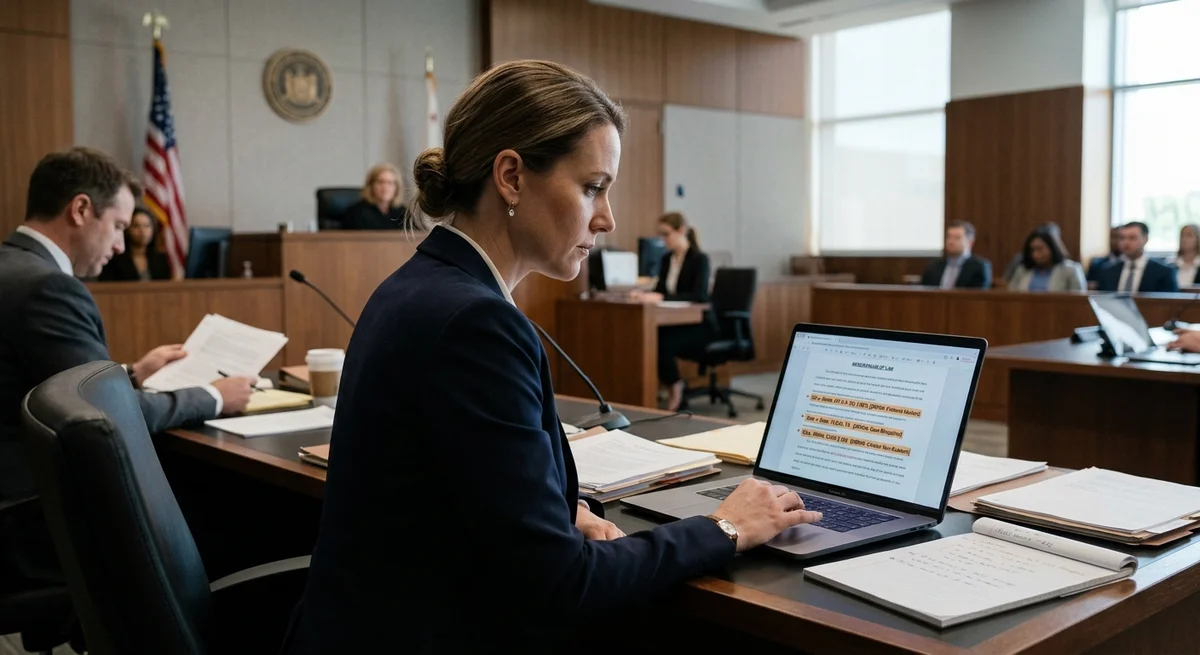
Australia's Federal Court has sent the legal community an unambiguous signal: generative AI is acceptable in court, but a human is still responsible for every word in the filed materials. The court's new guidance does not ban the technology. It does warn that errors, invented citations and other failures caused by neural networks may result in financial sanctions or other legal consequences for lawyers if they disrupt the proper handling of a case.
The court issued a separate practical note on how generative AI can be used in court proceedings. The trigger was a growing number of documents containing false quotations, nonexistent decisions, incorrect references to legal provisions and other errors produced by a model and missed by a human. The problem has long since stopped being local: similar cases are recorded not only in Australia but in other countries, where lawyers, litigants and even experts are building AI into their daily work faster than they can set up rules for checking the output.
The key point of the new guidance is that the court is not fighting the technology itself. On the contrary, the document stresses that the legal profession can use modern tools if it does so in good faith and does not replace professional judgment with a machine-made draft. AI can speed up drafting, help find wording, summarize large bodies of text or organize case materials. But once such a tool presents fiction as fact and a lawyer carries it into an official procedural document, the problem is no longer technical. It becomes professional and ethical.
The warning against misleading the court is especially stern. If AI-generated errors hinder proceedings, raise costs, delay timelines or force the court and the other side to spend time checking nonexistent references, the consequences can be quite tangible. This is not only about reputational damage to a particular lawyer or firm, but also about financial or legal measures by the court. That is an important emphasis: the excuse "the neural network generated it" is not treated as a defense, because the duty to verify the accuracy of filed materials does not go away.
For Australia, the issue is no longer theoretical. As early as 2025, the country discussed the first notable case in which a lawyer was punished for using fabricated AI-generated references. Episodes like this created the sense that occasional reminders about professional diligence were no longer enough. The court had to move to a more direct and formalized regime: the technology is allowed, but the limits of responsibility are set in advance. That helps both participants in the process and judges, because it narrows the room for dispute over where acceptable automation ends and bad-faith submission of materials begins.
The broader meaning of the step is that the judicial system is trying to preserve basic trust in the documents on which proceedings rest. If model hallucinations start entering the process en masse, it is not only the quality of individual claims or motions that suffers. The very principle by which a court assumes that a text signed by a lawyer has passed minimal professional verification gets eroded. In practice this means extra delays, unnecessary costs for the parties and a heavier load on court staff, who have to spend resources not on assessing the dispute on its merits but on filtering out machine-made junk.
The decision is unlikely to stop the use of AI in the legal industry, but it sets more grown-up rules of the game. Courts need not a rejection of the technology but a clear boundary of responsibility: using it is fine, shifting verification onto the model is not. For the market, it is one more signal that a professional's value is now defined not by access to AI but by the ability to filter out errors, confirm facts and avoid turning a quick draft into a courtroom risk.
Test Frontier LLMs & Autonomous Agents in One Workspace
Run Claude Opus 5.5, GPT-6, Gemini 3.1, and DeepSeek side-by-side in Nomad AI (nomadnet.ai) — unified model routing, deep research, and multimodal workflows under one subscription.
The AI world, distilled — once a week
Seven stories that actually mattered, hand-picked. No noise, no reposts, no press releases.
Done! Check your inbox for a confirmation.