Guidesly shows how Jack AI on AWS turns trip media into reports and marketing
Guidesly has shown how to turn photos, video and trip data into a finished report without manual assembly. Its Jack AI system on AWS ties media to trip context, uses computer vision and generative models, then prepares marketing materials for different channels. It is an example of AI built for a specific operational task, not for a demo.
AI-processed from AWS Machine Learning Blog; edited by Hamidun News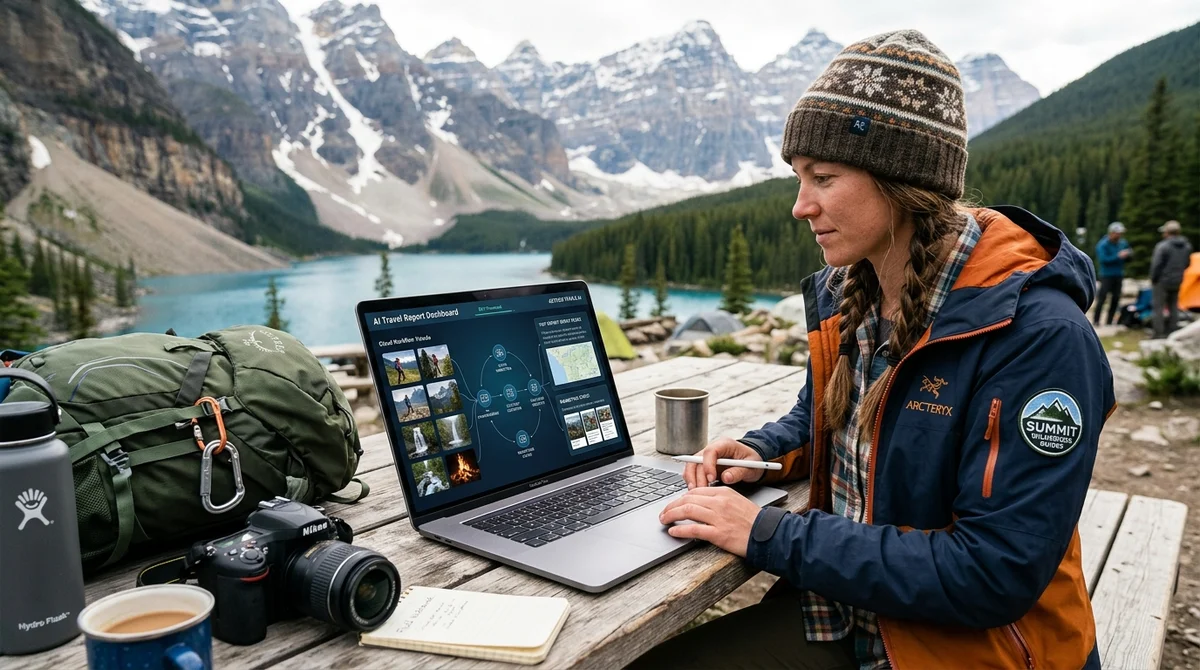
Guidesly has turned guides' routine post-trip work into an automated AI pipeline: Jack AI collects photos, video and related trip data, analyzes them with computer vision and generative models, and then produces ready-made reports and promotional materials. Guides are left with less manual editing, and the business gets a way to quickly turn field material into content that can be published across different channels.
For Guidesly, the goal was not simply to generate attractive text from a few images. The platform had to tie media to the context of a specific trip: who led the group, where and when the outing took place, which activities happened, what conditions the route presented, and what is worth pulling into the final story. This matters especially in the outdoor segment, where the quality of the story affects not only audience engagement but also sales of future tours, bookings and trust in the guide.
Guidesly built the architecture on a set of managed AWS services. AWS Lambda and AWS Step Functions handle event intake and processing, which lets it split the process into sequential stages instead of keeping everything in one monolith. Media files and intermediate artifacts are stored in Amazon S3, and structured trip data in Amazon RDS. Amazon SageMaker AI and Amazon Bedrock come next in the chain: the former helps with ML components and data processing, the latter with generative models that turn the recognized context into texts, descriptions and marketing-ready materials.
The key idea of the pipeline is not to limit generation to the image alone. The system first collects the source photos and videos, then enriches them with additional trip data, and then applies computer vision to extract facts and objects from the media. On that basis, the LLM can write not abstract text but a report that better reflects the customer's actual experience: where the fishing trip or hike took place, what happened during the day, and which moments are worth showing to prospective new customers. That makes the output useful not just as an internal note but as ready material for a website, newsletter or social media.
The operational layer matters separately. Guidesly is betting on security, reliability and scalability, because working with user photos, video and commercial content quickly runs into questions of access, storage and pipeline predictability under load. Serverless components and managed AWS services let the team avoid spending resources on its own infrastructure and focus on product logic: task orchestration, recognition quality and the tone of the final materials. For the company, it is also a way to add new publishing channels faster without reworking the entire system.
From a product standpoint, the Guidesly case shows an important shift: the value of generative AI increasingly arises not in a standalone chat interface but inside a specific vertical workflow. Here the model does not merely answer a user's question; it completes a business process from uploading raw content to publishing a marketing-ready result. For travel and outdoor services this is especially telling: the most valuable data originates in the field, and the winner is whoever turns it into a clear story and a commercially useful asset fastest.
The main takeaway is that Jack AI is not AI for AI's sake but an example of how generative AI, computer vision and cloud orchestration combine into an applied service with measurable benefits. If this approach catches on more widely, the next step will be industry AI pipelines that automatically turn unstructured materials into ready-made reports, cards, emails and sales content.
- Nov 2, 2026Anthropic needs to grow revenue 32% a year to cover $850 billion in contracts
- Nov 2, 2026The Verge reviewer builds a $50 Meta Muse Charm alternative with Claude Code
- Oct 31, 2026Worldwide Express hands disputed invoices to AI agents and cuts unresolved disputes by 75%
- Oct 31, 202610 million people have activated Meta's Muse agent, but Hilton and eBay barely see any orders
Test Frontier LLMs & Autonomous Agents in One Workspace
Run Claude Opus 5.5, GPT-6, Gemini 3.1, and DeepSeek side-by-side in Nomad AI (nomadnet.ai) — unified model routing, deep research, and multimodal workflows under one subscription.
The AI world, distilled — once a week
Seven stories that actually mattered, hand-picked. No noise, no reposts, no press releases.
Done! Check your inbox for a confirmation.