Palantir and Thales compete for the FAA's AI air traffic management tool
The FAA has launched a competition among Palantir, Thales and Air Space Intelligence for a new AI tool to manage air traffic. It is a decision-support system that could help controllers spot congestion earlier, forecast delays more accurately and respond faster to disruptions. For US aviation, it signals that AI is moving closer to critical infrastructure.
AI-processed from Bloomberg Tech; edited by Hamidun News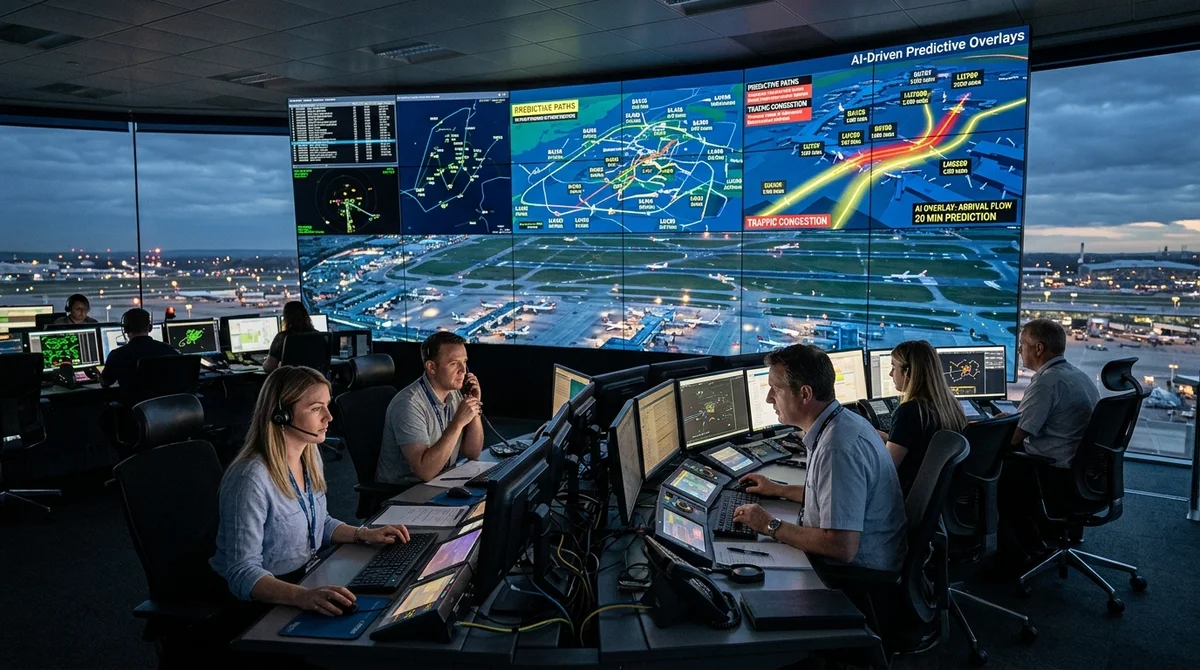
The FAA is launching a competition among Palantir, Thales and Air Space Intelligence for a key AI tool for air traffic management, and the stakes are far higher than in an ordinary IT contract. If the regulator picks the right solution, the US aviation system could gain a new layer of forecasting and coordination in places where weather, airport congestion and tight schedules too often turn into delays, cancellations and cascading disruptions across the network.
According to available information, the US Federal Aviation Administration has brought Palantir Technologies, Thales and Air Space Intelligence into a competition for a new artificial intelligence tool for air traffic management. This is not a public chatbot for passengers. It is an internal system meant to give a clearer view of air traffic conditions and speed up operational decisions. The competition format matters in itself: the FAA is not betting on a single vendor in advance, but comparing different technological approaches, experience with critical infrastructure and the ability to deploy solutions in an environment where the cost of error is especially high.
For the FAA, such a system looks like a pragmatic investment. US air traffic management depends on a huge number of variables: weather, the load at specific airports, route restrictions, airline schedules, runway availability and many local factors that change quickly during the day. Even when controllers and operators have enough data, it still has to be assembled into a clear picture and turned into an action plan. That is why AI is seen here mainly as a decision-support system: it can flag bottlenecks in advance, assess scenarios for redistributing traffic flows, help forecast delays and shorten reaction time to disruptions, without taking humans out of the control loop.
The contestants themselves show what the regulator may be looking for. Palantir is known for platforms that handle large data sets and complex analytics in government and corporate projects. Thales has worked for decades in aviation, defense, and systems tied to safety and navigation. Air Space Intelligence specializes in software tools for aviation operations and real-time decision optimization. In this lineup, the FAA is effectively comparing three strengths: data integration, industry expertise and narrower product specialization. For the regulator, it is a logical way to learn which approach delivers the biggest effect not in a presentation, but under real network load.
The FAA's interest in such tools reflects a broader shift: artificial intelligence is increasingly treated not as a showcase technology but as a working layer for critical processes. This is especially visible in aviation, because the industry depends on accuracy, resilience and speed of response all at once. Building new airports, extending runways or radically increasing staff cannot be done quickly, while improving forecasting and coordination through software is far more realistic. That is why regulators, airlines and technology vendors are testing more and more tools that do not just collect data but propose actions before a problem grows into a large-scale operational crisis.
The main takeaway is that the FAA already views AI not as a fringe experiment but as a candidate for an infrastructure tool. If the competition leads to a working deployment, the winner will not be the only beneficiary: the entire US air traffic system could gain a more predictable and resilient management model. But the deciding factor will be not the prominence of a participant's name, but the ability to prove reliability, transparency and practical value under real aviation workloads. That is the stage at which it will become clear whether the market can offer the FAA not a polished demo, but a tool for daily operations.
Ship AI Faster with Founders, Engineers & Weekly Architecture Reviews
Inside Vibe Club (hamidun.com/club) — weekly live masterminds with Zhemal Khamidun, Tech Radar, full LMS access, and 370+ production Claude Code skills.
The AI world, distilled — once a week
Seven stories that actually mattered, hand-picked. No noise, no reposts, no press releases.
Done! Check your inbox for a confirmation.