Shanghai: When Ordinary AI Is No Longer Enough for Global Dominance
Shanghai is officially switching to "the future is already here" mode. Mayor Gong Zheng presented the 2025 development plan, shifting the emphasis from plain software to heavy hardware and infrastructure. The priorities are the low-altitude economy, satellite internet and smart electric cars. The city plans not just to deploy AI, but to integrate it into traditional steel and petrochemical production. This is not just an official's report. It is a roadmap for how China intends to work around technology sanctions by building a closed ecosystem from the seafloor to orbit. The key point: Shanghai is laying the foundation for full technological autarky.
AI-processed from 36Kr (36氪); edited by Hamidun News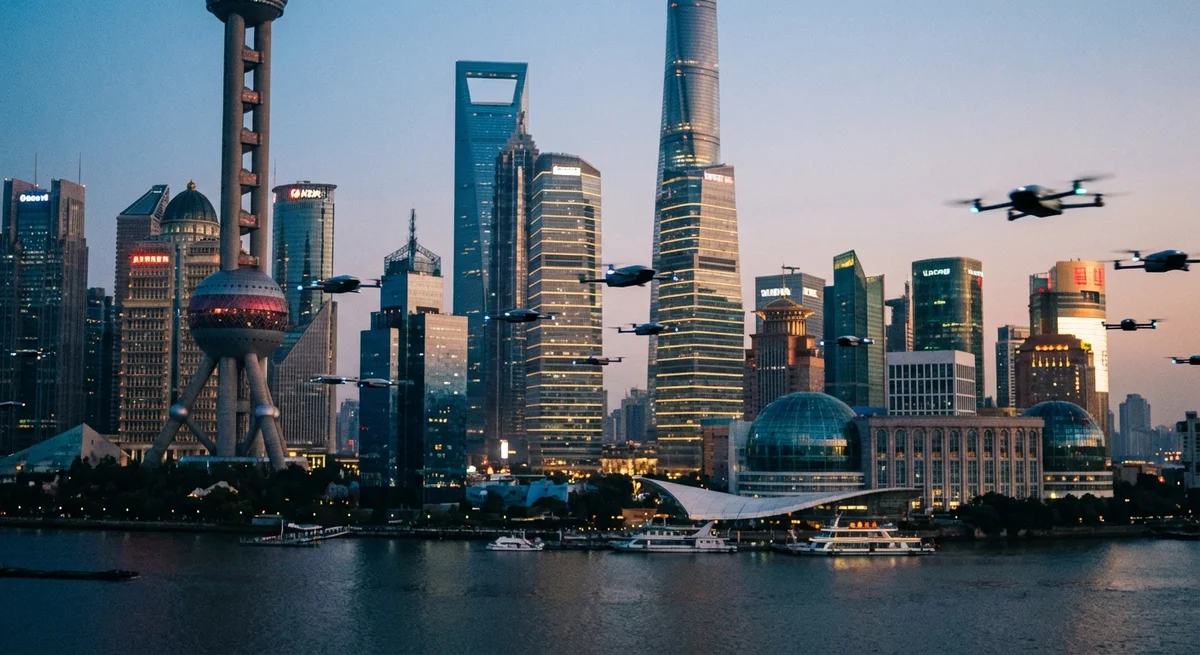
While the rest of the world argues about whether ChatGPT will replace programmers, Shanghai has decided to play big. At the opening of the fourth session of the 16th Municipal People's Congress, Mayor Gong Zheng presented not just a progress report but a genuine manifesto of technological expansion. If you thought China was slowing down, the news from Shanghai suggests the opposite: the city intends to become a global epicenter of what it calls a "modern industrial system". This is not about neural networks writing poems. It is about the real economy, which will now run on steroids made of algorithms and satellite connectivity.
Context matters more than the figures here. Shanghai outgrew its status as a mere financial hub long ago. Facing constant pressure from the West and restrictions on chip exports, China's leadership is betting on vertical integration. When the mayor talks about supporting integrated circuits and biopharmaceuticals, he means building supply chains that cannot be cut from outside.
But the most interesting part lies in the new terms now officially written into this year's development plans. Shanghai is heading toward the "low-altitude economy" and satellite internet.
What is the low-altitude economy? Picture the sky over a megacity filled not only with smog but with thousands of autonomous drones and air taxis. It is a huge market for logistics and passenger transport, and it requires not only the aircraft themselves but also a highly sophisticated AI-based air traffic management system. Shanghai plans to become the first city where the concept of a "smart sky" is an everyday reality.
At the same time, the city is investing in satellite internet, clearly trying to create a viable alternative to Starlink. This is critical for controlling those same drones and for providing connectivity anywhere in the ocean, which brings us smoothly to another priority: the maritime economy.
Interestingly, the authorities have not forgotten the "old guard". Instead of simply shutting down factories, Shanghai plans to introduce digital intelligent technologies into steel and petrochemical production. It is an attempt to make traditional industry "green" and efficient through deep automation. In effect, the city is building a giant neural network in which factories, cars, satellites and ships are linked in a single digital loop. Artificial intelligence acts here not as a standalone product but as glue binding all these industries into one organism.
Particular attention goes to intelligent connected new-energy vehicles. Shanghai already hosts the largest electric car plants, but the task is now broader: make them fully autonomous and integrated into the city's infrastructure. This means that in the coming years we will see mass deployment of V2X technologies (vehicle-to-everything communication), in which a car talks to traffic lights, other cars and even the road surface in real time. This requires enormous computing power, which the city also plans to expand by building specialized digital industry clusters.
The key point: Shanghai has stopped playing catch-up and started building the infrastructure of the future, which the West so far discusses only in theory. Can the city digest such ambitions amid a global economic cooldown?
- Nov 2, 2026Meta's Muse assistant keeps dossiers on loved ones and gets root on Ubuntu by default
- Nov 1, 2026Local models lose to Opus and Codex: 0.21 on a MacBook versus 1.00 for Codex
- Nov 1, 2026Kimi scores 96.2% on a 1C database analytics test and emerges as a fallback if Claude access is blocked
- Nov 1, 2026OpenAI Rewrites GPT Behavior Rules: Five Values and a Chain of Command
Test Frontier LLMs & Autonomous Agents in One Workspace
Run Claude Opus 5.5, GPT-6, Gemini 3.1, and DeepSeek side-by-side in Nomad AI (nomadnet.ai) — unified model routing, deep research, and multimodal workflows under one subscription.
The AI world, distilled — once a week
Seven stories that actually mattered, hand-picked. No noise, no reposts, no press releases.
Done! Check your inbox for a confirmation.