Shanghai Bets on "AI+": 50 New Factories and an Army of Digital Agents
Shanghai is officially shifting into "AI+" mode. Mayor Gong Zheng announced a plan to build more than 50 advanced smart factories this year. It is not just a machine upgrade but a systemic overhaul, from computing capacity to industry-specific datasets and vertical models. While the rest of the world argues about chatbots, China is wiring neural networks into production lines and terminals. The main goal is to create an environment for AI-native startups and turn industry into an autonomous system. Industrial AI looks set to become the new national sport of the Middle Kingdom.
AI-processed from 36Kr (36氪); edited by Hamidun News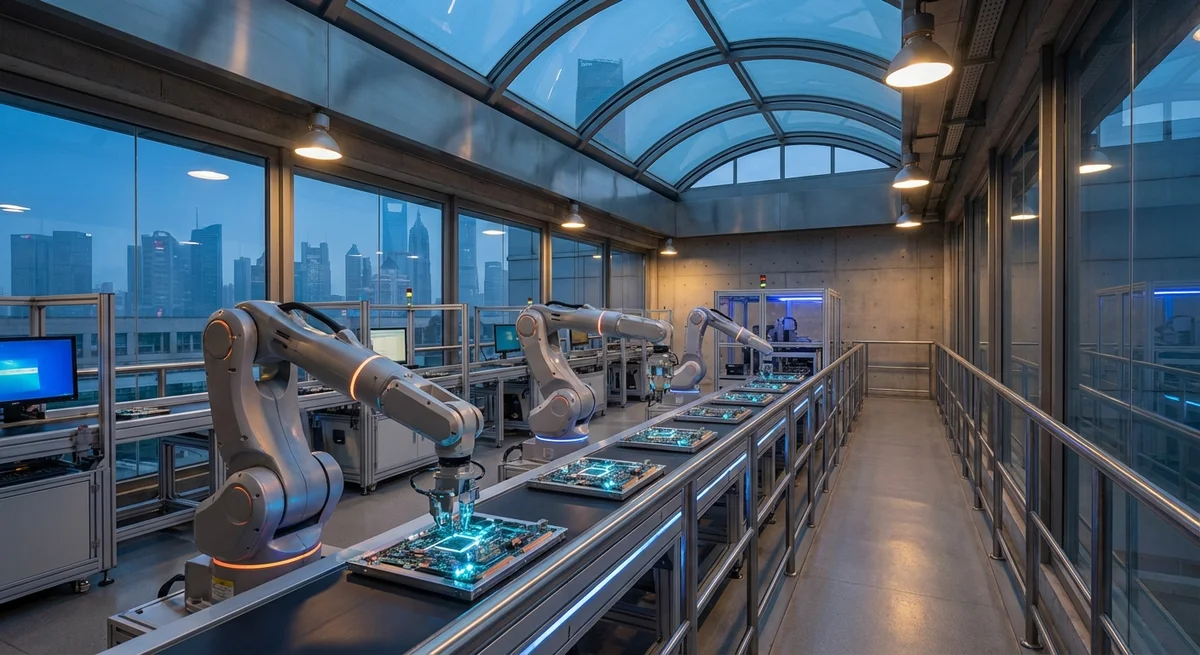
While we amuse ourselves generating pictures and debating whether ChatGPT will replace copywriters, Shanghai has decided it is time to put neural networks to work at real machine tools. At the opening of the session of the city's People's Congress, Shanghai Mayor Gong Zheng presented a report that reads more like a plan to seize the technological future than a dull bureaucratic document. The city is officially committing to deep adoption of the "AI+" strategy. That means artificial intelligence stops being a gimmick for IT people and becomes the foundation of the whole metropolis's economy.
Let's look at what stands behind the numbers. The plan for this year is to launch more than 50 advanced smart factories. But don't assume these are just workshops with a couple of robotic arms. The aim is a full-fledged infrastructure. Shanghai plans to invest aggressively in computing capacity and, far more interestingly, in industry-specific data corpora, or a "language environment" for industries. China understands well that for a neural network to grasp how to smelt steel or assemble microchips, it needs not general knowledge from the internet but specific data from real production sites. This is where its main competitive advantage lies.
The report paid particular attention to so-called vertical models. Unlike general-purpose models that do a little of everything, these solutions are tuned for specific tasks, from logistics to fine chemicals. Alongside them come intelligent agents. These are no longer mere algorithms but autonomous entities able to make decisions in real time. Shanghai wants such agents to run terminals, warehouses and production chains without excessive human involvement. In effect, the city is building a giant living organism in which AI is both brain and nervous system.
Why does this matter right now? China is clearly trying to leap past simple automation straight into the era of "smart manufacturing". After several years of pressure on tech giants, the government seems to have found the ideal use for their technology. Innovation must now serve not only food delivery or ad sales but also higher efficiency in heavy industry. It is an attempt to build the so-called "new productive forces" that are discussed in every office in Beijing. If the plan works, Shanghai will become not just a financial hub but the world's leading exporter of ready-made solutions for autonomous industry.
Interestingly, the city authorities are betting on AI-native business formats. They expect companies that build their processes around the capabilities of artificial intelligence from the start, rather than bolting it onto old methods. The mayor explicitly stated support for new types of terminals and devices that will run on AI. That opens a huge market for hardware and software developers. While Western regulators increasingly think about how to restrain AI, Shanghai is creating conditions in which neural networks are handed the keys to the factory gates and told: "Go ahead."
Of course, serious challenges lie behind the ambitious plans. Building 50 factories is only half the battle. It is far harder to supply them with enough chips under sanctions and to find specialists able to combine classic manufacturing with deep learning. Still, Shanghai has always been the showcase of Chinese capitalism, and if this experiment can succeed anywhere, it is here. All we can do is watch how quickly the "AI+" slogan turns from a line in a government report into the real roar of autonomous conveyors.
The bottom line: China is moving from "software for entertainment" to "software for factories." Will the rest of the world be able to compete with an industry run by self-learning algorithms, or will we stay in the era of manual control?
- Nov 2, 2026Meta's Muse assistant keeps dossiers on loved ones and gets root on Ubuntu by default
- Nov 1, 2026Local models lose to Opus and Codex: 0.21 on a MacBook versus 1.00 for Codex
- Nov 1, 2026Kimi scores 96.2% on a 1C database analytics test and emerges as a fallback if Claude access is blocked
- Nov 1, 2026OpenAI Rewrites GPT Behavior Rules: Five Values and a Chain of Command
Test Frontier LLMs & Autonomous Agents in One Workspace
Run Claude Opus 5.5, GPT-6, Gemini 3.1, and DeepSeek side-by-side in Nomad AI (nomadnet.ai) — unified model routing, deep research, and multimodal workflows under one subscription.
The AI world, distilled — once a week
Seven stories that actually mattered, hand-picked. No noise, no reposts, no press releases.
Done! Check your inbox for a confirmation.