Palantir, Thales and Air Space Intelligence compete for FAA's AI air traffic contract
The FAA wants to shift air traffic control from a reactive model to a predictive one. To get there, it is launching SMART, an AI system meant to spot conflicts two hours ahead instead of today's 15 minutes. Palantir, Thales and Air Space Intelligence are competing for the contract. The project gained urgency after a March incident at LaGuardia exposed overloaded controllers and aging systems.
AI-processed from TNW; edited by Hamidun News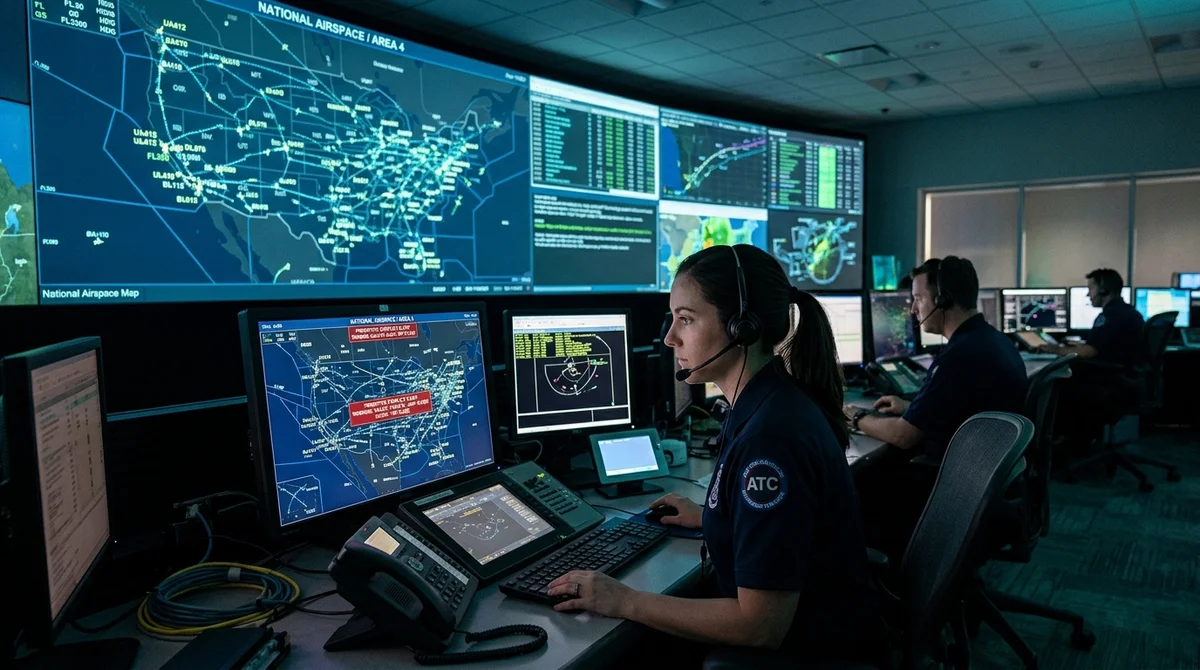
The FAA is opening a competition for one of the most sensitive AI systems in US critical infrastructure. The SMART platform is supposed to help controllers see potential conflicts in the air two hours ahead, rather than the 15 minutes they get today. Palantir, Thales and Air Space Intelligence are competing for the contract, and the stakes go beyond a new government deal: this is an attempt to rebuild the underlying logic of how American airspace is managed.
SMART stands for Strategic Management of Airspace Routing Trajectories. The idea is to move from a reactive model, where controllers solve problems almost in real time, to a predictive one, where the system calculates bottlenecks, route conflicts and capacity constraints before aircraft even take off. The FAA plans to rely on high-precision 4D modeling for this, meaning it analyzes trajectories not only in space but also in time. If the project goes to plan, SMART could go live, at least in limited form, as early as 2026.
Each of the three bidders brings its own strength. Palantir arrives with a deep portfolio of government contracts and experience building platforms that ingest huge volumes of operational data and turn them into decision-making interfaces. A SMART win would give the company an important foothold in yet another nationwide civilian agency.
Thales is betting on industry expertise. The company has supplied aviation systems for decades, and its equipment is already deeply embedded in American infrastructure. According to the FAA, Thales products are used in more than 99% of instrument landing systems at US airports, which gives it an edge on integration.
The third contender, Air Space Intelligence, is much smaller but looks like the most specialized player in the race. The Boston startup develops the Flyways AI platform, which airlines already use and which helps manage more than 40% of US air traffic through partnerships with major carriers. That is what makes ASI a dangerous rival for the giants: the company has not just an AI team, but a product already running in a live aviation environment. The startup also recently announced a partnership with Joby Aviation to prepare for integrating electric air taxis into the national airspace.
The project became far more urgent after a March 22 incident at LaGuardia Airport, where an Air Canada Express plane collided with a fire truck on the runway. The investigation found that the controller was handling two roles at once, and that the automated runway safety system did not issue a warning because it could not reliably track the situation as the vehicles converged near the runway. The episode was a painful reminder of two long-standing problems in American aviation: chronically overloaded controllers and infrastructure that has long failed to keep pace with flight volumes.
Against that backdrop, SMART is part of a much broader overhaul. The FAA has already received $12.5 billion from Congress to modernize air traffic control and estimates it will need another $20 billion to finish the program. The agency is replacing 612 outdated radar systems, moving the NOTAM system to a cloud architecture and accelerating hiring: about 1,200 new controllers have already been hired in fiscal 2026, roughly half the annual target. Transportation Secretary Sean Duffy confirmed both the SMART project and the list of three bidders on April 17, and the FAA promised to share more details at a separate event on April 21.
But even with political backing and an obvious need, a fast rollout is not guaranteed. The FAA has a poor track record with large technology overhauls: its previous program, NextGen, stretched out for more than a decade and ran billions over initial estimates. On top of that, any automation in air traffic control inevitably runs into more than algorithms: human trust, training, regulatory procedures and compatibility with systems already in place. So the promise to launch SMART this year looks like either a very compressed schedule or the rollout of a pilot version rather than a full nationwide deployment.
The bigger point is that the FAA is no longer just trying to patch the old system with piecemeal upgrades. The agency is testing whether AI can become a new decision-making layer in infrastructure that handles about 45,000 flights a day. If SMART really learns to reliably spot conflicts two hours out and suggest safer routes in advance, it will ease the load on controllers and give the industry a safety margin. But if the project stalls in a drawn-out procurement, weak integration or overestimated AI capabilities, it risks joining the long list of expensive, unfinished reforms in American aviation.
Ship AI Faster with Founders, Engineers & Weekly Architecture Reviews
Inside Vibe Club (hamidun.com/club) — weekly live masterminds with Zhemal Khamidun, Tech Radar, full LMS access, and 370+ production Claude Code skills.
The AI world, distilled — once a week
Seven stories that actually mattered, hand-picked. No noise, no reposts, no press releases.
Done! Check your inbox for a confirmation.