China's Robotics Revolution: How Close Are Autonomous Humanoids?
How close are autonomous humanoids to real work? A visit to 11 companies in five Chinese cities shows an industry moving fast, backed by strong manufacturing, cheap components and fierce competition. But the main barrier is no longer hardware. It is reliability, safety and the ability of robots to perform useful tasks on their own, without constant human supervision.
AI-processed from Guardian; edited by Hamidun News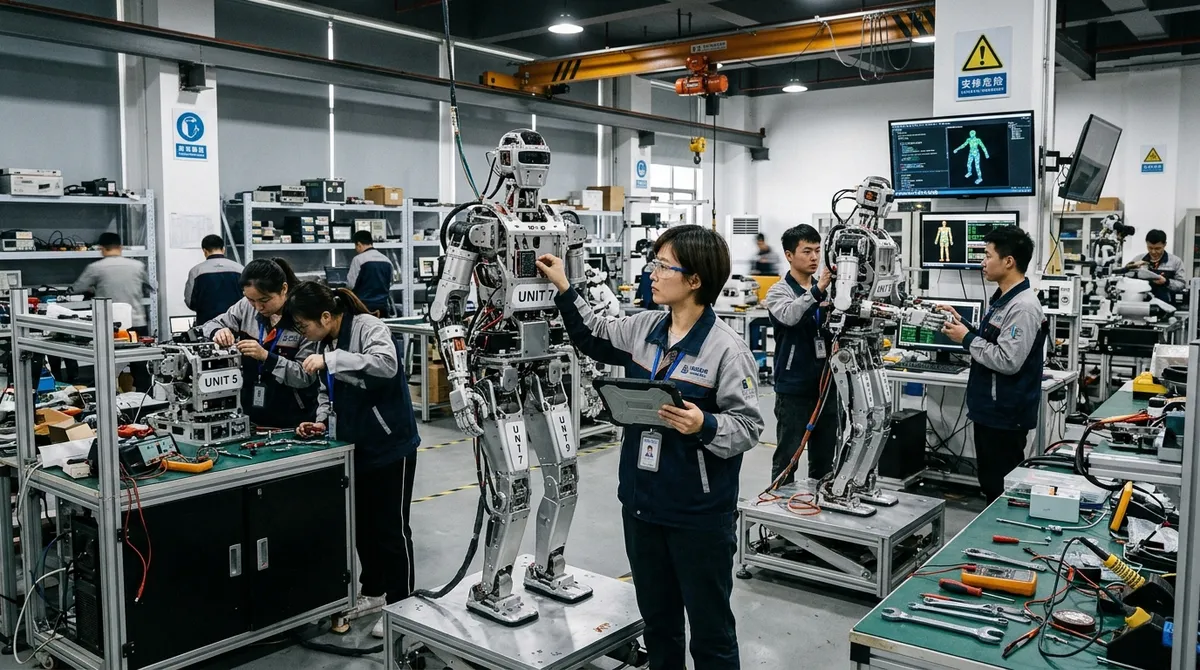
Autonomous humanoid robots in China no longer look like distant science fiction. They look like an engineering problem with clear timelines, constraints and a price tag. A trip through 11 companies in five Chinese cities shows an industry maturing quickly: manufacturers are no longer selling only a beautiful future, but trying to build a working model that can be produced in series, serviced and fitted into the real economy. The same route makes something else clear, too: a noticeable gap remains before truly independent machines that can work reliably without constant human backup.
The main takeaway from this reporting is that Chinese robotics left the laboratory demo stage long ago. When a journalist sees not one showcase company but 11 players in five different cities, a broader picture emerges: this is not a single breakthrough but an entire industrial environment. Mechatronics, computer vision, control systems, batteries, actuators and software are all developing at once. For humanoid robots this is critical, because they need not one outstanding technology but the coordinated work of many components, each of which must be cheap, precise and reliable enough.
This is where China looks especially strong. The advantage comes not only from engineering talent but from a dense manufacturing ecosystem in which components, contractors, assembly and testing sit closer together than in many other countries. That proximity speeds up iteration: a design can be quickly rebuilt, a part swapped, a component made cheaper, or a new software version tested on real hardware. For a young industry this matters no less than loud claims about the future, because the winner will not be the flashiest prototype but whoever manages to cut costs, improve stability and turn a demonstration into a repeatable product.
The question itself, how close we are to the science-fiction image of an autonomous humanoid robot, also helps keep spectacle separate from readiness. A robot can walk confidently across a stage, lift a box or wave a hand, but that does not mean it is ready for full-fledged work in an unpredictable environment. Real autonomy demands far more: stable navigation, understanding of context, precise manipulation, safe behavior around people and the ability to handle errors without halting the whole system. These are the qualities that usually separate an impressive demo from a machine someone is willing to pay for on an ongoing basis.
So the most realistic path for humanoids today, judging by this picture, runs not through a universal robot for every occasion but through narrower, controlled scenarios. At first these may be warehouses, factories, site inspection, materials transport or other tasks where the space is predictable, processes repeat and the benefit can be calculated in advance. In such conditions even incomplete autonomy makes sense if the robot reduces the load on people, works longer than a standard shift or takes over unpleasant and potentially dangerous operations. A mass-market household robot that does everything equally well remains, for now, more of a marketing symbol than a near-term reality.
The conclusion is simple: China's robotics revolution matters not because perfect androids will walk the streets tomorrow, but because an industry is taking shape right now that can bring such a scenario closer step by step. Visits to five cities and 11 companies show the race is already being run at the level of production, integration and economics, not just ideas. For the market, the signal is to look not at the loudest promises but at where robots are already starting to deliver measurable value. That is where it will be decided how quickly fiction turns into infrastructure.
- Nov 2, 2026ASTC Compresses Agent Context Without Training, Cutting Attention Pairs by 50.68%
- Nov 2, 2026TraceSpec raises DSpark throughput for LLM agents by 12.5–22.6%
- Nov 2, 2026A Caption on the Image Triggers 55% Joint Errors Across Both Channels of a Dermatology Agent
- Nov 2, 20264B agent Mage-VL-Cowork scores 66.0% on OSWorld-Verified, beating a 30B model
Test Frontier LLMs & Autonomous Agents in One Workspace
Run Claude Opus 5.5, GPT-6, Gemini 3.1, and DeepSeek side-by-side in Nomad AI (nomadnet.ai) — unified model routing, deep research, and multimodal workflows under one subscription.
The AI world, distilled — once a week
Seven stories that actually mattered, hand-picked. No noise, no reposts, no press releases.
Done! Check your inbox for a confirmation.