Beijing's Humanoids Head for Series Production: Why Does a Robotics Center Need 700 Million Yuan?
China is moving from talk to action in the humanoid race. The Beijing humanoid robot innovation center has raised more than 700 million yuan in its first market round. Investors include Baidu and Beijing state funds. This is not just another R&D investment but the official start of the commercialization stage. While Tesla refines Optimus, China is building a full ecosystem for mass production of "iron people." The key point: Beijing intends to standardize the industry and turn humanoids into an affordable industrial product faster than we expect.
AI-processed from 36Kr (36氪); edited by Hamidun News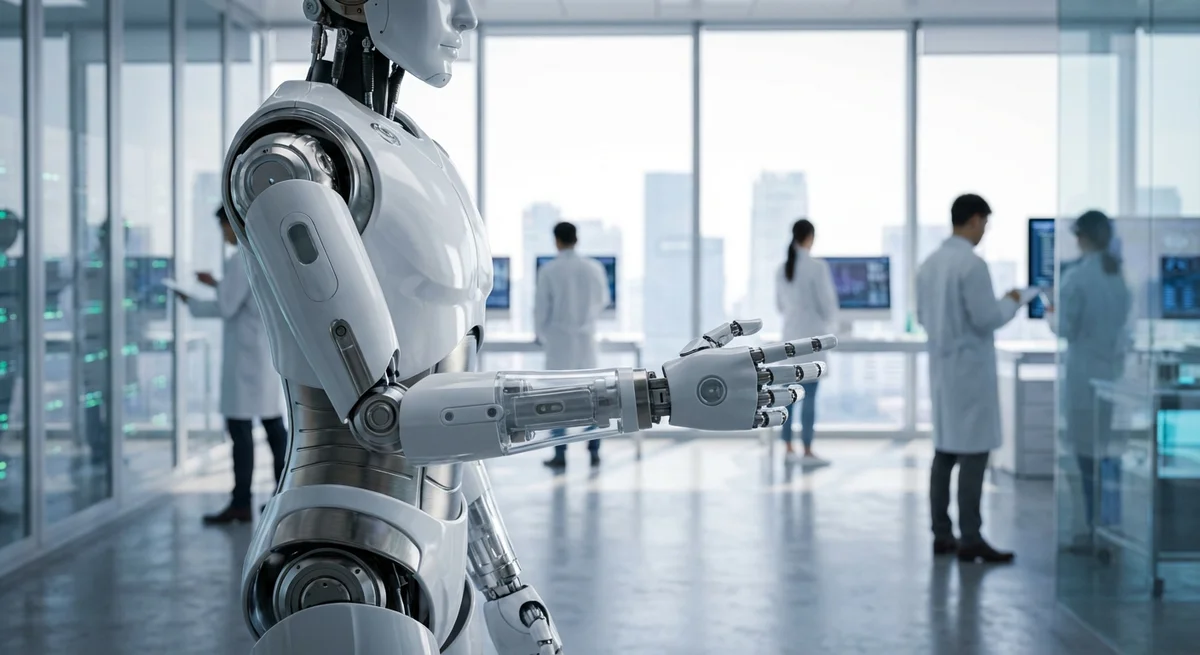
While the world argues over whether GPT-5 will gain consciousness, China is methodically building physical bodies for that consciousness. While we admire the somersaults of Boston Dynamics robots, Beijing is creating a structure that will turn these expensive "toys" into a mass-market product. The Beijing humanoid robot innovation center has just closed its first market funding round, raising more than 700 million yuan (about 96 million dollars). The event matters far more than it seems at first glance, because it marks the end of the era of pure experimentation and the start of hard industrialization.
Let's look at the context. This center is not just another garage startup. It is a strategic hub created late last year to pool the efforts of leading industry players, including Xiaomi and UBTECH. China's Ministry of Industry and Information Technology (MIIT) earlier set an ambitious goal: to establish mass production of humanoids by 2025. The current 700 million is fuel for the final push. Where robotics in China was once fragmented, the state and private capital are now forming a single fist to standardize parts, software and control algorithms.
The investor list speaks for itself. Besides state funds such as the Beijing AI Industry Investment Fund, Baidu is taking part in the round. Why would a search giant want robots? Simple: a robot needs a brain. Baidu plans to integrate its large language models (LLMs), such as Ernie Bot, into physical bodies. Without powerful AI, a humanoid remains just a set of servo drives, but with cloud computing and neural networks behind it, it becomes an autonomous assistant able to understand complex commands in natural language.
What exactly are they building? The center's main project is the Tiangong platform. It is not just one robot but a kind of "Android for humanoids": an open base on which other companies can build their own solutions. The Chinese have realized that the winner will not be whoever builds the smartest single robot, but whoever builds the cheapest and most scalable supply chain. The investment will go toward accelerating work on high-precision reducers, tactile sensors and energy-efficiency systems, which remain the weak spot of all anthropomorphic machines.
The shift to commercial operation means we will soon see these robots not at trade shows but in real factories in Beijing and Yizhuang. China faces a demographic crisis and a labor shortage, so for it humanoids are not a luxury but a matter of economic survival. While American companies such as Figure AI or Tesla focus on building the perfect product, Beijing is laying the foundation so that "Made in China" will in future mean "made by Chinese robots."
The key point: China has stopped playing in the lab and started building the assembly line. Will the West be able to compete on price once humanoids become as mass-market as electric cars?
- Nov 2, 2026DeepSeek open-sources Super-agent prototype: p95 task completion time of 15.7 minutes vs. 29.5
- Nov 2, 2026Bun creator uses Claude Code to port 750K lines from Zig to Rust in 11 days
- Nov 2, 2026Microsoft releases 4B model Mage-VL-Cowork, which solves 66.0% of OSWorld-Verified tasks
- Nov 2, 2026Meta's Muse assistant keeps dossiers on loved ones and gets root on Ubuntu by default
Test Frontier LLMs & Autonomous Agents in One Workspace
Run Claude Opus 5.5, GPT-6, Gemini 3.1, and DeepSeek side-by-side in Nomad AI (nomadnet.ai) — unified model routing, deep research, and multimodal workflows under one subscription.
The AI world, distilled — once a week
Seven stories that actually mattered, hand-picked. No noise, no reposts, no press releases.
Done! Check your inbox for a confirmation.