Chinese Humanoid Robots at MWC Shanghai: Penalty Kicks and Piano Playing
At the Mobile World Congress exhibition in Shanghai, Chinese humanoid robots became the main sensation. A Bloomberg correspondent personally tested the machines: they can kick penalties World Cup-style and play piano. The results are mixed, but the fact of public demonstrations itself speaks to the maturity of the technology — just a couple of years ago such tests were conducted only in closed laboratories.
AI-processed from Bloomberg Tech; edited by Hamidun News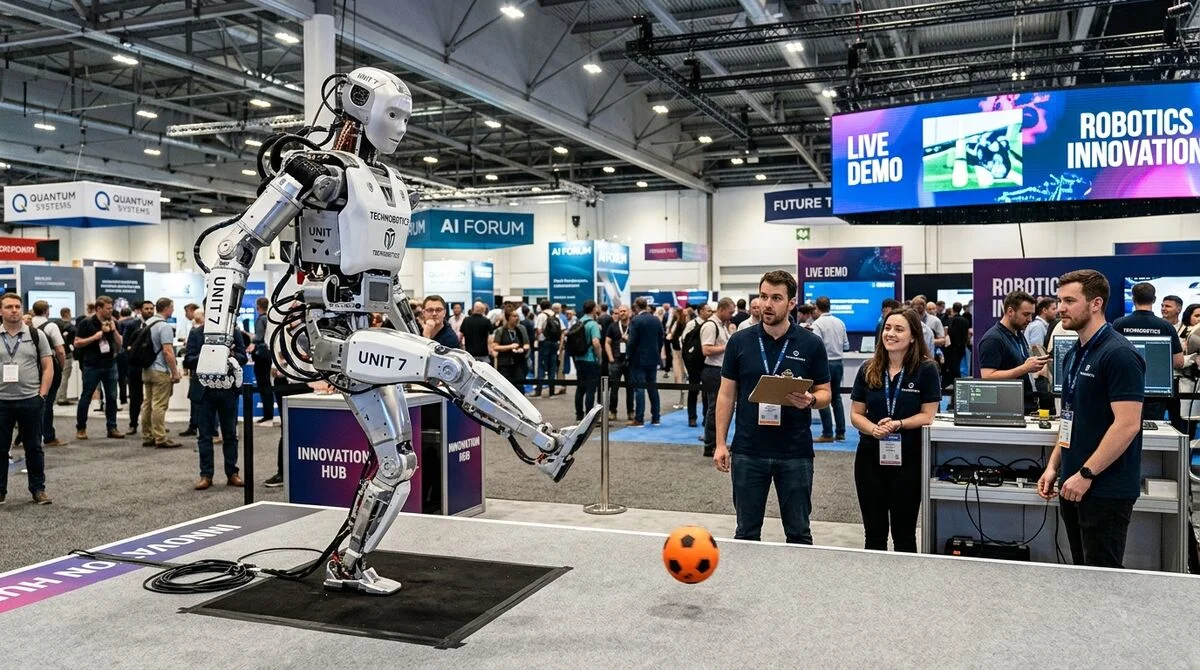
At the Mobile World Congress exhibition in Shanghai, Chinese humanoid robots became the main surprise: instead of booths with the next batch of smartphones, visitors were greeted by machines on two legs capable of playing piano and kicking penalty shots right before the audience.
MWC Stars on Two Legs
Mobile World Congress in Shanghai is traditionally considered an exhibition of mobile technologies. But in 2026, the real sensation was not a new chipset or foldable screen — it was humanoid robots from Chinese manufacturers. Several companies brought machines directly to their pavilions, and their booths drew the longest queues. Bloomberg correspondent Stephen Engle decided to test the robots not with boring technical tests, but with tasks understandable to everyone: kick a penalty shot and play a melody on the piano. Both exercises require what is hardest to program — fine coordination, balance, and precise movements in real time.
Why Penalty Kicks and Piano
It seems like a strange choice for evaluating industrial robotics — but these tests have their own logic:
- A penalty kick requires dynamic balance: the robot must stand on one leg and transfer weight in motion
- Playing piano tests finger independence: pressing the correct key without touching adjacent ones
- Both tests demonstrate the ability to perform precise actions without external support
- Spectacularity is also part of the calculation: such demonstrations explain progress better than any technical specifications
- This is how manufacturers convince investors and customers that the technology really works
The results were mixed. Some machines confidently handled basic movements, while others lost balance or executed commands with noticeable delay. However, the mere possibility of public tests says a lot: just a few years ago this happened exclusively in closed laboratories.
China Accelerating
Over the past two years, the country has sharply increased investments in physical AI. Government support programs, available manufacturing base, and a rapidly growing startup ecosystem have produced results: China has become the world's largest manufacturer of humanoid robots by number of units produced. MWC Shanghai featured machines from Unitree, UBTECH, Agibot, and several companies less known outside China. Each manufacturer emphasized their own strengths: walking speed, load capacity, or hand dexterity.
"Chinese manufacturers are transitioning from prototypes to mass-produced machines faster than anyone expected a year ago," note industry analysts.
According to forecasts, by 2030 the country will have deployed over a million humanoid robots — in manufacturing, logistics, and elderly care sectors.
What It Means
A competition of robots kicking penalty shots is not just a media spectacle. This is a signal: Chinese robotics has reached the level of public maturity. Machines are reliable enough for live demonstrations and convincing enough to attract corporate buyers. The next question is no longer "can the robot kick a penalty shot," but "when will it pay for itself on an assembly line."
Need AI working inside your business — not just in your newsfeed?
I build production AI for companies — custom CRM, internal tools, autonomous agents, workflow automation. Owned by you, shaped to your process, no per-seat tax. Built by Zhemal Khamidun, CPO of AlpinaGPT (AI platform, 6,000+ users).
The AI world, distilled — once a week
Seven stories that actually mattered, hand-picked. No noise, no reposts, no press releases.
Done! Check your inbox for a confirmation.