AI Is Changing Car Design: GM and Nissan's Neural Concept Show Where Development Is Heading
GM and Nissan are the first automakers to show how neural networks change the way cars are made. The traditional cycle from sketch to showroom takes 5–7 years. AI compresses the iterations, letting designers test hundreds of body-shape variants where they once worked with dozens. Nissan Neural Concept is the first serious example. Designers did not press a button and get a finished result, but neural networks sharply sped up their work.
AI-processed from The Verge; edited by Hamidun News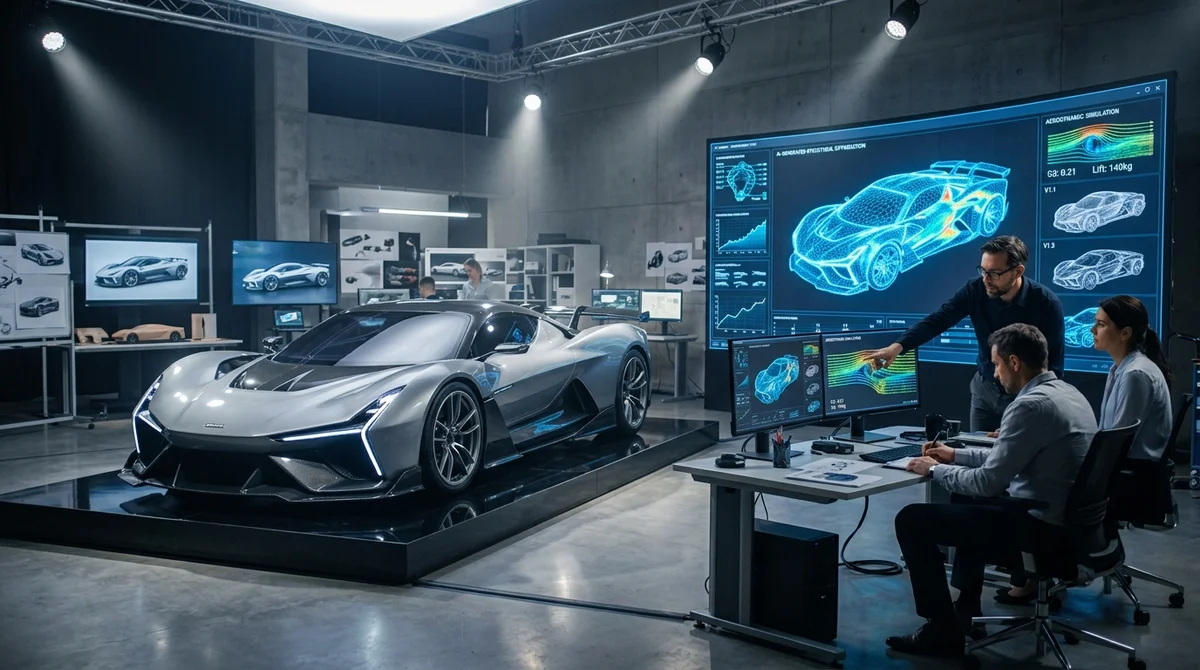
Car design is going through a quiet but significant revolution. GM and Nissan are the first major players to show the public what a car born with the help of artificial intelligence looks like. And it is nothing like the futuristic show car people are used to seeing at motor shows.
The traditional path of a car from idea to dealership takes five to seven years. It all starts with a pencil sketch, and that is not a metaphor. Even today, when powerful 3D visualization and VR sculpting tools are available, most new cars are still born on paper. Then comes endless iteration of sketches from every angle, manual conversion into 3D models, and then sculpting in clay. Yes, real clay: it lets designers physically feel the body lines and proportions, which can look different on a screen. Only after that does actual engineering development begin, and that also takes years.
That is why the cars arriving in showrooms this summer were conceived back in 2020–2021, under completely different market conditions, different raw-material prices and different buyer priorities. Companies were betting on a future without knowing what it would look like. This is a structural flaw of the industry: decisions are made five years before the market can judge them.
AI is starting to break that rhythm. Nissan unveiled Neural Concept, a concept car whose design made active use of neural networks. It is important to understand that this does not mean designers pressed a button and received a finished car. AI is built into the workflow differently. The algorithms can generate and evaluate hundreds of body-shape variants in the time that used to produce a dozen sketches. They analyze aerodynamics, visual weight and proportions, and return to the designer not one option but a broad range of directions to choose from. The designer still makes the final decisions, but now does so from a much wider pool of ideas.
GM is moving along a similar path, integrating generative tools directly into the workflow of its design studios. The key point here is not replacing people but expanding what they can do. The character of a car, its "face," its emotional message and its style are still defined by people with decades of experience. AI takes over routine iteration and helps test hypotheses faster, work that used to take weeks of painstaking effort.
In practical terms, this means some development stages get shorter. Where it once took months to go from an approved concept to a final 3D model, that cycle may now shrink. Clay models are not going away: a physical prototype is still irreplaceable for judging real form. But AI can substantially cut the number of iterations that come before that stage, and so the overall development time. In the long run, this may mean new models reflect current trends rather than the tastes of five years ago.
It is worth grasping the scale of the change. The auto industry is one of the most conservative fields when it comes to design processes. Its studios have decades of accumulated culture, where the sketching tradition is passed down as a craft. Bringing AI into this environment is not just a technical upgrade; it is a cultural shift. Some designers see the new tools as a threat to the profession, others as a chance to finally realize ideas without months of waiting.
It is telling that GM and Nissan were the first to enter the AI design race, rather than tech startups or newer players such as Rivian or BYD. That points to the maturity of the tools: large traditional corporations are ready to trust AI with a real part of the production cycle.
The next logical step comes when a car developed with AI's help stops being news. Perhaps some of these cars are already driving near you, and nobody gives it a second thought.
Test Frontier LLMs & Autonomous Agents in One Workspace
Run Claude Opus 5.5, GPT-6, Gemini 3.1, and DeepSeek side-by-side in Nomad AI (nomadnet.ai) — unified model routing, deep research, and multimodal workflows under one subscription.
The AI world, distilled — once a week
Seven stories that actually mattered, hand-picked. No noise, no reposts, no press releases.
Done! Check your inbox for a confirmation.