Nissan bets on AI-defined cars: autonomous features planned for 90% of models
Nissan is changing its turnaround strategy: the company wants to build autonomous driving features into 90% of its future cars while trimming its model lineup by 20%. The bet is on so-called AI-defined vehicles, cars where software, driver-assistance systems and updates increasingly set the competitive edge. For Nissan, it is an attempt to speed up its business turnaround without widening its range.
AI-processed from Guardian; edited by Hamidun News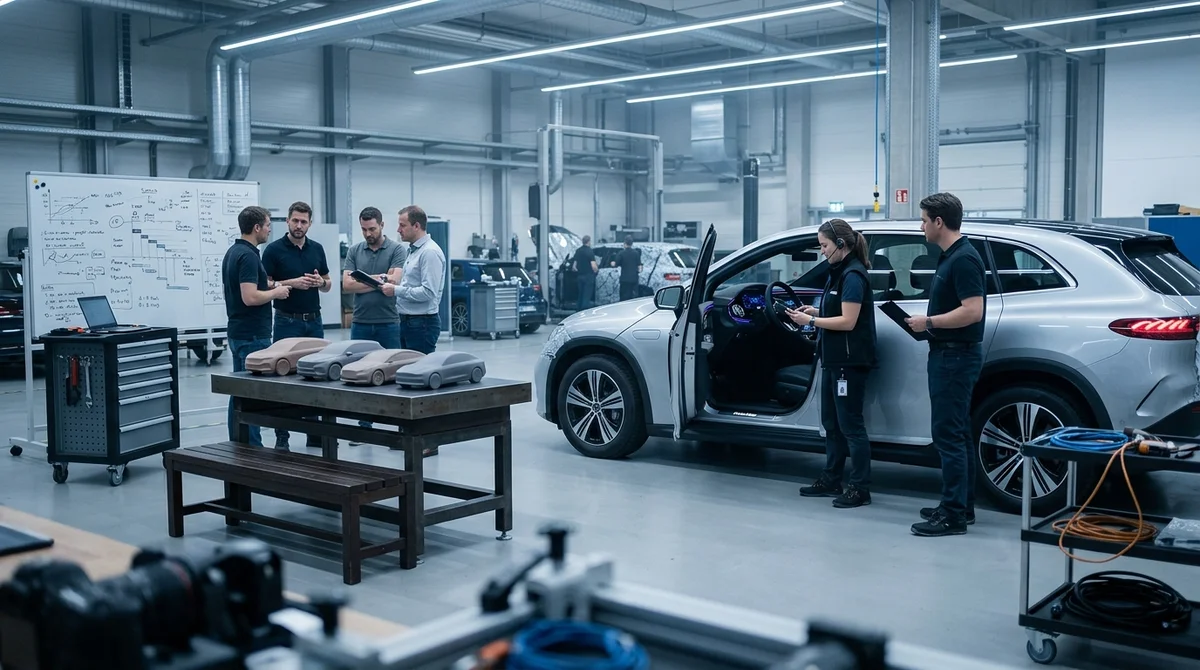
Nissan is launching the next stage of its turnaround plan: the company wants to build autonomous driving features into 90% of its future cars while cutting its model lineup by a fifth. The Japanese automaker is betting that software and AI systems will help restore momentum after a prolonged period of weak results.
What the plan is built on
Nissan's new plan rests on the idea of "AI-defined vehicles." In the company's public wording, this means a car's core value should shift away from the number of versions and mechanical differences toward software features, driver-assistance systems and the ability to receive updates. For the market, this is an important signal: Nissan wants to compete not only on design, price and powertrains, but also on how the car behaves on the road and how quickly the manufacturer improves it after sale.
Nissan CEO Ivan Espinosa directly tied the company's future turnaround to autonomous technology. Going by the statement, this is more about a notable expansion of driver-assistance systems than about nearly all cars suddenly becoming fully driverless. On paper, the goal sounds ambitious: autonomous features should appear in 90% of the company's cars in the future. For Nissan, it is an attempt to make AI and software features not an add-on but the central part of the product.
Fewer models, more software
At the same time, Nissan plans to cut its model range by 20%. For an automaker, this is not just savings on marketing or catalogs, but an attempt to relieve some of the burden on development, production and supply. The fewer variants it has to support, the easier it is to allocate investment across platforms, electronics and the software stack. It also reduces the costs of certification, component procurement and servicing the lineup in different markets. With advanced driver-assistance systems expensive to develop, this kind of concentration looks logical.
In practice, this approach could give Nissan several advantages:
- bring new features to mass-market models faster, rather than only to individual flagships
- reduce engineering complexity and the number of parallel projects
- unify the hardware base for sensors, compute modules and updates
- shift budget from low-volume models to software feature development
- make the strategy easier to explain to investors and dealers
"AI-defined vehicles" is the phrase
Nissan uses to describe its bet on cars where the software increasingly makes the difference.
Why the bet is risky
The problem is that the car market stopped forgiving half-measures in software long ago. If a manufacturer promises advanced autonomous driving features, users expect stable performance, a clear interface and regular updates, while regulators expect predictable system behavior in real-world conditions. That is harder than simply adding a new option to the price list. Nissan will have to cut costs, update its product logic and prove that it can develop the software side of its cars quickly, all at once.
There is also a strategic risk. A smaller lineup helps with focus, but it also leaves less room for error: if the chosen platforms or feature set miss market expectations, correcting course will be harder. Moreover, in the smart-car segment, competition is no longer only among traditional automakers, but also among teams that can work faster with data, electronics and post-sale updates. For Nissan, this means the turnaround plan will be judged not by presentations but by the speed of real-world rollout.
What this means
Nissan is trying to restart its business through a narrower lineup and smarter cars. If the company really does scale autonomous features across most of its models, it could regain its role as a technologically visible player. If not, the AI-defined vehicles formula will remain a nice slogan with no effect on sales.
- Nov 2, 2026DeepSeek open-sources Super-agent prototype: p95 task completion time of 15.7 minutes vs. 29.5
- Nov 2, 2026Bun creator uses Claude Code to port 750K lines from Zig to Rust in 11 days
- Nov 2, 2026Microsoft releases 4B model Mage-VL-Cowork, which solves 66.0% of OSWorld-Verified tasks
- Nov 2, 2026Meta's Muse assistant keeps dossiers on loved ones and gets root on Ubuntu by default
Key Questions Answered
What the plan is built on?
Nissan's new plan rests on the idea of "AI-defined vehicles." In the company's public wording, this means a car's core value should shift away from the number of versions and mechanical differences toward software features, driver-assistance systems and the ability to receive updates. For the market, this is an important signal: Nissan wants to compete not only on design, price and powertrains, but also on how the car behaves on the road and how quickly the manufacturer improves it after sale. Nissan CEO Ivan Espinosa directly tied the company's future turnaround to autonom
What are the key details on Fewer models, more software?
At the same time, Nissan plans to cut its model range by 20%. For an automaker, this is not just savings on marketing or catalogs, but an attempt to relieve some of the burden on development, production and supply. The fewer variants it has to support, the easier it is to allocate investment across platforms, electronics and the software stack. It also reduces the costs of certification, component procurement and servicing the lineup in different markets. With advanced driver-assistance systems expensive to develop, this kind of concentration looks logical. In practice, thi
Why the bet is risky?
The problem is that the car market stopped forgiving half-measures in software long ago. If a manufacturer promises advanced autonomous driving features, users expect stable performance, a clear interface and regular updates, while regulators expect predictable system behavior in real-world conditions. That is harder than simply adding a new option to the price list. Nissan will have to cut costs, update its product logic and prove that it can develop the software side of its cars quickly, all at once. There is also a strategic risk. A smaller lineup helps with focus, but i
Test Frontier LLMs & Autonomous Agents in One Workspace
Run Claude Opus 5.5, GPT-6, Gemini 3.1, and DeepSeek side-by-side in Nomad AI (nomadnet.ai) — unified model routing, deep research, and multimodal workflows under one subscription.
The AI world, distilled — once a week
Seven stories that actually mattered, hand-picked. No noise, no reposts, no press releases.
Done! Check your inbox for a confirmation.