Mirror bacteria could kill all life, and Chinese workers battle their AI doppelgangers
Scientists still don't know how dangerous synthetic 'mirror life' really is — organisms made from mirror molecules that the immune system can't recognize. Meanwhile, in China, thousands of voice actors and content creators are losing work to AI doppelgangers: companies are cloning their voices and appearance for pennies. Two stories about boundaries humanity has already crossed.
AI-processed from MIT Technology Review; edited by Hamidun News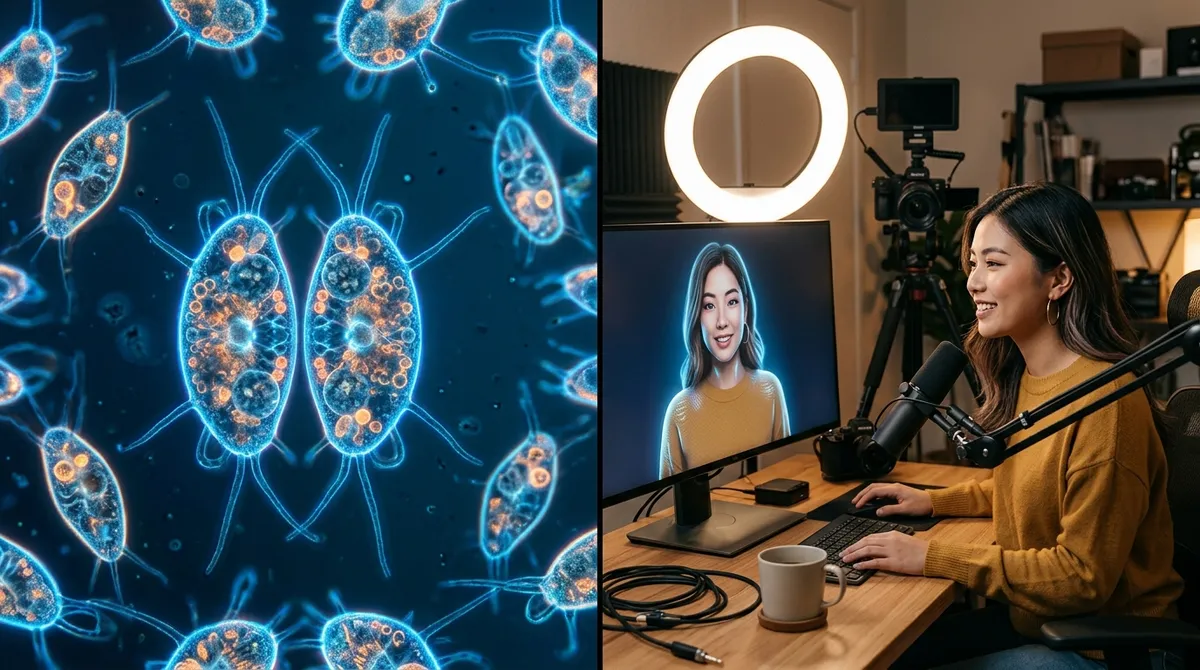
In one issue of MIT Technology Review, two stories came together that at first glance seem unrelated — and both force us to seriously consider the consequences of progress that can no longer be stopped. Nobody knows if mirror life will kill us In February 2019, a group of scientists proposed to the US National Science Foundation an idea on the edge of fantasy: to create synthetic organisms built from "mirror" molecules. All living nature uses L-amino acids and D-sugars.
Mirror organisms would work with their opposites — D-amino acids and L-sugars. This is not just exotica: a mirror cell would be invisible to most pathogens and immune systems, since they are designed for ordinary biochemistry. The project seemed like academic utopia.
But in recent years, synthetic biology has made great strides: tools have emerged for creating increasingly complex mirror molecules. In 2023, several laboratories independently reported progress in synthesizing mirror polymerases — enzymes that copy DNA. If a self-reproducing mirror organism can be created, it will be beyond the reach of most immune mechanisms.
Neither antibiotics, nor antibodies, nor phages are designed for such biochemistry. The problem is that nobody knows how dangerous this is — and how close we are to this threshold. Some researchers consider the risks catastrophic and comparable to nuclear weapons.
Others insist that mirror organisms will prove too metabolically weak to survive in the real world. The truth, it seems, lies somewhere in between. But there is no single international regulatory mechanism for this field yet.
Chinese workers against AI-twins In parallel, another conflict is unfolding in China — far more earthly, but no less acute. Announcer Lyu Ya from Hunan Province spent several years building a career in video content: recording videos, participating in live broadcasts, accumulating an audience. Last year, her agency offered her a contract allowing them to create an AI-clone of her appearance and voice.
She refused. The agency found another person and trained a model on her videos without permission. This is not an isolated story.
According to estimates by Chinese industry associations, the AI-avatar market in the country grew threefold in 2024 and exceeded 10 billion yuan by year-end. Platforms like Douyin actively promote the format: for brands, it's cheaper to buy a license for an AI-host than to employ a live worker. The cost of one AI-avatar ranges from several thousand to tens of thousands of yuan as a one-time fee; a live content creator costs hundreds of thousands per year.
Chinese workers began to unite. In several major cities, meetings of announcers, voice actors, and live broadcast operators took place — people trying to secure legislative protection for their digital images. In March 2025, the first public action took place in Shenzhen: several dozen people demanded that regulators require platforms to obtain explicit written consent before training models on employees' biometric data.
What does all this mean Both stories are united by one logic: technology develops faster than society can establish rules. In the case of mirror life — these are biological safety rules that don't yet exist. In the case of AI-twins — these are rules for protecting digital identity, which are only beginning to form.
The Chinese example is particularly important: what is being tested today in a market of 1.4 billion consumers will become global tomorrow. The announcer from Hunan is a harbinger of conflicts that will soon come to Europe and the United States.
And mirror bacteria remind us: not all risks of new technologies are immediately obvious. Sometimes awareness comes too late.
Need AI working inside your business — not just in your newsfeed?
I build production AI for companies — custom CRM, internal tools, autonomous agents, workflow automation. Owned by you, shaped to your process, no per-seat tax. Built by Zhemal Khamidun, CPO of AlpinaGPT (AI platform, 6,000+ users).
The AI world, distilled — once a week
Seven stories that actually mattered, hand-picked. No noise, no reposts, no press releases.
Done! Check your inbox for a confirmation.