Meta, Microsoft and Google are building gas power plants for AI data centers. What could go wrong?
Meta, Microsoft and Google are building their own gas-fired power plants next to new AI data centers. The grid can't keep up with demand, nuclear reactors won't arrive before the 2030s, and the race for compute won't wait. But experts warn that 30-year fossil fuel assets could become a strategic trap, just as the rest of the world moves toward decarbonization. *Meta is designated an extremist organization and banned in Russia.
AI-processed from TechCrunch; edited by Hamidun News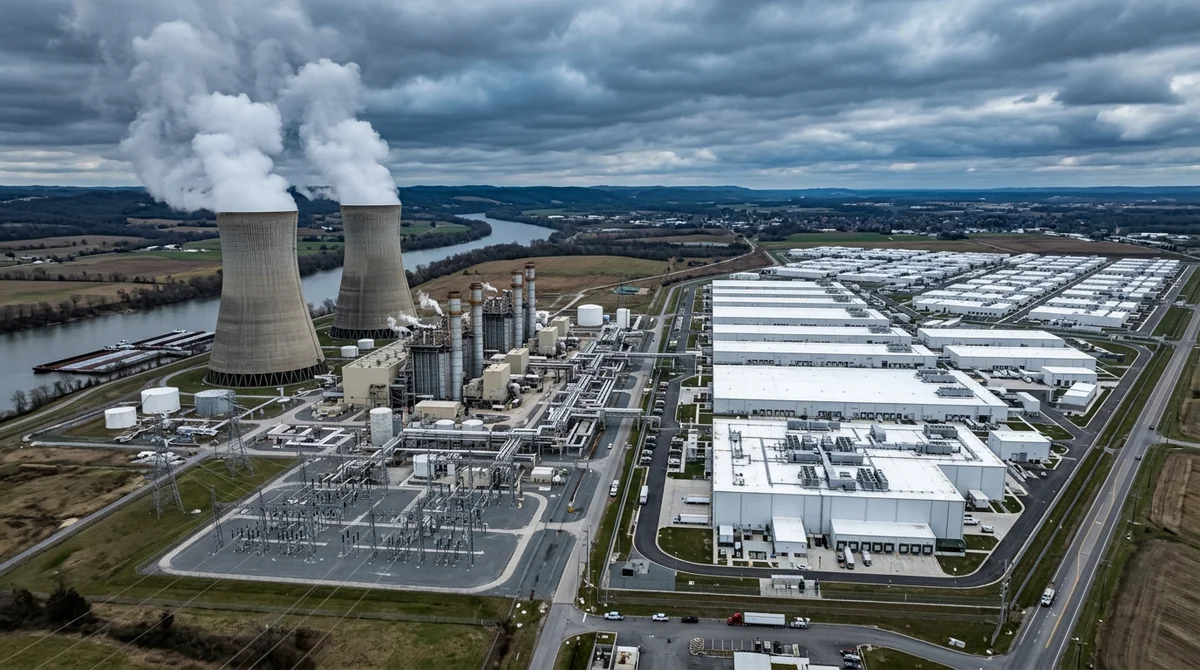
Three of the world's largest tech companies, Meta, Microsoft and Google, are placing big bets on natural gas. This isn't about buying green certificates or offsets: the companies are building their own gas power plants right next to new AI data centers. The scale is striking, and the question "what could go wrong?"
is getting harder to ignore. The generative AI boom has driven an almost vertical spike in electricity demand. Training and running large language models consumes dozens of times more electricity than standard server racks.
Goldman Sachs estimates that total US data center power consumption could grow 160% by 2030 compared with 2023 levels. The grid can't keep up: in some US states, new grid connections take three to five years. Hence the logic of taking power generation into their own hands.
Meta, Microsoft and Google have announced or are already building gas facilities with capacities ranging from a few hundred megawatts to the gigawatt range. Natural gas looks like the obvious choice: it's reliable, relatively cheap, and a plant can come online in two to three years, far faster than a nuclear reactor or a large wind farm. Solar and wind have a fundamental flaw when it comes to AI infrastructure: they generate power not when it's needed, but when the sun shines or the wind blows.
AI data centers need a constant 24/7 load, and battery storage at the required scale simply doesn't exist. Nuclear power is attractive, and all three companies are investing in small modular reactors, but the first commercial projects won't come online before the late 2030s. Gas fills the gap here and now.
Gas power plants are assets with a 30-year lifespan. A decision made today locks in fossil fuel dependence until at least the 2050s. The risks fall into three categories.
Regulatory: climate policy is tightening, carbon taxes are already in force in the EU, and similar mechanisms are under discussion in the US. If CO₂ emissions cost $100–200 per ton ten years from now, the economics of gas plants will change radically, leaving companies with costly "stranded assets." Reputational: all three companies made ambitious climate commitments.
Microsoft set a goal of becoming carbon negative by 2030, and Google declared it ran on 100% renewable energy back in 2017. Building gas generation directly contradicts these pledges, and ESG investors and climate organizations have already taken notice. Price: the natural gas market is inherently volatile.
The 2021–2022 crisis showed that prices can jump five- to sixfold within a few months amid geopolitical shocks. The paradox is stark: companies that sell AI as a tool for solving global problems are themselves becoming some of the largest corporate CO₂ emitters. The stakes in the AI race are so high that no one is willing to stop.
Gas plants are becoming a "temporary solution" that, judging by the scale of investment, looks increasingly permanent. When the reckoning comes, whether through carbon taxes, regulatory fines or shareholder lawsuits, it will prove very expensive.
*Meta is designated an extremist organization and banned in Russia.
- Nov 1, 202616 models tested on 7 search tools: Exa averaged 10.5 out of 14, SearXNG about 3
- Nov 1, 2026Google's StreamVibe video agent beats other models by 10.7% on response timing and quality
- Nov 1, 2026OpenAI Rewrites GPT Behavior Rules: Five Values and a Chain of Command
- Nov 1, 2026Voice bots built on LLMs turn to Jev, a fast classifier, for decisions in 200–500 ms
Test Frontier LLMs & Autonomous Agents in One Workspace
Run Claude Opus 5.5, GPT-6, Gemini 3.1, and DeepSeek side-by-side in Nomad AI (nomadnet.ai) — unified model routing, deep research, and multimodal workflows under one subscription.
The AI world, distilled — once a week
Seven stories that actually mattered, hand-picked. No noise, no reposts, no press releases.
Done! Check your inbox for a confirmation.