Meta is accelerating a power build-out: Entergy adds $14 billion to its investment plan because of data centers
Meta's influence now reaches beyond the chip market and into the power sector. Entergy has raised its four-year investment plan by almost a third, to $57 billion. Most of the roughly $14 billion it added will go to gas-fired power plants for Meta's data center project in northern Louisiana. The story shows how the AI boom is starting to reshape the basic infrastructure of entire regions. *Meta is designated an extremist organization and banned in Russia.
AI-processed from Bloomberg Tech; edited by Hamidun News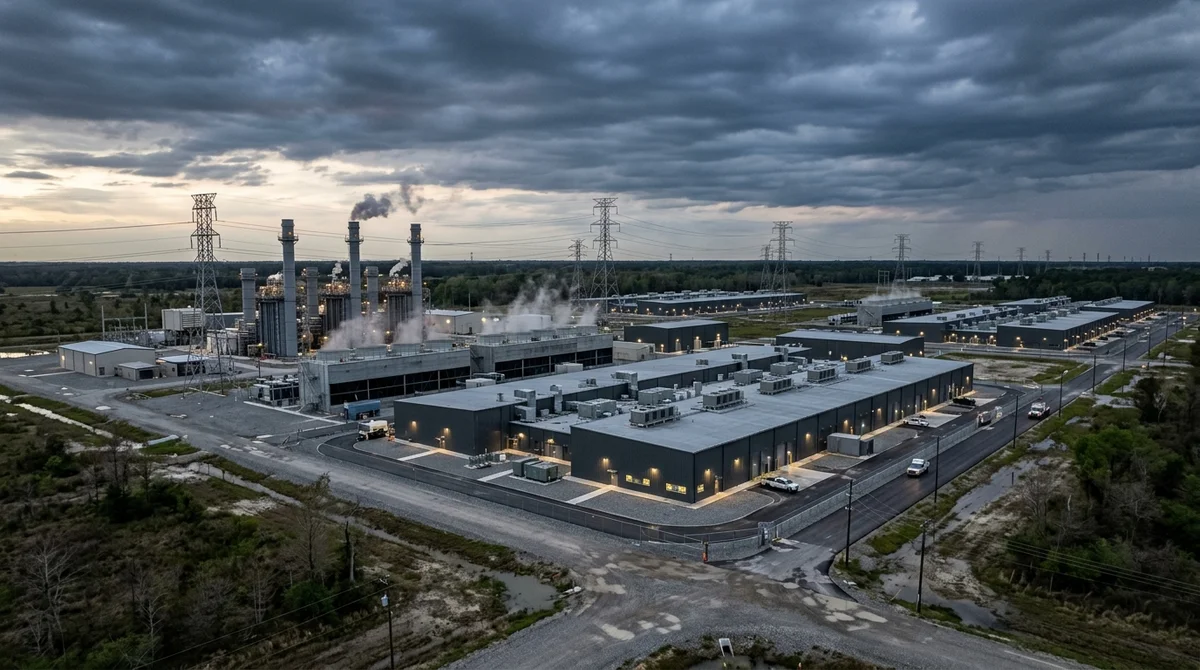
Meta is accelerating its AI infrastructure build-out in the US at the power level, not just the server level. US utility Entergy has raised its four-year capital spending plan by almost a third, to $57 billion, mainly to build gas-fired power plants for a large Meta data center project in northern Louisiana.
Where the increase came from For a utility, a revision like this is not a cosmetic tweak.
It signals that demand from new compute sites has grown large enough to change the investment cycle of an entire region. In effect, Meta's appetite for electricity pushed Entergy to fast-track new generation. This is not about upgrading the existing grid.
It is about building capacity that can power a huge data center cluster without risking shortfalls as new server buildings come online. The stated scale is telling, too. Entergy's four-year capex rose by about $14 billion to $57 billion, adding almost a third to the previous plan.
The main driver is gas-fired power plants for northern Louisiana, where Meta is building out its infrastructure. When a single tech company triggers a revision of this size, it stops being a local construction project and becomes an infrastructure pivot toward a new wave of AI demand. For the local power market, that means years of added strain on planning, financing, and connecting new capacity.
Key numbers What matters here is not just the spending itself but how it breaks down.
The market is getting another confirmation: AI data centers don't need abstract "green energy whenever it's available." They need predictable capacity in the right place on the right timeline. Entergy's investment plan now effectively reflects not ordinary demand growth but a jump driven by one specific digital megaproject. For investors and regulators, that offers a convenient yardstick: it shows not just Meta's intent to build, but what that decision costs utility infrastructure in hard money.
- Entergy's new four-year investment plan: $57 billion Increase over the previous plan: about $14 billion Size of the increase: almost a third Main target of the spending: gas-fired power plants Source of the demand: Meta's large-scale data center project in northern Louisiana Taken together, these facts show that for grid operators, the AI boom is no longer measured in servers and chips but in additional power plants, grid solutions, and long-term financial commitments. The bigger the site, the less room there is to experiment with an unstable supply profile: data centers need power 24/7 and a clear schedule for bringing capacity online. That is why news about new data centers increasingly reads like energy news, not just tech news.
Why gas?
The most notable takeaway is the bet on gas-fired generation specifically. This is not necessarily an ideological choice in favor of fossil fuels; it more likely reflects the practical logic of a large infrastructure project. When demand is growing fast and compute has to come online on a tight schedule, companies look for options they can plan, finance, and connect without too long a delay.
In that context, the price per kilowatt-hour matters, but so does the ability to guarantee uninterrupted operation of a complex compute load. For Meta, this means AI infrastructure growth is increasingly constrained by energy, not just by access to GPUs and land to build on. For regional utilities, it means big tech companies are becoming anchor customers that can reshape capital programs for years ahead.
For states that want to attract data centers, it means the competition is no longer only about tax breaks but also about the ability to deliver large amounts of reliable capacity quickly. If the grid and generation can't keep up, AI investment may stall even when market interest is high.
What it means
The AI boom is starting to change not only the model market but also the basic industrial infrastructure of the US. If a utility adds $14 billion to its investment plan for a single Meta project, the next round of competition among tech giants will be fought over megawatts, interconnection timelines, and control of energy sources. For the market, it is one more signal: the future of AI is being built not only in data centers but in the energy balances of entire states.
*Meta is designated an extremist organization and banned in Russia.
- Nov 1, 2026MoneyGate safety layer blocked all 42 fraudulent requests to local AI models
- Oct 31, 2026Open-source LLM gateway KTMS 1.0 plugs your own GPUs into the cloud and survives outages
- Oct 31, 202622B-Parameter LTX-2.5 Runs on a 10 GB RTX 3080, but Takes 5 Minutes per Shot
- Oct 29, 2026T-Tech Introduces LIMe, a Method That Trains Language Models With 15% Less Compute
Test Frontier LLMs & Autonomous Agents in One Workspace
Run Claude Opus 5.5, GPT-6, Gemini 3.1, and DeepSeek side-by-side in Nomad AI (nomadnet.ai) — unified model routing, deep research, and multimodal workflows under one subscription.
The AI world, distilled — once a week
Seven stories that actually mattered, hand-picked. No noise, no reposts, no press releases.
Done! Check your inbox for a confirmation.