Isomorphic Labs Builds a Next-Generation AI Engine for Drug Design
Isomorphic Labs, a subsidiary of Google DeepMind, has unveiled a new specialized AI engine for drug development. The technology is described as an evolution of the ideas behind AlphaFold, effectively a proprietary AlphaFold 4-level tool for finding therapeutic molecules. The system can reportedly model highly complex interactions between proteins and ligands with unprecedented accuracy. It is meant to sharply cut the time from identifying a biological target to producing a ready drug candidate, optimizing the most expensive and riskiest stage of pharmaceutical research.
AI-processed from Jiqizhixin (机器之心); edited by Hamidun News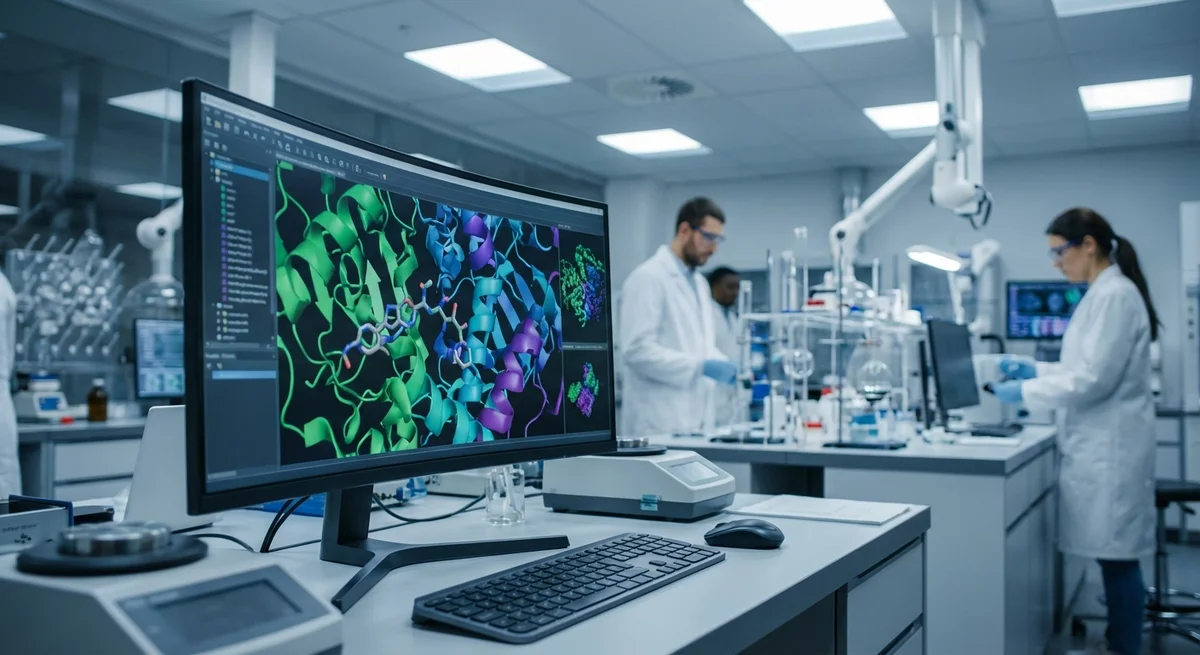
Isomorphic Labs, a Google DeepMind subsidiary, has announced a specialized AI engine for drug development, a system experts are already comparing to what AlphaFold became for structural biology. The new tool is positioned as a proprietary, AlphaFold 4-class development, but built not to predict protein structures but to find and optimize therapeutic molecules. If the company's promises hold up in practice, the pharmaceutical industry is facing one of its most significant technological shifts in decades.
To grasp the scale of this, it helps to recall where the main risk sits in the drug creation process. The road from discovering a biological target to getting a drug approved takes 10–15 years on average and costs billions of dollars. The most unpredictable stage is early development: the point where scientists try to find a molecule that will bind precisely to the right protein, will not harm the rest of the body, and will still stay active under real biological conditions. This is where most hopes collapse and enormous resources are lost. Isomorphic Labs' new engine aims straight at this bottleneck.
The technology is built on modeling interactions between proteins and ligands, small molecules that can attach to a protein and change its behavior. Ligands form the basis of most modern drugs. The problem is that predicting how a specific molecule will behave when paired with a specific protein is extremely hard: these are dynamic three-dimensional structures with thousands of possible configurations. Traditional methods, physical simulations and laboratory screening, take months even for relatively small compound libraries. According to available information, Isomorphic Labs' new system can do this work with unprecedented accuracy and several orders of magnitude faster.
The link to AlphaFold's legacy is neither accidental nor metaphorical. AlphaFold 2, introduced in 2020, solved a problem biology had struggled with for half a century: predicting a protein's three-dimensional structure from its amino acid sequence. That opened the way to understanding millions of proteins whose structures had previously been unknown. Isomorphic Labs' new engine takes the next logical step: knowing the structure of a target protein, the system learns not merely to describe it but to actively search for molecules that can interact with it in the desired way. In essence, it is a shift from mapping the molecular world to deliberately engineering it.
The consequences for the pharmaceutical industry could be considerable. Major players such as Eli Lilly, Novartis and Roche have already invested heavily in partnerships with companies that use AI to speed up development. Isomorphic Labs, for its part, signed contracts in 2023 with several pharmaceutical giants worth more than a billion dollars in total. The new engine is expected to become the technological foundation for these partnerships, turning the abstract promises of AI pharmaceuticals into concrete candidate molecules. It is also telling that the company deliberately keeps the technology proprietary, unlike AlphaFold, which was opened to the scientific community. That signals DeepMind sees this tool as a real commercial weapon, not an academic contribution.
Still, questions remain among experts. The gap between AI systems' laboratory results and their real-world effectiveness in clinical trials remains wide. The history of pharmaceuticals has many cases where promising candidate molecules failed at late stages because of unforeseen side effects or insufficient bioavailability. How well the new engine can account for all this biological complexity is a question only practice will answer.
Nevertheless, the direction of travel is not in doubt. Isomorphic Labs is betting that the pharmaceutics of the future is first and foremost a computational problem, and that a properly trained neural network can detect patterns in molecular interactions where human intuition has long hit a dead end. If the new engine really does shorten the development cycle by even half, the economic and humanitarian impact would be enormous: dozens of diseases for which there are no effective drugs today could get treatment much sooner than current forecasts suggest.
- Nov 2, 2026Bun creator uses Claude Code to port 750K lines from Zig to Rust in 11 days
- Nov 2, 2026The Verge reviewer builds a $50 Meta Muse Charm alternative with Claude Code
- Nov 1, 202616 models tested on 7 search tools: Exa averaged 10.5 out of 14, SearXNG about 3
- Nov 1, 2026Google's StreamVibe video agent beats other models by 10.7% on response timing and quality
Ship AI Faster with Founders, Engineers & Weekly Architecture Reviews
Inside Vibe Club (hamidun.com/club) — weekly live masterminds with Zhemal Khamidun, Tech Radar, full LMS access, and 370+ production Claude Code skills.
The AI world, distilled — once a week
Seven stories that actually mattered, hand-picked. No noise, no reposts, no press releases.
Done! Check your inbox for a confirmation.