SandboxAQ brings its drug discovery models to Claude
SandboxAQ has built its drug discovery models into Claude. The startup argues that the main obstacle is not the quality of AI but access to it. Biochemists can now use powerful molecule design tools in natural language, without code or knowledge of machine learning. The company says the models are already powerful enough, but they are mostly in the hands of large companies with their own data science teams.
AI-processed from TechCrunch; edited by Hamidun News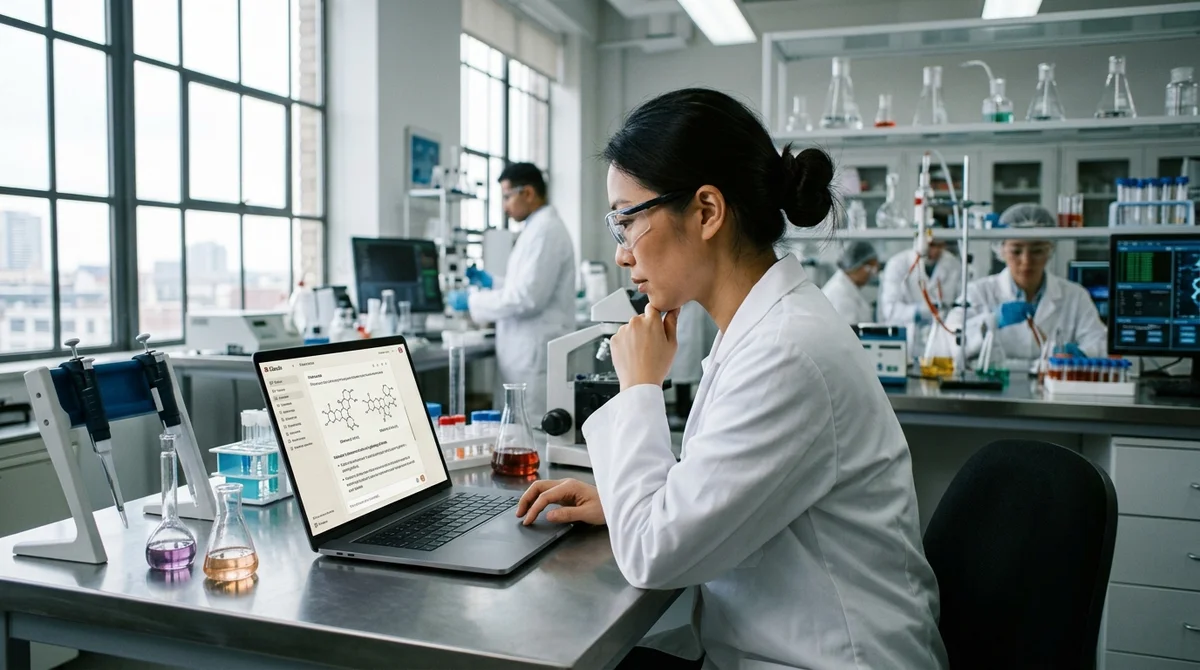
SandboxAQ has built its drug discovery models into Claude, making advanced biocomputational tools available to researchers without specialized computer science training.
Access over quality
While competitors such as Chai Discovery and Isomorphic Labs race to improve the models themselves, SandboxAQ is betting on something else: the main barrier to adopting AI in drug development is not a shortage of quality but the lack of a simple interface for the target audience. The models are already powerful enough. But they are owned mostly by large companies with their own teams of data scientists. Meanwhile, most biochemists and molecular biologists have never written code. The Claude integration closes exactly this gap.
How it works
A researcher opens Claude and asks a question in plain language: "Give recommendations for optimizing this compound," "Predict the activity of the molecule in this context," "What analogs exist in the literature." SandboxAQ's models process the request, analyze the molecular structures and return a result. No code, no parsing of formats. The biologist stays in a familiar environment but gains access to tools that previously required a computer scientist's expertise.
Competition in AI for life sciences
Several players are already active in the drug discovery tools market:
- Chai Discovery — builds models for molecular design and property prediction
- Isomorphic Labs (a DeepMind subsidiary) — focuses on predicting 3D protein structures
- SandboxAQ — embeds tools in popular platforms such as Claude
Each has chosen its own path, but all agree that AI dramatically cuts the time and cost of developing molecules. What used to take years is now a matter of months.
What this means
The integration shows that AI for life sciences is moving out of the lab and into mass-market products. Building capabilities into familiar interfaces is sometimes more effective than refining the algorithms themselves. This may speed up drug development at small companies and universities that have no machine learning departments of their own.
- Nov 1, 2026Local models lose to Opus and Codex: 0.21 on a MacBook versus 1.00 for Codex
- Nov 1, 2026Kimi scores 96.2% on a 1C database analytics test and emerges as a fallback if Claude access is blocked
- Nov 1, 2026OpenAI Rewrites GPT Behavior Rules: Five Values and a Chain of Command
- Nov 1, 2026Google admits AI Mode cuts search revenue, shares fall 15%
Key Questions Answered
What are the key details on Access over quality?
While competitors such as Chai Discovery and Isomorphic Labs race to improve the models themselves, SandboxAQ is betting on something else: the main barrier to adopting AI in drug development is not a shortage of quality but the lack of a simple interface for the target audience. The models are already powerful enough. But they are owned mostly by large companies with their own teams of data scientists. Meanwhile, most biochemists and molecular biologists have never written code. The Claude integration closes exactly this gap.
How it works?
A researcher opens Claude and asks a question in plain language: "Give recommendations for optimizing this compound," "Predict the activity of the molecule in this context," "What analogs exist in the literature." SandboxAQ's models process the request, analyze the molecular structures and return a result. No code, no parsing of formats. The biologist stays in a familiar environment but gains access to tools that previously required a computer scientist's expertise.
What are the key details on Competition in AI for life sciences?
Several players are already active in the drug discovery tools market: Chai Discovery — builds models for molecular design and property prediction Isomorphic Labs (a DeepMind subsidiary) — focuses on predicting 3D protein structures SandboxAQ — embeds tools in popular platforms such as Claude Each has chosen its own path, but all agree that AI dramatically cuts the time and cost of developing molecules. What used to take years is now a matter of months.
Test Frontier LLMs & Autonomous Agents in One Workspace
Run Claude Opus 5.5, GPT-6, Gemini 3.1, and DeepSeek side-by-side in Nomad AI (nomadnet.ai) — unified model routing, deep research, and multimodal workflows under one subscription.
The AI world, distilled — once a week
Seven stories that actually mattered, hand-picked. No noise, no reposts, no press releases.
Done! Check your inbox for a confirmation.