Isomorphic Labs teaches AI to find hidden pockets on proteins for drug design
Isomorphic Labs has developed IsoDDE, a system that finds sites on proteins where drug molecules can bind. The company has raised $2.1 billion and signed deals with Novartis and Eli Lilly. The system found a previously unknown pocket on the protein cereblon.
AI-processed from IEEE Spectrum AI; edited by Hamidun News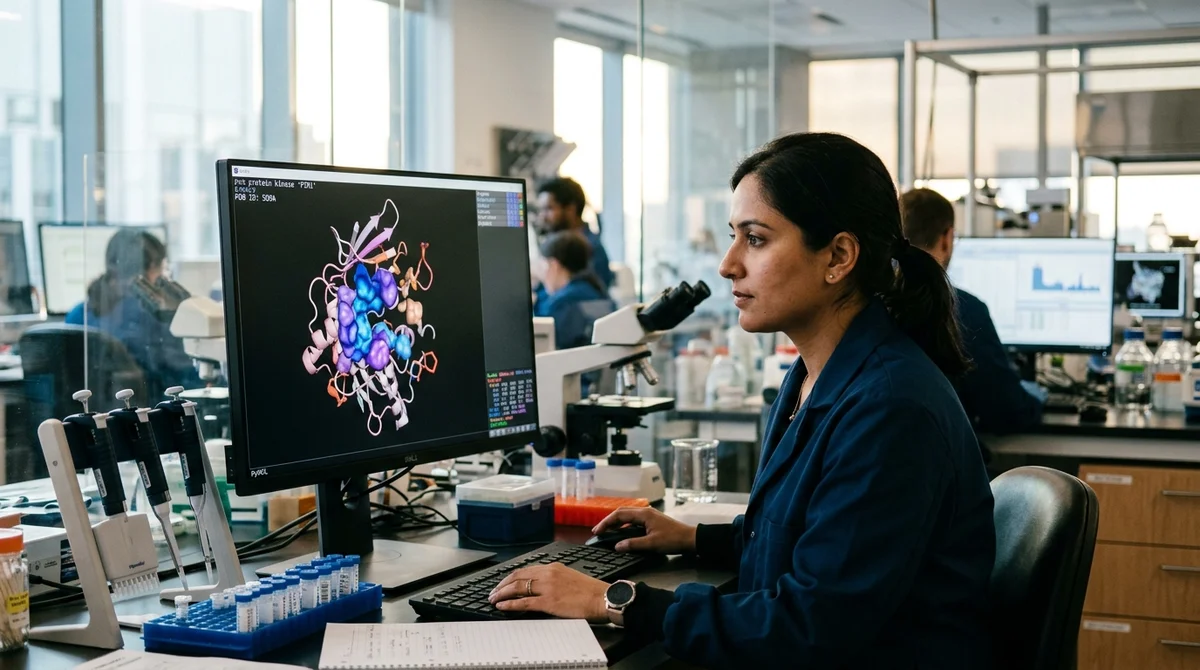
Artificial intelligence has been promising to speed up drug development for more than a decade. Yet despite billions of dollars in investment, only a handful of AI-designed drugs reach patients. Isomorphic Labs, a Google DeepMind spin-off, may change that with a new system called IsoDDE.
What AlphaFold lacks
AlphaFold2 and AlphaFold3 solved the central problem of predicting protein structure. The first model even earned a Nobel Prize. But proteins in a living cell do not exist in a vacuum. They constantly interact with other molecules: nucleic acids, ligands, ions and other proteins.
AlphaFold3 began modeling these interactions in a single framework, but researchers noticed a problem. The further the system moves from its training data, the worse its accuracy gets. For drug design this is critical: what's needed are new, unknown mechanisms of action, meaning pockets on proteins that no one has seen before.
IsoDDE (Isomorphic Drug Design Engine) is a unified computational system that predicts not only protein structure but also identifies binding pockets, molecular affinity and other properties.
Cryptic pockets: a perfectly matched key
Cryptic pockets are the most interesting part. These are regions on a protein's surface that are not visible in its normal, unbound state. They open only on contact with a specific molecule. Think of them as a lock that needs a perfectly matched key.
In January, Nature published a paper on a previously unknown cryptic pocket in the protein cereblon, one of the most important proteins in targeted protein degradation. This is the mechanism by which a cell gets rid of harmful proteins.
IsoDDE not only found this pocket from the protein sequence alone, but also accurately predicted how molecules bind in this unusual spot. The system matched the crystal structure published in Nature.
From small molecules to a whole arsenal
Most modern drugs are small molecules, relatively simple compounds. IsoDDE works with different types of therapeutic molecules:
- Antibodies
- Peptides
- Molecular glues
- Small molecules
- Combined approaches
The company has already signed major partnerships with Novartis and Eli Lilly and raised $2.1 billion in a Series B. IsoDDE's achievements are practical: the system finds targets that were previously considered undruggable. There are many diseases where the associated protein is known but hard to attack. This system makes such proteins tractable.
What this means
AI is finally approaching tasks that were out of its reach. Automating the foundational part of drug design, finding new targets and interaction mechanisms, is a turning point. It is not just a speedup but a qualitative shift in which diseases become targets for therapy at all.
- Nov 1, 2026Google's StreamVibe video agent beats other models by 10.7% on response timing and quality
- Nov 1, 2026OpenAI Rewrites GPT Behavior Rules: Five Values and a Chain of Command
- Nov 1, 2026Voice bots built on LLMs turn to Jev, a fast classifier, for decisions in 200–500 ms
- Nov 1, 2026Google admits AI Mode cuts search revenue, shares fall 15%
Key Questions Answered
What AlphaFold lacks?
AlphaFold2 and AlphaFold3 solved the central problem of predicting protein structure. The first model even earned a Nobel Prize. But proteins in a living cell do not exist in a vacuum. They constantly interact with other molecules: nucleic acids, ligands, ions and other proteins. AlphaFold3 began modeling these interactions in a single framework, but researchers noticed a problem. The further the system moves from its training data, the worse its accuracy gets. For drug design this is critical: what's needed are new, unknown mechanisms of action, meaning pockets on proteins
What are the key details on Cryptic pockets: a perfectly matched key?
Cryptic pockets are the most interesting part. These are regions on a protein's surface that are not visible in its normal, unbound state. They open only on contact with a specific molecule. Think of them as a lock that needs a perfectly matched key. In January, Nature published a paper on a previously unknown cryptic pocket in the protein cereblon, one of the most important proteins in targeted protein degradation. This is the mechanism by which a cell gets rid of harmful proteins. IsoDDE not only found this pocket from the protein sequence alone, but also accurately predi
What are the key details on From small molecules to a whole arsenal?
Most modern drugs are small molecules, relatively simple compounds. IsoDDE works with different types of therapeutic molecules: Antibodies Peptides Molecular glues Small molecules Combined approaches The company has already signed major partnerships with Novartis and Eli Lilly and raised $2.1 billion in a Series B. IsoDDE's achievements are practical: the system finds targets that were previously considered undruggable. There are many diseases where the associated protein is known but hard to attack. This system makes such proteins tractable.
Test Frontier LLMs & Autonomous Agents in One Workspace
Run Claude Opus 5.5, GPT-6, Gemini 3.1, and DeepSeek side-by-side in Nomad AI (nomadnet.ai) — unified model routing, deep research, and multimodal workflows under one subscription.
The AI world, distilled — once a week
Seven stories that actually mattered, hand-picked. No noise, no reposts, no press releases.
Done! Check your inbox for a confirmation.