How agentic AI is reshaping retail from the inside
Prasad Banala, director of software engineering at a major US retailer, told MIT Technology Review how his team is bringing agentic AI into the entire software development cycle. AI agents already validate technical requirements, generate code and automate testing. According to Banala, the key challenge is not the technology but reworking processes and team culture. The case shows that retail is becoming one of the main proving grounds for agentic AI in the enterprise sector.
AI-processed from MIT Technology Review; edited by Hamidun News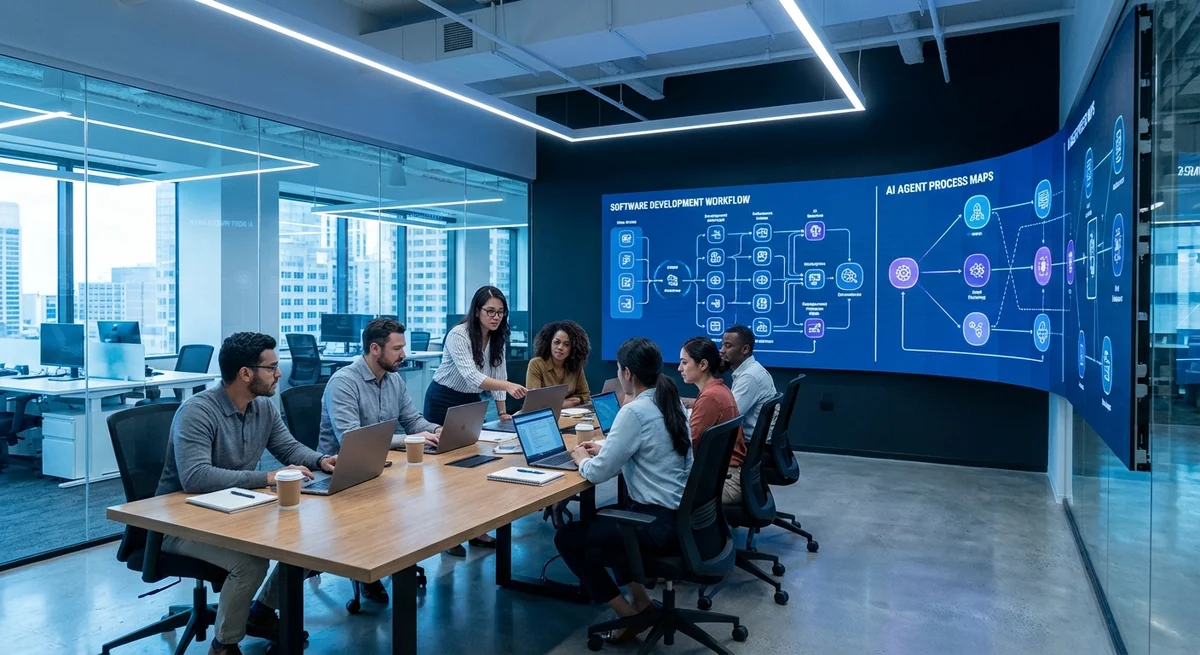
Retail is used to talking about artificial intelligence in terms of recommendation algorithms and customer support chatbots. But the most serious changes are happening where shoppers never look: in the engineering departments that write the code running a retailer's entire infrastructure. That is what Prasad Banala, director of software engineering at one of the largest retail operators in the US, described on a podcast from the Infosys Knowledge Institute, published by MIT Technology Review.
Banala describes an approach that goes well beyond the familiar use of AI as a programmer's assistant. His team has deployed agentic AI, meaning systems that can autonomously carry out complex multistep tasks, at every stage of the software development lifecycle. It starts with requirements validation: AI agents analyze business requirements and flag contradictions and gaps before engineers write the first line of code. The agents then take part in code generation and test automation, closing a loop that used to demand constant manual oversight.
Some context matters here. Over the past year, "agentic AI" has gone from an academic concept to the dominant trend in enterprise technology. Unlike ordinary language models, which answer queries on a question-and-answer basis, agentic systems can plan actions, use tools, interact with external services and adjust their strategy based on intermediate results. In essence, this is a shift from AI as adviser to AI as executor. Retail, with its enormous volumes of data, complex logistics and constant margin pressure, turned out to be an ideal environment for that shift.
Yet the most interesting part of Banala's account is organizational, not technological. In his words, the main barrier to working agentic AI is not model quality or computing power but whether teams are willing to rebuild their processes. When an AI agent takes over requirements validation, the business analyst's role does not disappear, but it changes radically. The specialist stops being the person who checks documentation by hand and becomes the one who sets the rules for the agent and monitors the quality of its output. Testers, architects and project managers are going through a similar transformation.
This shift has serious consequences for the whole industry. Retail is one of the largest employers in the world, and its technology divisions count thousands of engineers. If the model Banala describes proves effective at scale, it will inevitably spread to other sectors: banking, insurance, telecommunications, anywhere there are large development teams with established processes. In effect, big retailers are becoming a testing ground for enterprise agentic AI, and the results of these experiments will determine how engineering organizations are structured three to five years from now.
The risks deserve a mention too. Autonomous AI agents in the development cycle are not the same as a chatbot that suggests code. An agent's error at the requirements validation stage can cascade through an entire project. Questions of accountability, auditing and quality control in such systems do not yet have standard solutions. Banala says his team is building multilayered verification mechanisms, but details are still scarce, which is unsurprising for a company operating in a competitive environment.
The experience of this major US retailer shows an important pattern: the future of agentic AI is being decided not in labs or at conferences but in the day-to-day engineering practice of large organizations. It is there, where ambitious technology collides with real processes, that models emerge that will either change the corporate world or remain expensive experiments. For now, by all appearances, retail is betting on the first scenario.
- Nov 2, 2026DeepSeek Open-Sources Super-agent Prototype: p95 Task Time Drops from 29.5 to 15.7 Minutes
- Nov 2, 2026LLM Agent Built a Gearbox in KOMPAS-3D, but Scored Only 50 out of 100 on the Specification
- Nov 2, 2026Agents ignored the prompt to read memory in 7 of 7 sessions: an analysis of 13 thousand logs
- Nov 2, 2026Karpathy Built HackerTube, a Catalog of 6,454 Videos, in Two Hours with Claude Code
Test Frontier LLMs & Autonomous Agents in One Workspace
Run Claude Opus 5.5, GPT-6, Gemini 3.1, and DeepSeek side-by-side in Nomad AI (nomadnet.ai) — unified model routing, deep research, and multimodal workflows under one subscription.
The AI world, distilled — once a week
Seven stories that actually mattered, hand-picked. No noise, no reposts, no press releases.
Done! Check your inbox for a confirmation.