Olympics 2026: AI Chatbots and Drones Aim to Turn Viewers Into Participants
The 2026 Winter Olympics in Milan and Cortina will serve as a proving ground for technologies that could permanently change sports broadcasting. Organizers are betting on full immersion: FPV drones will stream footage from the athlete's point of view, and a 360-degree replay system will let viewers literally circle around a competitor mid-jump. But the main card is Olympics GPT. This specialized language model is meant to replace a Google search: it will explain the rules of curling, pull up 50 years of statistics and analyze jump technique during the live broadcast. While broadcasters fight for the attention of Gen Z, AI is becoming the only way to keep viewers in front of the screen.
AI-processed from Wired; edited by Hamidun News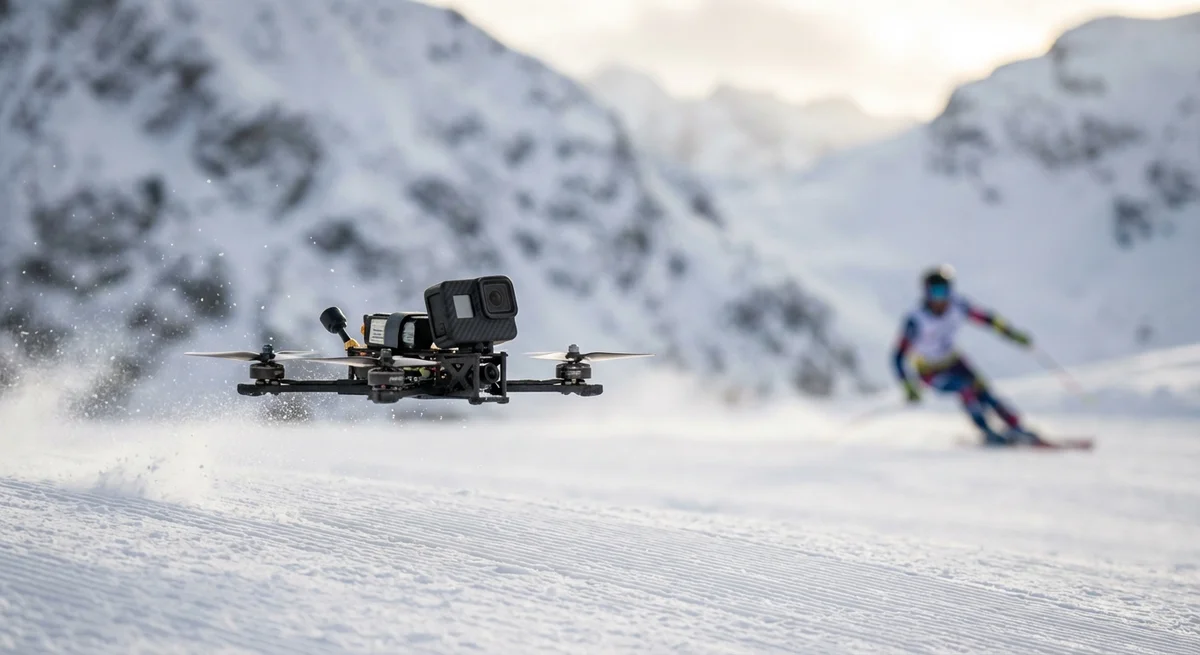
Remember when the height of Olympic broadcast ambition was a low-resolution slow-motion replay of the finish line? In 2026, in Milan and Cortina, those memories finally become antiques. The organizers have decided that watching skiers from the sidelines is a thing of the past, and now want to put us right inside the athlete's helmet. And to do it in a way that doesn't make your head spin or send your hand reaching for the remote to switch to the next series.
Sports broadcasts have long remained one of the most conservative niches in media. While the internet exploded with interactivity, the television picture of the Olympics changed very reluctantly. Yes, 4K was added and name graphics were stuck on screen, but the essence stayed the same: you sit on the couch and watch a small dot moving somewhere far away on a snowy slope. Milan 2026 breaks that wall. Using FPV (First-Person View) drones in a broadcast of this scale is not just a nod to gadget fashion, but an attempt to convey the extreme speed and adrenaline an alpine skier feels on the descent.
Previously, drones at stadiums worked like flying cranes: slow, smooth and predictable. Now small, agile aircraft will chase athletes at speeds above a hundred kilometers per hour, following their trajectory. That changes the aesthetics of the shot itself. We will see not just a "person on snow" but the dynamics of every micro-movement, the tilt of the body and the fight against air resistance. This turns viewing into a video game, only without the option to press "restart" after a mistake. To make this work, engineers had to solve a host of problems with transmitting the signal without delay in mountainous terrain, but the result promises to be impressive.
The second big bet is on real-time 360-degree replays. Imagine that during a figure skater's complex jump or a hockey player's maneuver, you can literally "fly around" the moment and pick any angle. The technology demands enormous computing power right at the venues: dozens of cameras must synchronize their images, and cloud algorithms must stitch them into a seamless three-dimensional space in a fraction of a second. This is no longer just a "replay"; it lets every viewer become the director of their own broadcast, studying details that were previously available only to judges.
But perhaps the most talked-about innovation will be Olympics GPT. In an era when everyone has access to all the world's knowledge in their pocket, the organizers realized that viewers need context here and now, not post-match reviews. It is a specialized language model trained on decades of Olympic statistics, the rules of all sports and detailed athlete biographies. Instead of frantically googling why curlers scrub the ice so furiously or what the personal best of a particular snowboarder is, you simply ask the AI in the app. The model can analyze what is happening on screen and provide explanations in real time. This turns passive watching into an interactive session with a personal expert.
Why does the International Olympic Committee need this? The answer is prosaic: the fight for survival in the attention economy. The younger generation is not willing to spend three hours on a linear broadcast if it lacks interactivity, gamification and dynamism. AI and new ways of visualization are a way to stay afloat in a world where TikTok and big-budget video games compete for the same 15 minutes of a user's free time. If you can't make sport more interesting than a game, you'll have to make the sports broadcast resemble a game. The Olympics is finally turning from a simple competition into an elaborate technology show, where data and algorithms become as important as the athletes' physical preparation.
Bottom line: the 2026 Olympics will show us a future where an AI chatbot in a smartphone matters more than the commentator, and a drone matters more than the traditional camera operator. One question remains: will all these special effects overshadow the very drama of human achievement?
- Nov 2, 2026The Verge reviewer builds a $50 Meta Muse Charm alternative with Claude Code
- Nov 2, 20268 Skills for video in Claude Code: from 244 pixel effects to rough-cut editing
- Nov 1, 2026Pika Labs releases open video model H3 Flex: 6 steps instead of 50
- Nov 1, 2026Google's StreamVibe video agent beats other models by 10.7% on response timing and quality
Test Frontier LLMs & Autonomous Agents in One Workspace
Run Claude Opus 5.5, GPT-6, Gemini 3.1, and DeepSeek side-by-side in Nomad AI (nomadnet.ai) — unified model routing, deep research, and multimodal workflows under one subscription.
The AI world, distilled — once a week
Seven stories that actually mattered, hand-picked. No noise, no reposts, no press releases.
Done! Check your inbox for a confirmation.