DHS to test 5G-connected autonomous drones on the US-Canada border in November 2026
DHS is preparing a cross-border test of 5G-connected autonomous drones and ground vehicles on the US-Canada border for November 2026. The main goal isn't "smart" navigation. Instead, the agency wants the vehicles to pass video, telemetry, and control between the two countries' networks without dropouts. If the experiment succeeds, it will lay the groundwork for future border security procurement.
AI-processed from Wired; edited by Hamidun News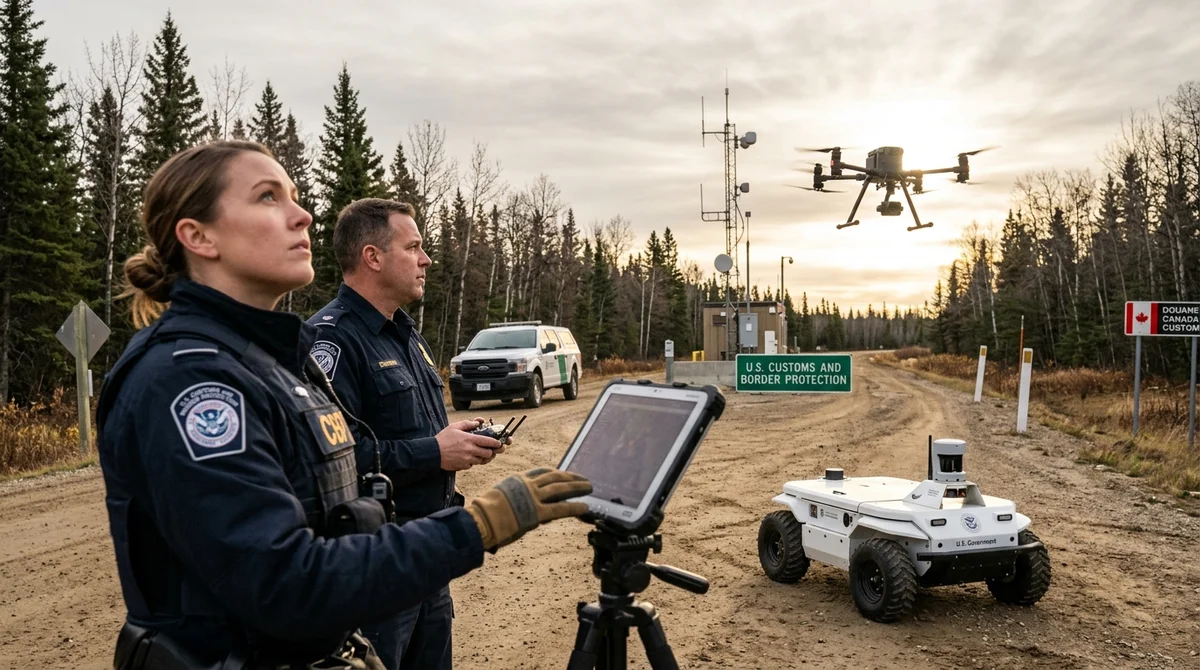
The US Department of Homeland Security is preparing an unusual border test for November 2026: autonomous drones and ground vehicles will cross the US-Canada line while streaming video and sensor data over commercial 5G networks without interruption. On paper, the scenario is emergency response, but the language in the documents sounds much closer to military reconnaissance than to ordinary communications for first responders.
How the test will work
The experiment is called ACE-CASPER — Advanced Communications Experiment – Cross-border Autonomous Vehicle Session Persistence Experiment and Research. It is planned for November 2026 as a multi-day exercise on a section of the US-Canada border. Under the scenario, drones and autonomous ground platforms will stream real-time video and sensor data to a joint binational command and control center as they cross the border and switch between the two countries' networks.
This will be the first joint US-Canadian technology experiment of its kind in almost ten years. From 2011 to 2017, Washington and Ottawa ran a series of border exercises called CAUSE, which tested the exchange of radio, video, and data between agencies on both sides of the line. The new phase is different: the focus is no longer just on interoperable communication channels, but on autonomous platforms that must operate on the move and stay connected at critical moments.
What DHS is looking at
The key emphasis here is not on giving drones full freedom of action. The published DHS request states explicitly that autonomous decision-making and AI navigation are not the main objective of the test. The priority is different: proving that a 5G connection stays stable while control, video, and telemetry pass through US and Canadian border infrastructure.
The main goal is to demonstrate "resilient and continuous 5G
connectivity" while crossing the border.
Participants are expected to bring fairly mature solutions, not lab prototypes. The requirements described in the documents include:
- vertical takeoff and landing drones with 5G modems compliant with 3GPP Release 18+
- an operating range of up to 5 km and beyond-visual-line-of-sight flights
- a ceiling of about 100 meters and at least 30 minutes of flight time
- real-time HD video streaming and telemetry
- similar requirements for autonomous or semi-autonomous ground vehicles
Technically, the hardest part isn't the flight itself but the seamless session handoff between the two countries' networks and agencies. For an ordinary consumer drone, losing the link for a few seconds is an annoyance. In a border scenario, where two teams need video, vehicle control, and a shared operating picture at the same time, such a dropout makes the system nearly useless. That's why DHS and the Canadian agency DRDC are testing connection resilience specifically, rather than flashy autonomy for a demo reel.
Policy and market
The experiment comes amid a tougher US policy on drones. Following the White House executive order of June 6, 2025, federal agencies have been more actively promoting the domestic drone industry and tools for detecting unauthorized aircraft. That sends an important signal to the market: if ACE-CASPER succeeds, DHS will have a practical template for future procurement in border monitoring, counter-drone systems, and secure mobile communications.
That said, the current phase is not yet a supply contract. DHS is recruiting participants through an RFI, promises no monetary compensation, and offers selected companies an LP-CRADA arrangement — joint testing without direct government funding. Vendors bear all participation costs themselves. In return, the winners get a rare chance to show their hardware in a real cross-border scenario involving US and Canadian agencies, which amounts to a ready-made showcase for upcoming tenders.
What it means
ACE-CASPER shows where the autonomous systems market is heading: the value now lies not only in the drone itself, but in how reliably it integrates into a network, transmits data, and works across agencies and jurisdictions. If the November test runs without failures, the next step may be not more demonstrations but regular procurement of such integrated systems for the border, emergency response, and law enforcement and security agencies.
- Nov 2, 2026DeepSeek open-sources Super-agent prototype: p95 task completion time of 15.7 minutes vs. 29.5
- Nov 2, 2026Bun creator uses Claude Code to port 750K lines from Zig to Rust in 11 days
- Nov 2, 2026Microsoft releases 4B model Mage-VL-Cowork, which solves 66.0% of OSWorld-Verified tasks
- Nov 2, 2026Meta's Muse assistant keeps dossiers on loved ones and gets root on Ubuntu by default
Key Questions Answered
How the test will work?
The experiment is called ACE-CASPER — Advanced Communications Experiment – Cross-border Autonomous Vehicle Session Persistence Experiment and Research. It is planned for November 2026 as a multi-day exercise on a section of the US-Canada border. Under the scenario, drones and autonomous ground platforms will stream real-time video and sensor data to a joint binational command and control center as they cross the border and switch between the two countries' networks. This will be the first joint US-Canadian technology experiment of its kind in almost ten years. From 2011 to
What DHS is looking at?
The key emphasis here is not on giving drones full freedom of action. The published DHS request states explicitly that autonomous decision-making and AI navigation are not the main objective of the test. The priority is different: proving that a 5G connection stays stable while control, video, and telemetry pass through US and Canadian border infrastructure. The main goal is to demonstrate "resilient and continuous 5G connectivity" while crossing the border. Participants are expected to bring fairly mature solutions, not lab prototypes. The requirements described in the doc
What are the key details on Policy and market?
The experiment comes amid a tougher US policy on drones. Following the White House executive order of June 6, 2025, federal agencies have been more actively promoting the domestic drone industry and tools for detecting unauthorized aircraft. That sends an important signal to the market: if ACE-CASPER succeeds, DHS will have a practical template for future procurement in border monitoring, counter-drone systems, and secure mobile communications. That said, the current phase is not yet a supply contract. DHS is recruiting participants through an RFI, promises no monetary comp
Test Frontier LLMs & Autonomous Agents in One Workspace
Run Claude Opus 5.5, GPT-6, Gemini 3.1, and DeepSeek side-by-side in Nomad AI (nomadnet.ai) — unified model routing, deep research, and multimodal workflows under one subscription.
The AI world, distilled — once a week
Seven stories that actually mattered, hand-picked. No noise, no reposts, no press releases.
Done! Check your inbox for a confirmation.