Data Centers in Orbit: Elon Musk Is Building the Cloud, Literally
Elon Musk is moving ahead with a plan to build orbital computing clusters for AI. The idea combines SpaceX's resources with xAI's appetite for compute: instead of competing with city grids for megawatts, the servers would run directly on solar power. Space eases the shortage of land and simplifies access to energy, but it creates new challenges: cooling in a vacuum and protection from radiation. If the project succeeds, Musk will have built the most independent IT infrastructure in history, free of terrestrial regulators and energy crises. It is a logical step in the vertical integration of his empires.
AI-processed from TechCrunch; edited by Hamidun News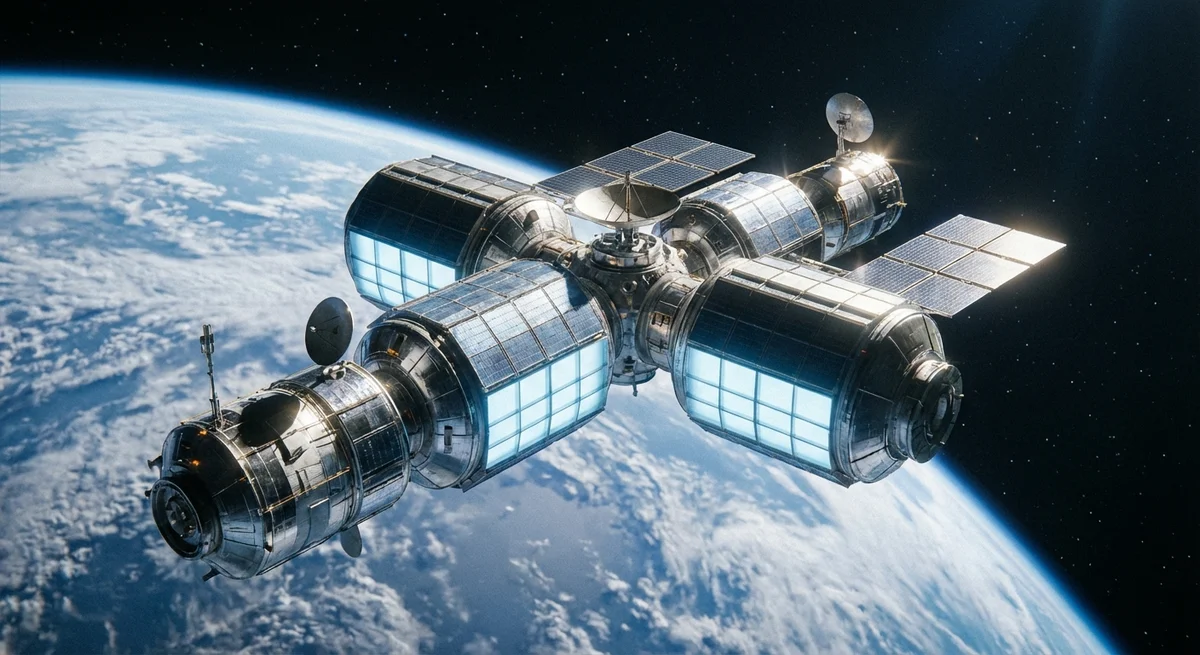
If you thought the 100,000 Nvidia H100 GPUs in the Colossus supercomputer were the limit of Elon Musk's ambitions, you clearly underestimated his passion for vertical integration. While rivals such as OpenAI and Microsoft beg governments for permission to build nuclear reactors to power their server farms, Musk has chosen a well-trodden path: simply leave the Earth's atmosphere. The idea of orbital data centers has stopped being material for science-fiction novels and become a concrete business plan, with SpaceX as the carrier and xAI as the anchor tenant.
Why now? It all comes down to an energy dead end. Modern AI models need so much electricity that old municipal grids simply cannot supply it without risking a blackout across an entire state. In space there is no outlet problem: solar power is available practically 24/7, and its intensity there is considerably higher. Musk already owns the largest satellite constellation in the world, and turning Starlink from a simple communications system into a distributed supercomputer looks like the most logical upgrade in the history of technology.
Of course, physics cannot be cheated, and this is where the main difficulties begin. In a vacuum there is no air to push through radiators, so cooling the servers becomes an engineering nightmare. Heat can only be shed through radiation, which requires enormous heat-exchanger surfaces. In addition, Nvidia's highly sensitive electronics tolerate cosmic radiation poorly. Musk will have to either build heavy shielding, which makes launches more expensive, or accept that a GPU's life in orbit will be bright but short. Still, given his approach to iterative design, we are more likely to see hundreds of cheap, disposable compute satellites than one armored aircraft carrier.
Why does the industry need this? Beyond energy, there is the question of data sovereignty and latency. For model training, a signal delay of a few milliseconds is not critical, while the ability to train a neural network outside the jurisdiction of any state offers a degree of political freedom. It is an ideal hedge against regulators who could ban certain datasets tomorrow, or demand limits on data-center power because of environmental concerns. In space there are no environmental activists and no local officials demanding reports on every liter of water spent on cooling.
Ultimately, this project is another attempt by Musk to close the loop inside his own companies. SpaceX launches, Starlink connects, and xAI computes. If the scheme works, the cost of training the next generation of Grok could fall several-fold simply because there are no electricity bills or land rent. While Sam Altman looks for trillions of dollars to build chip factories, Musk is building infrastructure that literally cannot be reached from the ground. It is bold, it is expensive, and it is very much his style.
The key question: will an orbital computing cluster become the key to winning the race to AGI, or will radiation fry the chips faster than Grok-3 can finish training?
- Nov 2, 2026Meta's Muse assistant keeps dossiers on loved ones and gets root on Ubuntu by default
- Nov 1, 2026Local models lose to Opus and Codex: 0.21 on a MacBook versus 1.00 for Codex
- Nov 1, 2026Kimi scores 96.2% on a 1C database analytics test and emerges as a fallback if Claude access is blocked
- Nov 1, 2026OpenAI Rewrites GPT Behavior Rules: Five Values and a Chain of Command
Test Frontier LLMs & Autonomous Agents in One Workspace
Run Claude Opus 5.5, GPT-6, Gemini 3.1, and DeepSeek side-by-side in Nomad AI (nomadnet.ai) — unified model routing, deep research, and multimodal workflows under one subscription.
The AI world, distilled — once a week
Seven stories that actually mattered, hand-picked. No noise, no reposts, no press releases.
Done! Check your inbox for a confirmation.