DingTalk in Beijing: Chinese businesses stop playing with AI and start making money from it
DingTalk's summit in Beijing made one thing clear: the era of empty AI promises is over. Alibaba's platform brought together dozens of companies to roll out AI agents at scale across manufacturing, logistics, and the public sector. The pitch goes well beyond "smart search" to full automation of business processes. The wave of contract signings confirms that businesses are ready to pay for real efficiency, not slick demo videos. While the global giants keep polishing their chatbots, DingTalk is betting on an ecosystem of applied tools that run "under the hood" of familiar software.
AI-processed from Jiqizhixin (机器之心); edited by Hamidun News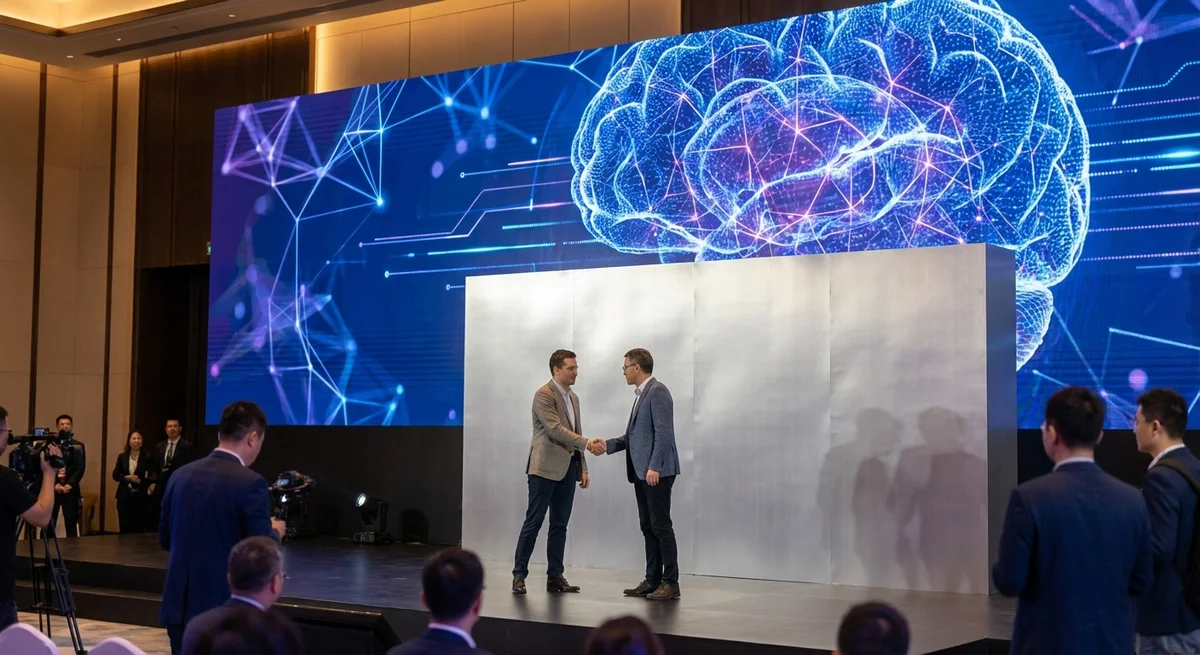
While the rest of the world watches OpenAI and Google trade blows over parameter counts and benchmark scores, China is doing what all of this was supposed to be for: AI has finally gone to work in factories, logistics centers, and government agencies. DingTalk's recent summit in Beijing settled the question. The era of "look, our bot can write poetry" is officially over.
Contracts, deep integrations, and the real economy are what's in fashion now. Neural networks used to be a toy for geeks; today they are the foundation of a new operating system for business. DingTalk started out as a simple corporate messenger from Alibaba, and over the past year it has covered ground that many of its Western counterparts are still only planning to cover.
The company turned the platform into a native habitat for artificial intelligence. At the Beijing event, it didn't just show polished slides; it brought representatives of dozens of companies onto the stage. These companies aren't merely "testing" the technology.
They have already deployed AI agents in their workflows. That marks an important shift: from a chat window where you ask questions to an agent that carries out tasks on its own inside the corporate ecosystem. Why does business need this?
Deploying neural networks at a large enterprise used to feel like bolting a rocket engine onto a horse cart. It was expensive, complicated, and nobody could say how it would pay off. DingTalk offered a different route: ready-made infrastructure where any company can assemble its own "digital employee" for a specific job, whether that's automating the legal department or running quality control on the assembly line.
Judging by the mass contract signings, Chinese businesses appreciate this pragmatic approach. They don't need "general intelligence"; they need a tool that cuts costs here and now. The change in rhetoric is telling.
A year ago, everyone was talking about model "hallucinations" and risks to humanity. In Beijing this time, the conversation was about the cost per API request, data processing speed, and the share of routine work that gets automated. China's AI market is in a hard-landing phase, coming down onto solid ground.
DingTalk is acting as the main guide. It isn't trying to build "the smartest AI in the world" in a vacuum; it's building the most useful interface for people who are used to counting money. This is an "AI-first" strategy in action: the technology becomes invisible as it weaves itself into familiar workflows.
That poses a serious challenge for global players. While Microsoft tries to get us to use Copilot in Word, DingTalk is wiring AI into processes we don't even think about, from supply chain management to the allocation of city resources. The point isn't "smart suggestions"; it's handing responsibility over to algorithms.
When dozens of companies sign deployment agreements at the same time, that's no longer an experiment but a new industry standard. Chinese companies are effectively building a marketplace of ready-made solutions, where one industry's know-how can be quickly packaged into an AI agent and scaled to others. Of course, skeptics may argue that the big talk of "digital transformation" often hides ordinary automation we've seen before.
But the difference is fundamental: today's tools built on large language models (LLMs) can do this many times faster and, more importantly, they can work with unstructured data that used to be "invisible" to computers. DingTalk is democratizing access to these technologies for mid-sized businesses by offering them ready-made templates instead of months of costly development from scratch. The future arrived not as Terminators but as boring, damn effective algorithms in your work messenger.
The bottom line: China has stopped playing catch-up on model parameter counts and switched to capturing the market for applied solutions. DingTalk made it plain that the future of AI isn't a standalone chatbot website but an invisible layer inside software that simply gets the work done. Will Western enterprise platforms be able to offer something on the same scale, or will they remain little more than chat windows?
- Nov 2, 2026Meta's Muse assistant keeps dossiers on loved ones and gets root on Ubuntu by default
- Nov 1, 2026Local models lose to Opus and Codex: 0.21 on a MacBook versus 1.00 for Codex
- Nov 1, 2026Kimi scores 96.2% on a 1C database analytics test and emerges as a fallback if Claude access is blocked
- Nov 1, 2026OpenAI Rewrites GPT Behavior Rules: Five Values and a Chain of Command
Test Frontier LLMs & Autonomous Agents in One Workspace
Run Claude Opus 5.5, GPT-6, Gemini 3.1, and DeepSeek side-by-side in Nomad AI (nomadnet.ai) — unified model routing, deep research, and multimodal workflows under one subscription.
The AI world, distilled — once a week
Seven stories that actually mattered, hand-picked. No noise, no reposts, no press releases.
Done! Check your inbox for a confirmation.