China's AI Sector in the Red: Gold Beats Chips Again
The morning on Chinese exchanges was jittery. While the main A-share indices crept lower, capital flowed out of hyped AI and into good old gold and oil. Telecom and semiconductors led the decline, Cambricon among them. It is an important signal: the market is overheated with expectations and reacts to the slightest uncertainty. While chip stocks get cheaper, gold miners such as Hunan Gold are up 7%. Investors seem to have decided to wait out the storm in real assets and leave tech ambitions for later. It looks like teraflops are losing to ounces today.
AI-processed from 36Kr (36氪); edited by Hamidun News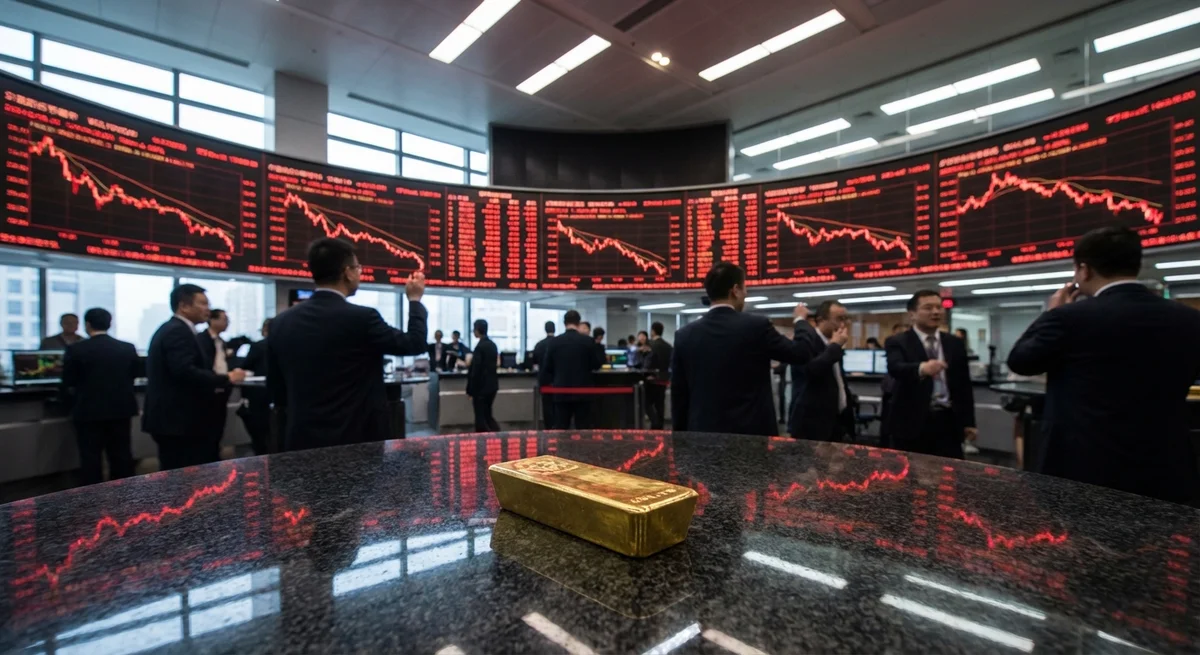
This morning the Chinese stock market reminded us that even the boldest dreams about artificial intelligence sometimes run into the harsh reality of macroeconomics. While we discuss new transformer architectures, mainland China's A-share indices opened in the "red zone." This is not a random wobble but a clear illustration of how investors are trying to strike a balance between faith in a technological miracle and the wish to preserve capital in unstable times.
The heaviest blow fell on those who only yesterday were seen as the engines of growth. Telecom equipment, internet and, most painfully for the industry, semiconductors began the day with a noticeable decline. Cambricon, one of the leading contenders for the title of "China's Nvidia," stands out in particular. When such a player loses more than two percent at the open, it prompts a rethink of risk across the entire AI hardware sector. Faith in endless growth of "hardware" is getting a cold shower.
Why is this happening right now? The market lives on expectations but feeds on confidence. Lately the Chinese tech sector has been caught in crossfire: on one side, harsh pressure from US export restrictions; on the other, an internal need to accelerate import substitution. Investors seem to have decided to pause as they watch high-tech companies struggle with a shortage of advanced lithography equipment and supply chain difficulties. The ChiNext index, which tracks high-tech companies, fell 0.8%, a fairly sharp move for a morning session.
It is interesting to see where the money is going. While chipmakers and software developers turn red, precious metals and energy are showing solid gains. Hunan Gold shares jumped more than 7%, and Keliy Shares added 6%. This is the classic "flight to quality" scenario, or more precisely, a flight to tangible assets. Gold and oil have again become more attractive than algorithms and neural chips, which points to rising global anxiety and a desire to insure against geopolitical surprises.
For the AI industry this is an important warning bell. We are used to neural network news being all about growth and endless investment. But the real chip manufacturing sector is capital-intensive and extremely sensitive to politics. The drop in shares of giants such as Zhongji Innolight, which specializes in optical modules for data centers, highlights the vulnerability of AI's infrastructure layer. If construction of the "hardware" foundation slows, the pace of software adoption will inevitably follow.
Still, there is no need to turn pessimistic. Such corrections often clear speculative "froth" from the market. For those building long-term AI strategies, the temporary weakness of Cambricon or Worthbuy shares may be a moment for deeper analysis of fundamentals. China continues to pour colossal resources into microelectronics sovereignty, and the current market volatility is unlikely to change that strategic direction. It is just that today, on the scoreboard, those who dig metal out of the ground are beating those who turn silicon into intelligence.
Ultimately, we are watching a battle of two narratives. One is about a bright digital future in which AI solves every problem. The other is about the good old world where gold in a vault and oil in a tanker matter more than teraflops in the cloud. Today the second wins, but history teaches us that technology cycles are longer than market panics. The only question is how deep this breather will be for China's tech sector before the next leap.
Bottom line: The market has temporarily cooled on AI hardware in favor of gold, but this is more a stress test for Chinese chipmakers than a change in the global trend.
- Nov 2, 2026TensorFold 1.2.0 boosts Qwen3.8-27B throughput on M3 Ultra by 44.2% at 16 streams
- Nov 1, 2026Local models lose to Opus and Codex: 0.21 on a MacBook versus 1.00 for Codex
- Nov 1, 2026Habr author fine-tunes YOLOv8l on dental X-rays and pushes mAP50 to 0.642
- Nov 1, 2026Voice bots built on LLMs turn to Jev, a fast classifier, for decisions in 200–500 ms
Ship AI Faster with Founders, Engineers & Weekly Architecture Reviews
Inside Vibe Club (hamidun.com/club) — weekly live masterminds with Zhemal Khamidun, Tech Radar, full LMS access, and 370+ production Claude Code skills.
The AI world, distilled — once a week
Seven stories that actually mattered, hand-picked. No noise, no reposts, no press releases.
Done! Check your inbox for a confirmation.