China's market in the red zone: why investors swapped chips for baijiu
It was a gloomy day on China's exchanges: the main Shanghai and Shenzhen indexes fell by more than 2%. Semiconductors and precious metals led the decline. As heavyweight Hua Hong lost 12% of its market value, investors hunted for the most conservative assets they could find. Baijiu unexpectedly emerged as the "defensive asset": shares of the strong-liquor makers rose against the broader trend. It's a textbook case of the market hedging risk while uncertainty hangs over the tech sector. For the chip industry, the day was extremely painful, and investors chose a real product over virtual prospects.
AI-processed from 36Kr (36氪); edited by Hamidun News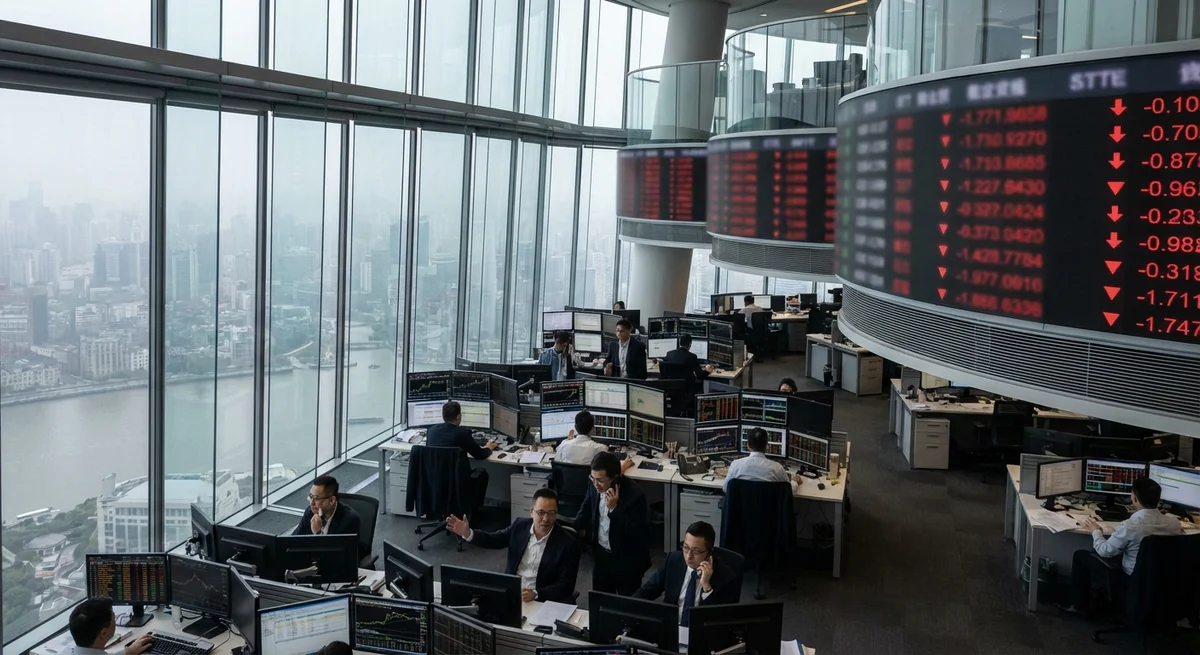
When the monitors in Shanghai and Shenzhen turn solid green (in China, green signals a decline, unlike red in the West), it's always time for a serious conversation. Today's session in the A-share (A) market felt like a cold shower for anyone who believed the tech sector's growth would stay cloudless. All three key indexes closed deep in negative territory, each losing about 2.
5%. That's not statistical noise. It's a clear signal that investors' appetite for risk has dried up, at least for now.
The context matters for understanding the bigger picture. After several weeks of optimism fueled by expectations of state support, the market ran into reality. The semiconductor sector, seen as the backbone of China's technological independence, took the brunt of the hit today.
Shares of Hua Hong, one of the largest contract chipmakers, plunged more than 12%. When a giant like that loses a tenth of its value in a single day, the blow ripples through the entire supply chain and rattles even long-term holders. Notably, gold and precious metals, traditionally considered a "safe haven," didn't work today.
Companies such as CGE and Hunan Gold even hit their daily limit-down. That suggests investors aren't simply shifting money from stocks into defensive metals; they're moving to cash en masse or looking for alternatives within the consumer sector. And here we see a distinctly Chinese paradox: when high tech is in trouble, the market starts believing in tradition.
The baijiu sector, China's famous strong liquor, unexpectedly rallied against the prevailing mood. Huangtai Liquor shares shot up to their daily limit, and Swellfun gained more than 7%. Investors apparently decided that in unstable times, making liquor is a far more understandable and reliable business than complex lithography processes.
It's an ironic reminder that fundamental consumer habits often prove more crisis-resistant than ambitious plans to replace imported processors. Beyond liquor, banks and road infrastructure posted small gains. This is the classic "flight to quality" playbook, plus dividend stories.
When innovative companies are in turmoil, capital flows to places with predictable cash flows and state backing, such as the banking system. For anyone following the AI and hardware market, there's an important lesson here: even the most advanced industry isn't insured against macroeconomic storms, and sometimes even chipmakers might envy the stability of distilleries. What does this mean for the industry in the near term?
Most likely, we'll see a period of heightened volatility. Chinese tech companies are now under double pressure: external restrictions on technology exports and an internal market correction. Still, drops like this often create openings for "smart money" to buy assets that have gotten cheaper.
The only question is when exactly the panic will give way to rational calculation and the belief that chips matter more than baijiu after all. The bottom line: the market is shifting into hard-defense mode, with traditional sectors crowding out high tech. Will this become a lasting trend, or will we see semiconductors bounce back quickly?
Ship AI Faster with Founders, Engineers & Weekly Architecture Reviews
Inside Vibe Club (hamidun.com/club) — weekly live masterminds with Zhemal Khamidun, Tech Radar, full LMS access, and 370+ production Claude Code skills.
The AI world, distilled — once a week
Seven stories that actually mattered, hand-picked. No noise, no reposts, no press releases.
Done! Check your inbox for a confirmation.