Chinese AI Sector in the Red Zone: Gold Defeats Chips Again
The Chinese stock market reminded us this morning that even the boldest dreams of artificial intelligence sometimes shatter against the harsh reality of macroeconomics. While we discuss new transformer architectures, the mainland China indices (A-share) opened in the red. This is not merely a random fluctuation, but a clear illustration of how investors are trying to find a balance between belief in a technological miracle and the desire to preserve capital in unstable times. Those who were considered growth engines yesterday took the biggest hit. The telecommunications equipment, internet, and, most painfully for the industry, semiconductor sectors started the day with noticeable declines. The fall of Cambricon's stock stands out particularly—one of the main contenders for the title of 'China's Nvidia'.
AI-processed from 36Kr (36氪); edited by Hamidun News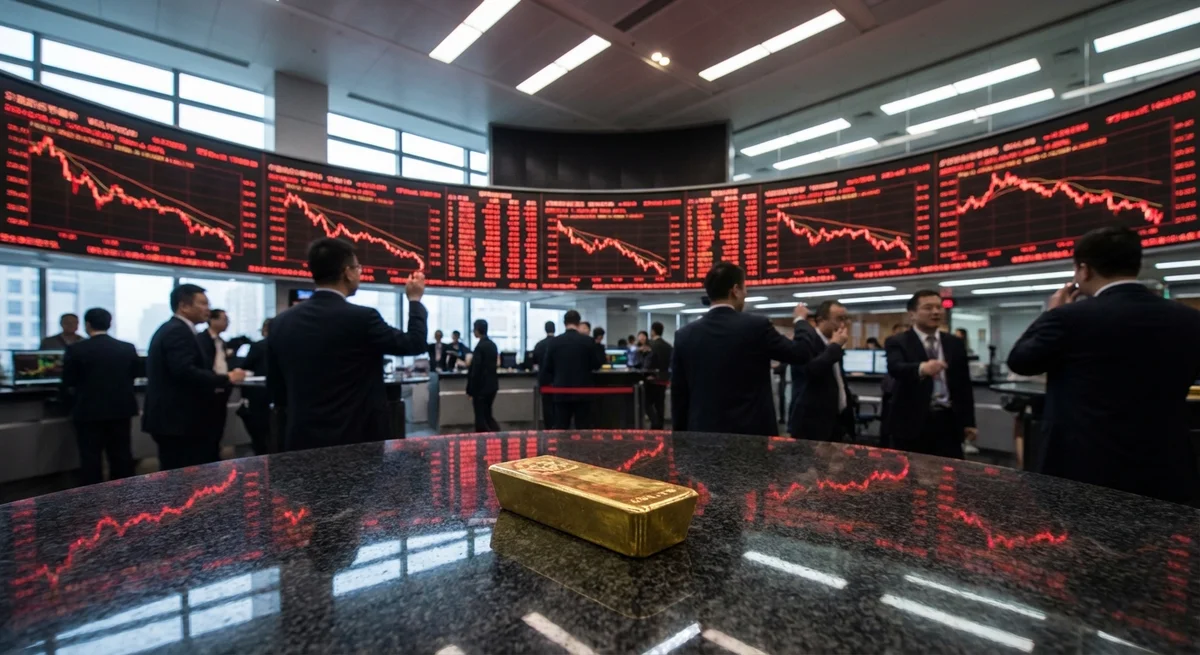
The Chinese stock market reminded us this morning that even the boldest dreams of artificial intelligence sometimes shatter against the harsh reality of macroeconomics. While we discuss new transformer architectures, the mainland China indices (A-share) opened in the red. This is not merely a random fluctuation, but a clear illustration of how investors are trying to find a balance between belief in a technological miracle and the desire to preserve capital in unstable times.
Those who were considered growth engines yesterday took the biggest hit. The telecommunications equipment, internet, and, most painfully for the industry, semiconductor sectors started the day with noticeable declines. The fall of Cambricon's stock stands out particularly—one of the main contenders for the title of 'China's Nvidia'. When such a player loses more than two percent at the opening, it forces us to reconsider risk assessment across the entire AI hardware sector. Clearly, the belief in endless growth of 'iron' is colliding with the cold reality check.
Why is this happening right now? The market lives on expectations but feeds on confidence. Lately, the Chinese tech sector is under crossfire: on one hand, harsh pressure from U.S. export restrictions, on the other, internal necessity for forced import substitution. Investors seem to have decided to take a pause, watching as high-tech companies struggle with a shortage of advanced lithographic equipment and supply chain complexities.
The ChiNext index, reflecting the dynamics of high-tech companies, fell 0.8%, which is a fairly sharp movement for a morning session. It's interesting to observe exactly where the money is going. While chipmakers and software developers are in the red, the precious metals and energy sectors are showing confident growth. Hunan Gold stock soared more than 7%, while Keliy Shares gained 6%. This is a classic 'flight to quality' scenario, or more precisely, to tangible assets. Gold and oil have once again become more attractive than algorithms and neurochips, indicating rising global anxiety and a desire to hedge against geopolitical surprises.
For the AI industry, this is an important warning sign. We've become accustomed to news about neural networks always being about growth and endless investments. But the real chip production sector is capital-intensive and extremely sensitive to policy. The decline in stocks of such giants as Zhongji Innolight, which specializes in optical modules for data centers, underscores the vulnerability of the AI infrastructure layer. If the construction of the 'hardware' foundation slows down, the pace of software solution deployment will inevitably follow suit.
However, we shouldn't fall into pessimism. Such corrections often clean the market of speculative 'foam'. For those building long-term strategies in AI, the temporary weakness of Cambricon or Worthbuy stocks could become a moment for deeper analysis of fundamental indicators. China continues to invest colossal resources in microelectronics sovereignty, and current market volatility is unlikely to change this strategic direction. It's just that today, those who extract metal from the ground are winning on the board, not those who turn silicon into intelligence.
Ultimately, we are witnessing a battle of two narratives. One is about a bright digital future where AI solves all tasks, the other is about the good old world where gold in a vault and oil in a tanker matter more than teraflops in the cloud. Today, the second narrative is winning, but history teaches us that technological cycles are longer than market panics. The only question is how deep this respite will be for the Chinese tech sector before the next surge.
The key point: The market has temporarily cooled on AI hardware in favor of gold, but this is more of a stress test for Chinese chipmakers than a change in the global trend.
Want to stop reading about AI and start using it?
AI News is a curated feed of AI/tech news. Hamidun Academy teaches you to use AI systematically in your work.
The AI world, distilled — once a week
Seven stories that actually mattered, hand-picked. No noise, no reposts, no press releases.
Done! Check your inbox for a confirmation.