Chinese Stock Exchanges: Investors Swap Gold for 'Hardware' for AI
Morning in Shanghai and Shenzhen began not with coffee but with classic market drama, where old money clashes with new technological ambitions. While the world discusses geopolitics, Chinese investors are busy with something far more tangible—they are moving yuan from gold bullion into optical modules and cloud servers. The indices opened unevenly: while the main Shanghai index (SSE Composite) declined by almost one percent, the tech-focused ChiNext, often called China's Nasdaq analogue, climbed steadily. This is not just market noise, but a vivid illustration of how China is trying to restructure its economy on the move. Let's look at the figures, because they speak louder than any slogans. The sector of precious metals and energy today looks as if a steamroller passed through it.
AI-processed from 36Kr (36氪); edited by Hamidun News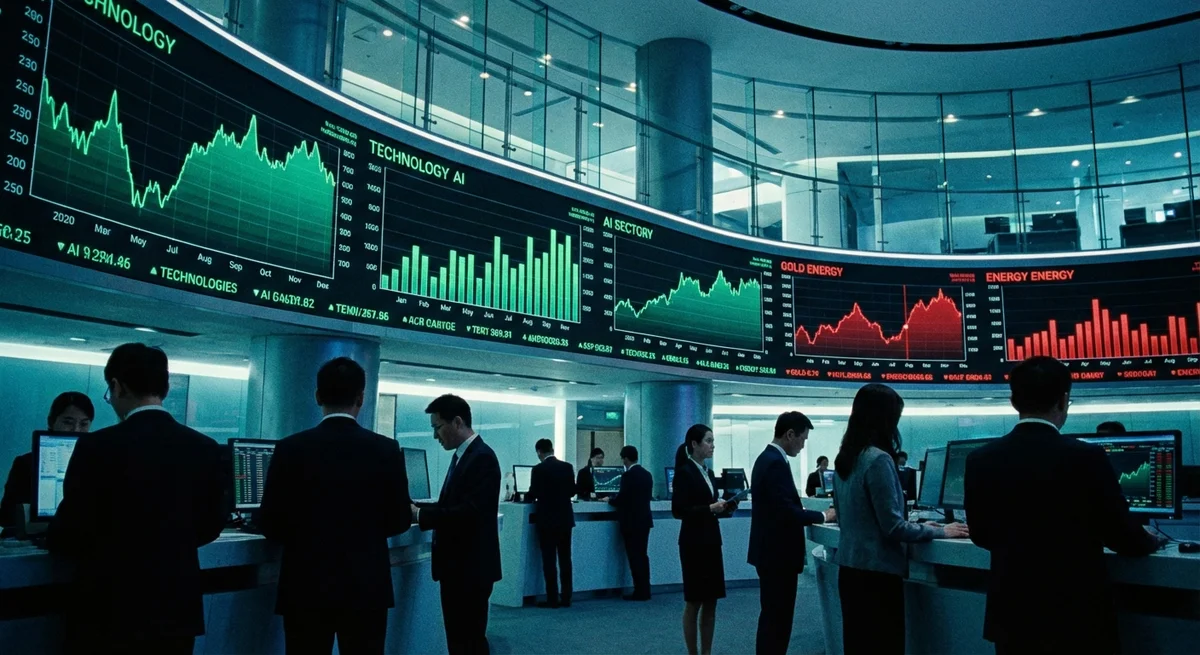
Morning in Shanghai and Shenzhen began not with coffee but with classic market drama, where old money clashes with new technological ambitions. While the world discusses geopolitics, Chinese investors are busy with something far more tangible—they are moving yuan from gold bullion into optical modules and cloud servers. The indices opened unevenly: while the main Shanghai index (SSE Composite) declined by almost one percent, the tech-focused ChiNext, often called China's Nasdaq analogue, climbed steadily.
This is not just market noise, but a vivid illustration of how China is trying to restructure its economy on the move. Let's look at the figures, because they speak louder than any slogans. The sector of precious metals and energy today looks as if a steamroller passed through it.
Shares of Zhaojin Mining and Huaxi Nonferrous crashed to the lower limit, while oil giant CNOOC lost more than 4%. In normal times this would have caused panic, but not today. On the other end of the ring we see the rise of companies that provide the "circulatory system" for artificial intelligence.
Xinyisheng, one of the key players in the market for optical modules necessary for high-speed data transmission in data centers, jumped 9%. This is happening as Beijing continues to pour resources into the "New Productive Forces" program, where AI sits at the head of the table. Why does this matter right now?
We are used to thinking of gold as a "safe haven" in times of uncertainty. However, the current situation shows that a new logic is forming in China: a safe haven is not what lies in a vault, but what allows you to train large language models faster than competitors. Even heavyweights like China Mobile declined somewhat, but this is rather a technical correction after a long rally.
Meanwhile, the internet sector and communications equipment manufacturers are feeling fine. Investors are betting on infrastructure, understanding that without powerful "hardware," any talk of sovereign AI will remain just talk. It is interesting to observe how the market ignores the general negative backdrop in favor of specific technological verticals.
If previously the Chinese market moved as one front following commodity prices, now we see clear division. Capital is flowing out of mining and old-style telecom giants toward flexible technology companies and cloud solution providers like Capital Online. This is a sign of market maturation: investors are beginning to distinguish hype from real infrastructural necessity, which will be in demand regardless of how much a barrel of oil or an ounce of gold costs.
Of course, such volatility is a double-edged sword. Sharp spikes in the technology sector could turn into equally sharp cooling if expectations from AI implementation don't materialize in profit in the coming quarters. But for now the trend is obvious: China is building a digital fortress, and the bricks in it are not gold bars but chips and high-speed cables.
For us, this is a signal that the global AI arms race is moving into a phase of hard pragmatism, where stock exchange quotes become an indicator of the state's real technological priorities. Key takeaway: China's market has definitively chosen its favorite—computational power is now more important than commodity stability. Can the AI sector alone pull the entire economy upward?
Want to stop reading about AI and start using it?
AI News is a curated feed of AI/tech news. Hamidun Academy teaches you to use AI systematically in your work.
The AI world, distilled — once a week
Seven stories that actually mattered, hand-picked. No noise, no reposts, no press releases.
Done! Check your inbox for a confirmation.